News
Trezor and Exodus Wallet User Reports $600K Crypto Theft
User reports the theft of over $600,000 in crypto from Trezor Safe 7 and Exodus on an iPhone, with around $580,000 in USDT on TRON.


Key points
- Reported losses: A user reported the theft of more than $600,000 in crypto assets after using a Trezor Safe 7 and an Exodus wallet on the same phone, according to an investigation published on November 23, 2026, by the on-chain analytics account Onchain Lens.
- Breakdown by network: Onchain Lens traced the bulk of the drain to the TRON network with roughly $580,000 in USDT (nearly 95% of the combined total), along with $23,400 in USDC on Solana from Trezor and $9,500 from Exodus, totaling approximately $613,000 across the itemized figures.
- Fund trail: According to Onchain Lens, the address identified as belonging to the attacker received about 0.76 SOL from Binance prior to the Solana drain, and part of the stolen USDC on that network was traced to an address linked to Bybit.
A user of Trezor and Exodus wallets reported the theft of over $600,000 in cryptocurrency after operating a Trezor Safe 7 and the Exodus app linked to the same iPhone, according to an investigation posted this Monday by Onchain Lens. The victim stated that they had been using the Trezor Safe 7 for about two months connected via Bluetooth to Trezor Suite on an iPhone 17 Pro Max running iOS 27.2.1.
🚨 INVESTIGATION
OVER $600K DRAINED FROM TREZOR AND EXODUS WALLETS ON THE SAME IPHONE
Attacker funded from @binance. Part of hacked funds sent to @Bybit_Official.
A user reports losing over $600K across TRON and Solana while using an iPhone 17 Pro Max running iOS 27.2.1.… pic.twitter.com/IskP3lPt8N
— Onchain Lens (@OnchainLens) November 23, 2026
The victim noted that the hardware device arrived sealed with no visible signs of tampering and that the recovery phrase appeared on the device’s screen during initial setup. According to their account gathered by Onchain Lens, they wrote down the backup on paper and never stored it in digital form, while also stating that no one else had physical access to the phone and that they did not authorize the transfers.
The Trezor accounts on TRON and Solana shared that same recovery phrase, according to the Onchain Lens thread. A wallet backup allows access to be restored across multiple accounts even when funds reside on different chains, linking both Trezor losses beyond the mobile device itself.
Stories in 7 days1up to publication
- In 30 days6
Distribution of Drained Funds and Traceability
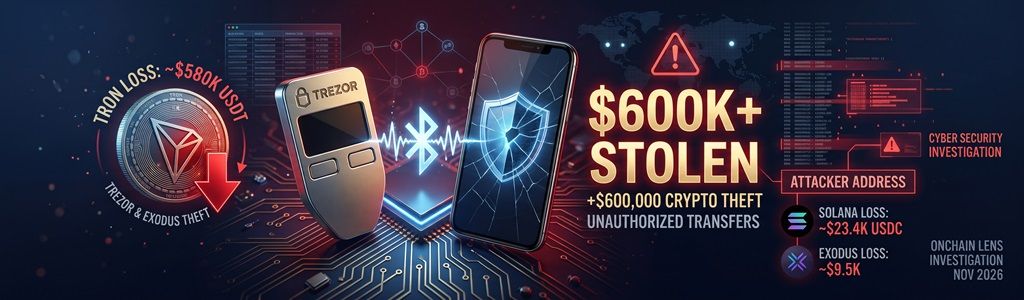
Onchain Lens estimated the losses on TRON at approximately $580,000 in USDT. The analysis compared a transfer recognized by the user with another reported as unauthorized on November 21, 2026, for 49,999 USDT, noting that both sent funds directly from the wallet and that the disputed transaction used the account’s default owner permission.
That technical detail is relevant because a prior token approval can enable another contract or address to move balances under an active allowance. In the TRON case reviewed by Onchain Lens, the movement used the account’s own authority on the network ledger, while the lack of authorization stems from the user’s account. The TRON funds were subsequently distributed across several addresses, according to Onchain Lens.
On Solana, Onchain Lens identified another $23,400 in USDC withdrawn from the Trezor wallet. The report indicates that the victim’s address appeared as the transfer authority, signer, and fee payer in the examined transaction, without a separate delegate in the instruction.
Added to those amounts was $9,500 stolen from the Exodus wallet, according to Onchain Lens. Adding the three itemized figures brings the total loss to roughly $613,000, with around 95% concentrated on the TRON network.
The on-chain analytics firm noted that the address attributed to the attacker received close to 0.76 SOL from Binance prior to the Solana withdrawal. Subsequently, part of the USDC stolen on Solana moved toward an address associated with Bybit, whereas the receiving addresses for the TRON loss belonged to a separate cluster, and the victim reported the incident to Bybit, according to the report.
Key Architecture and Access Questions
Each application manages private keys under different frameworks according to the documentation cited in the investigation. Exodus states that its software wallet generates and encrypts private keys locally and stores them on the device itself.
Trezor notes that the Safe 7 model keeps private keys inside protected hardware and uses an independent chip for Bluetooth, so signing keys remain on the device even when the phone communicates with it. Exodus also documents an integration with the Safe 7 to display the wallet as a portfolio in its mobile app, although the Onchain Lens report did not establish whether the user paired the hardware with Exodus or solely through Trezor Suite.
The iPhone was running iOS 27.2.1, a version released by Apple on November 9, 2026, that included Bluetooth-related security patches. Onchain Lens reported finding no evidence linking those flaws to the transfers, and the exact mechanism by which signing authority was obtained remains undetermined.
The victim notified Bybit of the case following the movement of funds on Solana, while tracking of the addresses on TRON and Solana continues on the public ledgers of both networks as reported by Onchain Lens.
Notice. For information only; not investment advice.