EthereumNews
Polygon Launches Agglayer v1.0 to Speed Up Institutional Transfers
Polygon Labs launched Agglayer v1.0 on November 23, 2026, cutting withdrawals to Ethereum to under 15 minutes after nearly $10 billion settled.


Key points
- Accelerated settlement: Tests on the Katana mainnet in November 2026 recorded 1 minute and 19 seconds from Ethereum to the connected network and 14 minutes and 20 seconds on the return to Ethereum.
- Cumulative volume: Agglayer has processed nearly $10 billion in cumulative settlements since entering production in 2024.
- Architecture and licensing: The protocol operates under open MIT and Apache licenses with no integration fees, and adds support for Hyperledger Besu-based private chains and non-EVM networks such as Miden.
At the start of the fourth week of November, Polygon Labs announced the launch of Agglayer v1.0. It is a solution designed to speed up cross-chain transfers aimed at institutional entities. The upgrade reduces settlement time back to Ethereum from roughly 90 minutes to under 15 minutes on supported routes.
Information from Polygon Labs indicates that transfers from Ethereum to connected networks are completed in under two minutes. The company maintains that this design could allow institutions to move funds with cryptographic verification without relying on trusted signers on traditional bridges.
Price at publication$0.076722:19 UTC
- Past 7 days−4.0%
- All-time high−94.1%$1.29
Technical and Operational Architecture
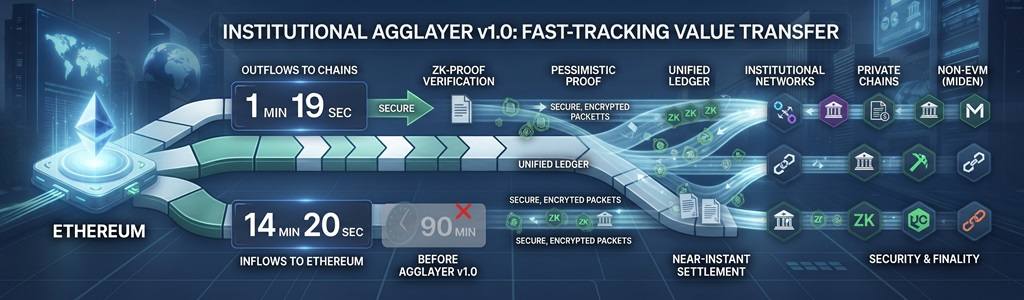
The protocol uses zero-knowledge (ZK) proofs verified on Ethereum alongside a unified ledger. Official documentation indicates that proofs are generated in real time via the Succinct Prover Network and that settlement certificates are submitted whenever there is activity to settle rather than waiting for fixed intervals.
On eligible routes, waiting for Ethereum finality becomes optional. Data from Polygon Labs suggests that skipping this wait saves around 15 minutes per transfer, while operators seeking more conservative configurations can keep it active.
The system incorporates a mechanism called pessimistic proof and a unified ledger. Official documentation notes that this framework limits each connected chain’s risk exposure to the funds deposited on it.
Measurements on the Katana mainnet in November 2026 yielded a time of 1 minute and 19 seconds for transfers from Ethereum and 14 minutes and 20 seconds for the return to Ethereum, compared to the ~90 minutes recorded on Agglayer prior to version 1.0. In benchmarks published by Polygon Labs in November 2026, other ZK rollup bridges took around 14 minutes inbound and between 3 and 6 hours with manual claiming on the return.
Institutional Reach and Open Money Stack
Agglayer v1.0 becomes available to institutions through Open Money Stack, a suite of tools integrating blockchain settlement, embedded wallets, fiat conversions, and payment services. Polygon Labs reported that Open Money Stack completed a SOC 2 Type 1 examination focused on the design of its relevant security controls.
The company noted that this review provides insight into the controls implemented, though it does not equate to an absolute security guarantee nor eliminate all operational or technological risk. The connected ecosystem includes networks such as Katana and OKX’s X Layer, alongside Miden as the first connected non-EVM chain.
The protocol supports any virtual machine and institutional private chain deployments built on Hyperledger Besu. According to official documentation, chains built with Polygon CDK connect by default, while the software is distributed under MIT and Apache licenses with zero integration fees.
From its production rollout in 2024 through November 2026, Agglayer accumulated nearly $10 billion in settled cross-chain transaction volume. Polygon Labs described this release as the fastest zero-knowledge-verified settlement infrastructure in production—a characterization by the company that does not on its own constitute an independent comparative audit against all existing systems.
For bank-scale stablecoin payment services, the company presented the upgrade as a way to combine reduced settlement times with cryptographic backing on Ethereum. The deployment also relies on partner infrastructure from providers such as Conduit, Gateway, and Succinct.
Among upcoming verifiable milestones, Polygon Labs announced the integration of Ethereum’s fast confirmation rule to further reduce return times to that network. Additionally, the company plans to work alongside Conduit, Gateway, and Succinct on a high-availability upgrade for institutional deployments scheduled for early 2027.
Notice. For information only; not investment advice.