
Supreme Court Petitions Could Shape Federal Tax Risk for Robinhood and Kalshi Sports Contracts


Table of Contents
TL;DR
- Robinhood asked the Supreme Court to decide whether federal law preempts state gaming rules for sports event contracts, but the Court has not agreed to hear the case.
- The petition does not directly concern federal wagering tax, although a gambling classification could complicate Robinhood’s argument that its contracts are exempt.
- Kalshi faces a parallel dispute, while any eventual Supreme Court ruling could reshape regulation without automatically settling federal tax liability.
Robinhood’s Supreme Court petition over sports event contracts could carry tax consequences for prediction-market operators, but the justices have not agreed to hear the case and the petition does not directly ask them to decide federal wagering tax. In its September 10 petition, Robinhood asks whether the Commodity Exchange Act preempts state gaming laws for sports contracts traded on federally regulated markets. The dispute could indirectly influence how prediction markets defend the legal distinction between derivatives and gambling.
Supreme Court Fight Centers on Regulation, Not Tax
Robinhood argues that the CFTC has exclusive jurisdiction over eligible transactions on designated contract markets, while Nevada maintains that state gaming rules can apply to sports-related contracts. The Ninth Circuit rejected Robinhood’s request for preliminary protection, prompting the petition. A separate Supreme Court petition involving Kalshi followed a Third Circuit ruling favorable to the platform, creating competing appellate outcomes around state authority. The immediate legal question concerns regulatory preemption, not taxation, extending the wider legal battle over sports event contracts across multiple jurisdictions.

The tax exposure arises because Robinhood has disclosed that it has not collected or remitted federal excise tax on its event contracts, saying it does not believe they qualify for that levy. Federal law imposes a 0.25% excise tax on certain authorized wagers, while Robinhood has warned that adverse tax treatment could be material and potentially make event contracts uneconomical. A ruling that strengthens the gambling classification could make Robinhood’s tax position harder to defend, but would not itself resolve the federal tax question. The distinction matters as Robinhood’s prediction-market business expands.
The Supreme Court docket currently shows Robinhood’s petition pending, with Nevada’s response due December 7 after an extension. That means the Court must first decide whether to grant review before any merits ruling can occur. Kalshi faces a parallel Supreme Court petition filed by New Jersey over whether states can regulate its sports event contracts despite federal commodities oversight. Any eventual ruling could reshape the regulatory foundation behind the platforms without automatically determining their federal tax liability. The uncertainty also intersects with Kalshi’s challenge to state taxes on sports prediction markets, where federal preemption arguments already affect the economics of operating across states. The practical impact would depend on the scope of any opinion and how tax authorities apply the Internal Revenue Code to these contracts.

DOJ and CFTC Sue Arkansas to Block Kalshi Enforcement
The U.S. Department of Justice and Commodity Futures Trading Commission have sued Arkansas and Attorney General Tim Griffin in federal court, seeking to stop the
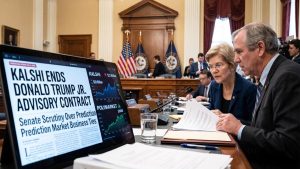
Kalshi Removes Trump Jr. as Adviser Following Senate Scrutiny Over His Business Ties
A Reuters spokesperson reported this Thursday, November 12, that Kalshi put an end to Donald Trump Jr.’s advisory contract. The departure of the U.S. president’s

Crypto Firms File Amicus Brief Defending CFTC Single-Stock Perp Authority
TL;DR Amicus Brief: Coinbase, Kalshi, Payward, DRW Holdings, Jump Trading, and Paradigm are seeking court approval to file a brief supporting the CFTC’s authority over

Robinhood Launches IPO Access In UK For US Share Requests
TL;DR Robinhood has launched IPO Access in the UK, allowing retail investors to request shares in eligible US IPOs at the official offering price before

TL;DR Robinhood can generate approximately $21 in revenue from a $1,000 prediction-market trade, compared with just $0.12 from an equivalent stock transaction. Event contracts generated

Pump.fun Transfers $6.85M in Solana to Kraken Amid Growing Robinhood Competition
TL;DR: Transferred volume: Lookonchain recorded the transfer of 76,111 SOL (approximately $6.85 million) from Pump.fun fee accounts to Kraken following 15 days of dormancy. Historical