TL;DR:
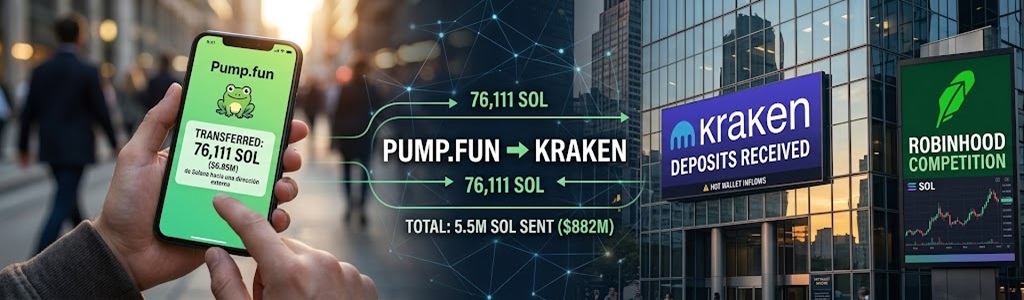
- Transferred volume: Lookonchain recorded the transfer of 76,111 SOL (approximately $6.85 million) from Pump.fun fee accounts to Kraken following 15 days of dormancy.
- Historical cumulative total: The on-chain tracker estimates the platform’s cumulative sales at 5,553,833 SOL, valued at roughly $882.4 million at an average of $158.88 per token.
- Competitive pressure: Traders and analysts pointed to Robinhood as a potential competitor in the memecoin sector amid criticism of the protocol’s fee model.
Memecoin launchpad Pump.fun transferred 76,111 SOL to Kraken, equivalent to $6.85 million. The transaction interrupted a 15-day period of operational inactivity between protocol-associated addresses and the cryptocurrency exchange.
Data from Arkham showed multiple transfers from Pump.fun fee wallets to a deposit address on Kraken. The batches included individual transfers of 7,227 SOL, 7,170 SOL, and 20,464 SOL. Subsequently, alerts from market analyst The Money Ape indicated the relocation of these assets to the exchange’s main hot wallet.
🚨 BEARISH FOR SOLANA 🚨
Pump fun dumping another 76,111 $SOL worth $6.85 Million to Kraken via an intermediary wallet, ending 15 days of inactivity.
Did they already know about China's investigation into Solana's advertising in Shanghai? pic.twitter.com/pEs8dPgyai
— TMA | The Money Ape (@TheMoneyApe) November 6, 2026
The source categorized the move within an ongoing pattern of institutional sales. However, the firm did not provide an execution price for the recent batch, as an on-chain deposit confirms receipt of funds on the trading platform but does not certify the exact time or price of a spot market liquidation.
With this transaction, the historical tally of transfers attributed to Pump.fun reached 5,553,833 SOL, equivalent to approximately $882.4 million based on a volume-weighted average price of $158.88 per unit. The previous transfer, documented on September 27, 2026, involved 47,994 SOL valued at $5.83 million, at which point the cumulative total stood at 5,236,623 SOL. Current figures exceed that threshold by 317,210 SOL and $34.4 million.
Scrutiny of the Fee Model and the Rise of Competitors
Parallel to these on-chain flows, market traders voiced concerns regarding the platform’s economic architecture. In a post on X, a trader identified as “j” claimed that Pump.fun’s structure fosters continuous token rotation without establishing sustainable incentives for regular participants.
According to the trader’s observations, the fee schedule extracts liquidity prior to token migration to decentralized liquidity pools. The analyst argued that the mechanism delivers substantial revenue to the protocol at the expense of a low survival rate for native projects launched on the platform.
Several market participants suggested that Robinhood could establish itself as a prominent alternative in on-chain retail trading. In particular, market commentator Kioto noted that Robinhood’s announcements regarding network infrastructure could potentially attract speculative volume if superior incentives are implemented. Suggestions submitted by the community included capping creation limits to one token every 24 hours per user, higher initial capitalizations, and cumulative liquidity models.
In response to criticism surrounding value retention, Pump.fun previously documented capital allocation initiatives for its native token. Between August 3 and August 9, 2026, the platform generated $10.03 million in fees and allocated $5.02 million to repurchase and burn 2.15 billion PUMP. The protocol’s operational framework stipulates that 50% of designated revenue is locked via smart contracts programmed for circulating supply reduction.
These recent treasury movements also coincided with reports of restrictions on Solana events in Shanghai. Statements from a People’s Bank of China official cited by the Financial Times of China indicated the suspension of a network event over alleged violations of local cryptoasset advertising regulations in the Lujiazui district. Although commentary accounts speculated on a potential link between both occurrences, no documentary evidence has connected Pump.fun’s transfers to regulatory inquiries in mainland China.
The ecosystem remains focused on the upcoming update to Pump.fun’s governance smart contract and the publication of periodic PUMP buyback reports scheduled for the end of the current monthly cycle.