TL;DR
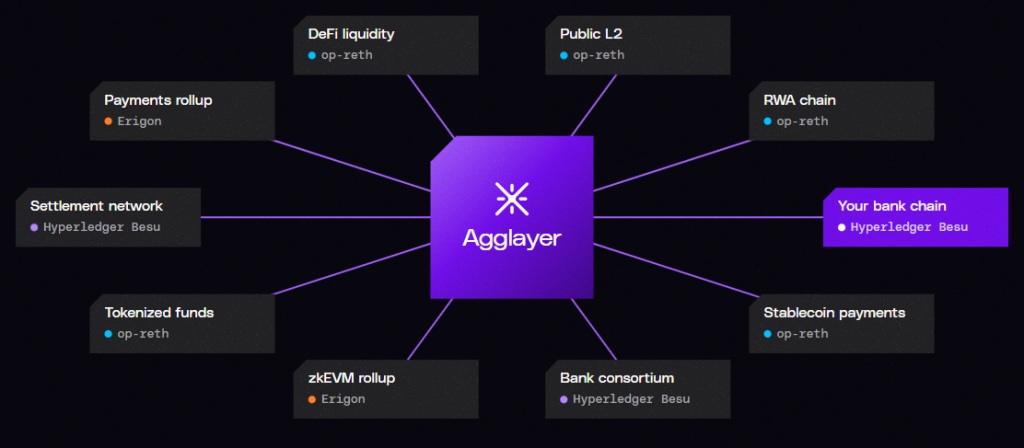
- Polygon introduced CDK Besu, a solution that allows banks and financial institutions to create private blockchains connected to Agglayer.
- The infrastructure uses Hyperledger Besu and zero-knowledge proofs to transfer assets between networks without publishing private transaction data on Ethereum.
- CDK Besu is already production-ready on Ethereum mainnet. Institutions using Besu will also be able to connect their existing networks to Agglayer.
Polygon launched CDK Besu, a new configuration of its Chain Development Kit (CDK) that allows banks and financial institutions to connect their private blockchains to other networks and access their liquidity through Agglayer.
The solution uses Hyperledger Besu, an open-source Ethereum client used in enterprise infrastructure, and allows institutions to deploy private networks with validators they authorize themselves.
Until now, connecting a private Besu-based blockchain to other networks required custom integrations, typically through bridges that relied on groups of signers to authorize transfers.
With CDK Besu, the connection to Agglayer is built in from the first block. Assets can move between connected networks, with transfers settled on Ethereum using zero-knowledge cryptographic proofs.
Institutions retain control over their validators, access permissions, and authorized participants. In addition, transaction data remains within their private infrastructure and is not published on Ethereum.
Polygon Connects Private Networks to Agglayer
CDK Besu uses the QBFT consensus mechanism, which allows a known set of validators to approve blocks and achieve immediate finality.
This configuration is designed primarily for banks, financial infrastructure providers, and consortia that need to control participation in their networks.
Through Agglayer, institutions can transfer assets to other connected blockchains, including public networks that provide liquidity for stablecoins and tokenized assets.
The infrastructure maintains a single canonical version of each asset across networks. This prevents the same token from having multiple representations created by different bridges.
For example, a bank could issue tokenized deposits on its own blockchain and allow clients to transfer them to another network to purchase shares in a tokenized money market fund.
Without this connection, the process could require converting deposits back into traditional money, transferring funds through banking systems, and purchasing the asset on the destination network.
With Agglayer, the token can move directly between the two blockchains, eliminating those intermediate steps.
Polygon also stated that institutions will not have to share revenue generated by their networks’ activity with the company.

Cryptographic Proofs Limit Cross-Chain Risks
One of the central components highlighted by Polygon is the pessimistic proofs system, which uses cryptographic proofs to verify balances associated with transfers between networks.
These proofs prevent a blockchain from withdrawing more assets than it has received. According to Polygon, the mechanism limits the risk of a compromised network affecting funds deposited on other connected blockchains.
The proofs are generated through the Succinct Prover Network and, once verified, allow transfers to settle on Ethereum.
The system verifies bridge accounting but does not individually verify every transaction executed within each private blockchain.
Institutions requiring full execution proofs can choose another Polygon CDK configuration based on OP Stack.
CDK Besu also includes mechanisms for consortium-operated networks. Each institution can run its own validators and participate in decisions about adding or removing members.
To authorize certain operations connecting to Agglayer, the system can require approval from a minimum number of participants, preventing any single institution from acting unilaterally.
The solution is already production-ready on Ethereum mainnet, with test and development environments also available.
Polygon published the deployment instructions and open-source components needed to implement the infrastructure. It also confirmed that institutions already operating Hyperledger Besu networks will be able to connect them to Agglayer without having to build a new blockchain from scratch.