TL;DR
- Strategy CEO Phong Le expects the next 12 months to bring the largest increase in Bitcoin banking adoption in history, driven by institutional demand and growing financial integration.
- The Bitcoin Banking Adoption Index reportedly reached 34% among the world’s 30 largest banks in Q3 2026, with US institutions leading the expansion.
- Artificial intelligence and Bitcoin’s limited supply could strengthen the cryptocurrency’s role in financial services, including custody, investment products, lending, and blockchain-based settlements.
Strategy CEO Phong Le expects Bitcoin banking to accelerate over the next 12 months as major financial institutions expand their exposure to digital assets. Growing institutional demand, inflation concerns, and advances in artificial intelligence are contributing to a shift in how banks approach Bitcoin and blockchain infrastructure.
The forecast signals a potential change in traditional finance, where cryptocurrency services are increasingly viewed as opportunities to attract clients, diversify products, and develop new sources of revenue.
The next 12 months is likely to see the biggest increase in Bitcoin Banking adoption in history. Catalysts: monetary inflation, regulatory clarity, customer demand, tech modernization, agentic AI, FOMO, survival. https://t.co/VYS0hJa99U
— Phong Le (@phongle) October 14, 2026
Bitcoin Banking Gains Momentum As Institutions Expand
Le predicts that the coming year will bring the “biggest increase in history” in Bitcoin banking adoption. His outlook reflects a broader shift in financial markets, as established institutions explore ways to integrate digital assets into existing financial services.
Banks can generate revenue through cryptocurrency custody, investment products linked to Bitcoin, and loans backed by digital assets. These services allow financial firms to participate in the growing market without necessarily replacing their existing banking infrastructure.
According to the figures provided for the Q3 2026 Bitcoin Banking Adoption Index, engagement among the world’s 30 largest banks reached 34%. Fidelity reportedly led the group with a 77% adoption rate, followed by JPMorgan Chase at 47%, BNY at 46%, and Goldman Sachs and Morgan Stanley at 45% each.
These figures suggest that US financial institutions are moving faster than many international competitors. However, the index’s methodology and individual bank classifications are important when interpreting the reported percentages.
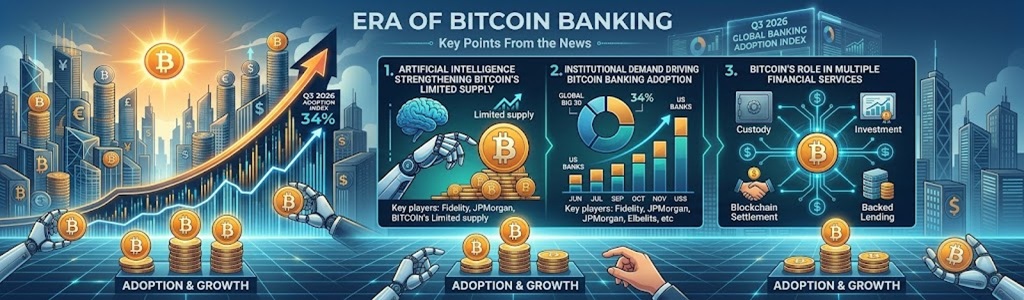
Artificial Intelligence Could Strengthen Bitcoin’s Appeal
Le also connected Bitcoin’s potential growth to artificial intelligence. As AI systems automate more tasks, investors may place greater value on assets with limited supply rather than businesses whose services or output can be replicated at lower costs.
Bitcoin’s fixed maximum supply of 21 million coins gives it a distinct monetary profile. Supporters argue that this scarcity could make BTC attractive to investors seeking alternatives to traditional assets, although market demand and price volatility remain significant factors.
AI agents could also create new demand for blockchain infrastructure. Autonomous software systems need reliable ways to transfer value and settle transactions, and programmable networks may offer capabilities that conventional banking systems do not readily provide. Stablecoins and other digital assets could complement Bitcoin in these applications.