TL;DR
- Stablecoins and tokenized assets are advancing as financial tools beyond the volatility and speculation of the crypto market.
- Tokenized funds and stablecoin-based applications provide access to investment instruments, international payments, and digital dollars.
- Regulation, financial risks, and a lack of interoperability still limit the widespread adoption of these products.
The cryptocurrency market remains focused on Bitcoin movements, expectations surrounding interest rates, and capital inflows into exchange-traded funds. However, a much more important transformation is unfolding away from trading screens: traditional money is beginning to use blockchain infrastructure to circulate, be invested, and be transferred.
Stablecoins, tokenized funds, and financial services that use digital assets are bringing cryptocurrencies closer to activities that previously depended exclusively on banks and traditional intermediaries. The real adoption of this technology could arrive without millions of users needing to buy Bitcoin, trade on exchanges, or even know they are using a blockchain.
For years, the industry presented mass adoption as a consequence of rising prices. More investors would buy cryptocurrencies, more companies would accept payments, and the financial system would eventually adapt. But that view confused speculative interest with economic utility. A person can use digital dollars to receive a salary, save, or send money abroad without having any interest in BTC’s price.

Real-World Assets Find Their Place on the Blockchain
The tokenization of real-world assets (RWAs) provides concrete evidence of that shift. According to RWA.xyz, tokenized products linked to U.S. Treasury securities have reached approximately $15 billion in distributed value, with participants including Franklin Templeton, Ondo, Circle, and Securitize.
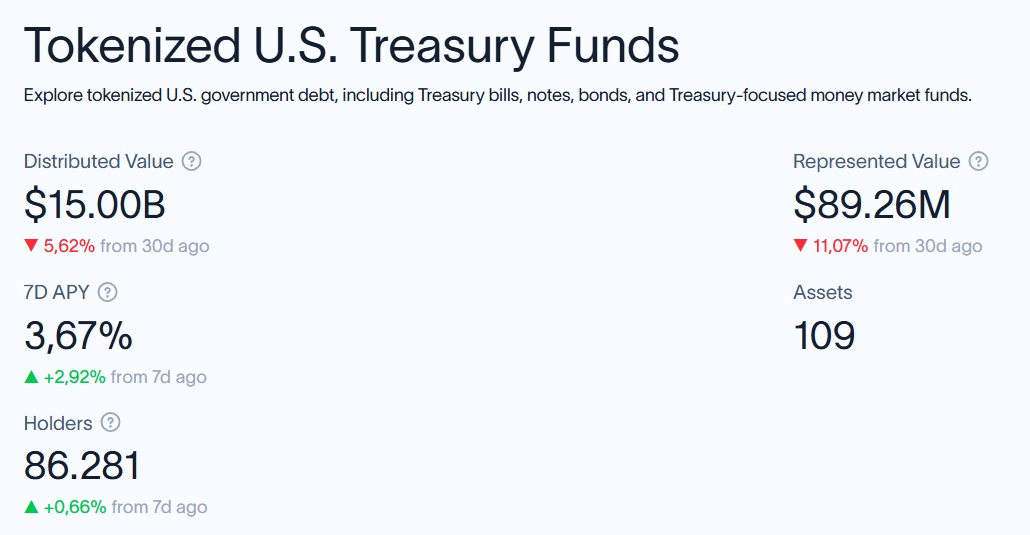
These instruments make it possible to represent ownership interests in financial assets through tokens. Their appeal does not depend on a cryptocurrency rising in price, but on facilitating certain operations, extending transfer hours, and connecting traditional products with digital platforms.
The economic difference is important. An investor who buys Bitcoin directly assumes its volatility. Someone accessing a tokenized money market fund seeks exposure to traditional financial instruments, although they also face inherent risks related to custody, liquidity, counterparties, and technological infrastructure.
Blockchain is beginning to compete for the infrastructure used to distribute and settle money, a business that can grow independently of speculative enthusiasm for cryptocurrencies.
Stablecoins Already Have Users Beyond Trading
The development of stablecoins provides another argument. Research by Visa and Dune found that the supply of stablecoins denominated in currencies other than the U.S. dollar grew by approximately 90% year over year through February 2026. The transfer volume of these assets increased 16-fold between 2023 and early 2026.
Although dollar-linked stablecoins continue to dominate, these cryptocurrencies also address everyday needs: international payments, access to foreign currencies, and transfers between people operating across different banking systems.
In economies with currency restrictions, high inflation, or inadequate financial services, the ability to hold digital dollars can be particularly attractive. Some of that demand relies on informal channels, raising concerns about oversight and user protection.
Interest is also growing in applications that combine stablecoin balances with savings or investment instruments. However, the two products should be distinguished: holding a stablecoin does not mean earning interest, and any additional yield comes from a financial activity that carries its own risks.
Adoption could accelerate as these functions become integrated directly into banking apps, digital wallets, and payment platforms. In that scenario, most users would choose a service based on its cost and ease of use rather than the technology behind it.
Regulation Still Limits the Expansion of Cryptocurrencies
Institutionalization does not guarantee that stablecoins will ultimately dominate payments either.
The Bank for International Settlements (BIS) warned in its 2026 annual report that these instruments face problems related to stability, fragmentation, and interoperability. A stablecoin issued on Ethereum, for example, cannot automatically be transferred to Solana without additional mechanisms.
Banks must also comply with identity verification, anti-money laundering, and deposit protection requirements. Stablecoin issuers, meanwhile, face different regulatory requirements depending on the jurisdiction.
These differences can slow adoption and favor solutions controlled by traditional institutions. It is even possible that banks adopt tokenization technology without using public stablecoins.
But that possibility does not necessarily weaken the main thesis. The financial integration of blockchain does not require cryptocurrencies to replace banks. It may happen precisely because banks begin using some of its tools.
The crypto industry has spent too many years measuring its success through prices, market capitalization, and bull cycles. Those variables will continue to matter to investors, but they explain little about the technology’s ability to address financial needs.
A tokenized fund that facilitates liquidity management, an application that reduces the cost of sending money, or a stablecoin that provides access to dollars may have greater economic importance for the crypto industry than a temporary rise in Bitcoin.
The real test of maturity will be the recurring use of these services, their costs, their security, and their ability to operate within financial regulations. And that transformation can continue even during a bear market.