


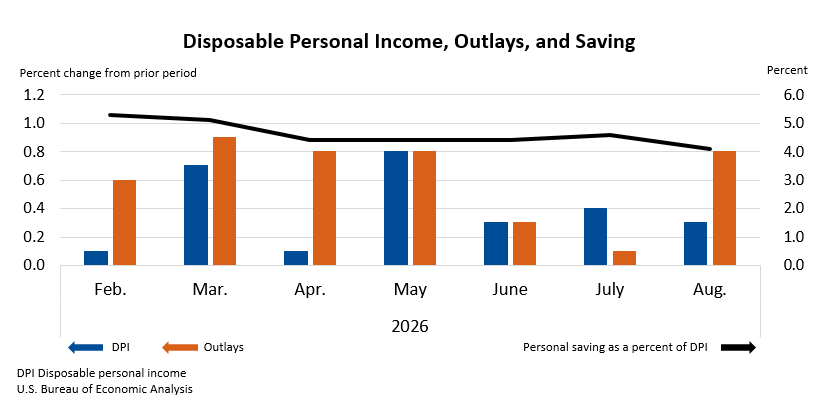
The Bureau of Economic Analysis reported a personal savings rate of 4.1% in August 2026 in the United States. The reading is the lowest since 2022 and, excluding the inflationary shock after the pandemic, the weakest since 2008.
The decline was 0.5 percentage points from July and 1.6 points since January 2025. Households are drawing down reserves to sustain consumption. The question for the crypto sector is whether Bitcoin as a hedge offsets shrinking financial margins.
For short and middle-income profiles, the answer is negative. Bitcoin can serve an institutional diversification function, not an emergency fund.
The savings rate is a flow variable: disposable income minus consumption. A low rate indicates households are spending a high share of income. If inflation exceeds wage growth, real disposable income falls. Households maintain consumption by reducing savings or increasing debt.
Debt service competes with asset allocation, Bitcoin purchases are discretionary. They occur after essential spending and debt repayment. A low savings rate reduces discretionary investment capacity. The crypto sector should not interpret low savings as a bullish signal for Bitcoin. The immediate relationship is lower marginal demand.
Treasury bills, or short-duration bonds. Bitcoin recorded deep drawdowns during liquidity contractions. The creation of Bitcoin ETFs in the United States improved access but partially linked price to institutional flows and tactical multi-asset allocation. Integration reduces the probability of pure countercyclical behavior.
In March 2020 and during the 2022 monetary tightening, Bitcoin fell alongside growth assets. Correlation regimes change. A hedge must work when needed. Bitcoin has not done so consistently during liquidity crises.
An effective inflation hedge requires negative or low correlation with consumer spending, deep liquidity, broad acceptance, low transaction costs, and volatility compatible with the protection horizon. Bitcoin partially meets liquidity and acceptance. It does not meet price stability or consistent negative correlation.
Gold also does not offer perfect protection, but its realized volatility is lower and its holder base includes central banks and sovereign funds. Bitcoin has less than two decades of history, and its relevant investment horizon is long. For a household needing funds in six or twelve months, Bitcoin is not a suitable instrument. Risk management requires assets with lower probability of permanent loss in short windows.
Bitcoin’s realized volatility exceeds that of gold or short-duration Treasury bills by several multiples. High volatility is not a problem for a long-horizon investor. It is a problem for a household with a short horizon. A 30% drawdown can force liquidation. Volatility drag reduces compound returns. Position sizing must account for drawdown risk. A 2% allocation can be inappropriate if emergency reserves are insufficient.
Institutional diversification is a different argument from hedging. A diversifying asset reduces portfolio variance when correlation is low. It can amplify losses during stress if correlation rises. The difference between diversifier and hedge is operational. Strategic allocation must rely on rolling correlations and stress tests, not on a commercial label. Institutional mandates differ from household balance sheets.
Pension funds and endowments have long liabilities and can rebalance during declines. A household cannot rebalance if income falls. Risk capacity is the ability to withstand losses without changing lifestyle. Risk tolerance is the willingness to accept volatility. A household with low savings has low risk capacity. Institutional adoption does not imply household suitability.
A composition error exists in the adoption narrative
The crypto sector observes growth in ETFs, corporate Bitcoin treasuries, and institutional participation. Flows do not come from households with a savings rate at minimums. If households reduce savings, they may sell assets to sustain consumption. Forced selling of retail positions is a risk during phases of rising unemployment or persistent inflation. Aggregate demand for Bitcoin depends on available cash flow and willingness to assume risk.
An institutional investor can rebalance; a household with essential expenses can liquidate at the worst point of the cycle. Procyclical flows amplify volatility. Market depth can thin during stress. Slippage increases. Exit costs rise.
Regulation and access limit the use of Bitcoin as a hedge for households. Direct holding requires custody, key management, and tax reporting. ETFs introduce intermediaries, fees, and market hours. Tax friction is relevant: selling Bitcoin triggers capital gains tax if held more than one year, or ordinary rates if held less.
An emergency fund in cash does not trigger tax on withdrawal. Self-custody adds operational risk. Exchange custody introduces counterparty risk. ETFs add management fees. Each option has costs. For short-term protection, costs can exceed benefits.
TIPS offer direct inflation protection. Gold has a long record as a store of value. Commodities cover specific inflationary shocks. Cash provides nominal certainty. Bitcoin can complement a portfolio, but it does not replace TIPS, gold, commodities, or cash. A diversified approach uses multiple hedges. Bitcoin’s role is small and tactical. Strategic allocation must reflect liquidity needs and horizon. For households, liquidity dominates.
What to observe in coming quarters: personal savings rate, core inflation, real wages, consumer credit delinquency, and ETF flows. The 90-day rolling correlation between Bitcoin and Nasdaq, implied volatility, and market depth allow evaluation of whether Bitcoin acts as a risk asset or diversifier.
If correlation rises during liquidity declines, the hedge thesis weakens. If correlation falls and volatility moderates, the thesis gains support. Evidence must precede narrative. M2, real yields, and global liquidity also matter. Bitcoin responds to liquidity conditions. When real yields rise, Bitcoin tends to weaken. When they fall, it can benefit. Real yields are a key variable. Global liquidity affects risk assets.
The crypto sector must track verifiable metrics
Regulatory developments matter: spot ETFs, accounting rules for corporate treasuries, and tax reporting requirements. Accessibility does not equal suitability. A product can be accessible but inappropriate for emergency protection.
For the professional investor, Bitcoin can be a tactical or strategic component. For the average household, the priority remains liquidity, solvency, and financial planning. The hedge narrative must adjust to evidence, not to price expectations.

