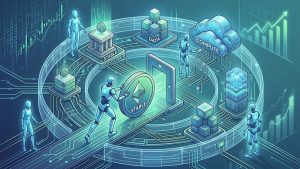
The boundary between traditional finance and the crypto ecosystem continues to narrow as major asset managers, technology companies, and regulators develop infrastructure for an increasingly digital economy. BlackRock’s recent report, “The Machine-Native Economy,” argues that artificial intelligence, stablecoins, and tokenized assets could eventually form a shared financial infrastructure for an economy in which software agents do more than process information: they could also make payments and contract services autonomously. The analysis, published in September 2026, connects the expansion of AI with a potential new source of demand for digital assets.
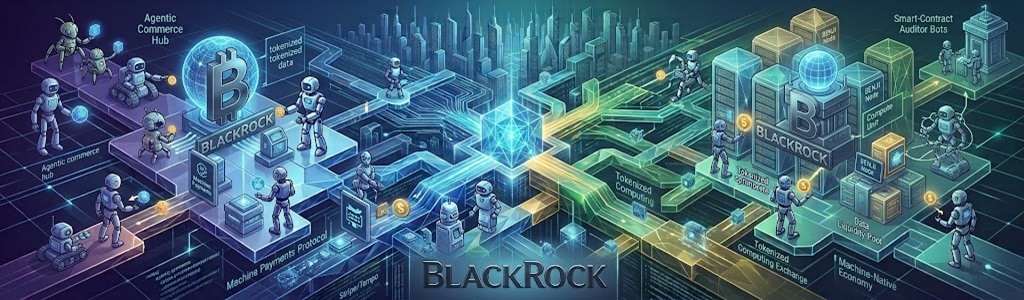
The thesis has also been discussed by financial content creator Coach JV, who focuses on three key connections. The first links AI models with blockchains and programmable digital systems. The second involves so-called agentic commerce, where autonomous agents can purchase data, use APIs, or contract computing resources without requiring a person to authorize every individual transaction. The third considers computing power as a potentially tokenizable resource, opening the possibility of representing, trading, or using certain rights to computational capacity as financial assets.
The Machine Economy Begins To Take Shape
BlackRock argues that the expansion of artificial intelligence could generate additional demand for technological and financial infrastructure. Estimates associated with the report place cumulative investment in AI infrastructure at as much as $5 trillion between 2025 and 2030, although this figure refers to the broader AI infrastructure market and does not represent a forecast for direct investment in cryptocurrencies. The relevance for digital assets lies in the possibility that an economy dominated by autonomous agents could require small, frequent, and programmable payments for storage, data, software, and computing resources.
The concept is already moving beyond theory through concrete technological tools. Coinbase has developed Agentic Wallets and the x402 protocol, infrastructure designed to allow agents to spend, receive, and manage digital assets under defined control rules. The platform says x402 has surpassed 50 million transactions and identifies use cases involving payments for APIs, data, and computing resources. Coinbase has also announced integrations with Amazon Bedrock AgentCore that are designed to allow agents to discover and pay for services autonomously.
The movement is not limited to crypto-native companies. Stripe and Tempo introduced the Machine Payments Protocol in March 2026, an open standard designed to allow AI agents to make payments directly to businesses and other digital services. Stripe argues that existing financial systems were largely designed around human users, while autonomous agents require programmable payment mechanisms capable of operating without the manual steps normally associated with financial transactions.
Regulators Prepare Markets For Tokenization
The technological shift coincides with signals from major U.S. financial regulators. On September 22, 2026, Michael S. Selig, chairman of the CFTC, said during the U.S. Treasury Market Conference that markets should prepare for large-scale tokenization, the expansion of on-chain finance, and markets capable of operating continuously, potentially 24/7.
Selig specifically said tokenized assets could facilitate near-instant settlement and real-time collateral mobility between clearinghouses, intermediaries, and end users. He also indicated that stablecoins could play an important role and that the CFTC is working to facilitate their responsible use in derivatives markets. His remarks do not mean that all U.S. markets will immediately move to 24-hour trading, but rather that regulators are considering how infrastructure should evolve for such a possibility.
The SEC has also moved in this direction. On September 17, 2026, the agency approved a temporary and conditional exemption designed to facilitate on-chain trading of certain tokenized U.S. equities through so-called Tokenized Securities Venues. The measure establishes specific limits and conditions, including requirements concerning shareholder rights, transparency, and auditable smart contracts.
These regulatory developments help explain why tokenization is acquiring a different institutional dimension. The discussion is no longer limited to experiments involving alternative digital assets. Instead, institutions are examining how blockchain technology could change traditional processes for issuance, trading, settlement, and ownership records.
Franklin Templeton And The “Great Crossover”
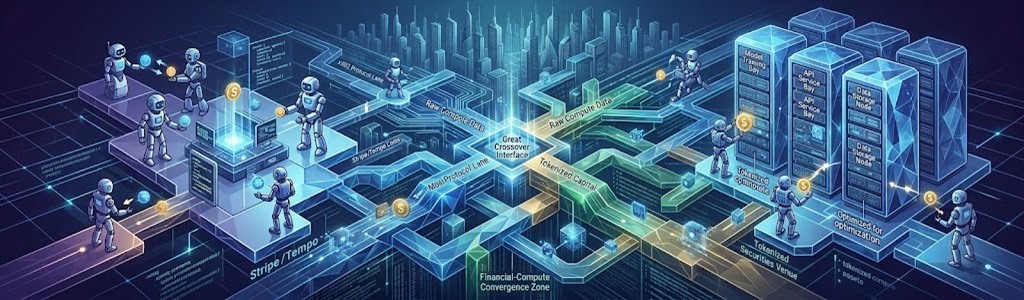
The transformation can also be seen among traditional asset managers such as Franklin Templeton, which has spent years developing products based on blockchain technology. Its Franklin OnChain U.S. Government Money Fund uses the BENJI token and forms part of a strategy the company presents through the concept of “The Great Crossover,” describing a potential convergence between on-chain and off-chain finance within a common financial infrastructure.
Franklin Templeton argues that, as this evolution progresses, assets could become tokenized while digital wallets could assume functions traditionally associated with financial accounts. The company also highlights that its tokenized fund uses blockchain infrastructure to record transactions and distribute income proportionally according to the time an investor holds the asset.
This development is significant because tokenization is not being driven exclusively by new market entrants. Traditional asset managers are building products on blockchain infrastructure, while companies such as Coinbase, Stripe, and Tempo are developing tools for programmable payments. At the same time, U.S. regulators are examining how existing rules can adapt to markets that could operate with greater automation and continuous availability.
Final Reflection: A Convergence Still Under Construction
The integration of AI, stablecoins, blockchain, and tokenized assets does not automatically guarantee investment returns or mean that the traditional financial system will disappear. The more tangible development is that technologies originally associated with the crypto ecosystem are increasingly entering institutional discussions around payments, capital markets, settlement, and automation.
In this environment, Coach JV’s interpretation provides one perspective on the broader transformation, although some of his conclusions about how major institutions may behave in the future remain analytical views rather than established facts. What can be observed is that BlackRock is studying the machine economy, Coinbase is developing infrastructure for autonomous payments, Stripe and Tempo have introduced standards for machine-to-machine transactions, Franklin Templeton continues to expand its on-chain strategy, and U.S. regulators are establishing frameworks for tokenization.
The central question is no longer simply whether blockchain can transform finance, but how far that transformation could go once machines are capable of operating, paying, and transacting on their own. The process remains at an early stage, but the convergence between artificial intelligence and digital assets is increasingly becoming a concrete area of financial development rather than a purely technological hypothesis.
Disclaimer: This article has been written for informational purposes only. It should not be taken as investment advice under any circumstances. Before making any investment in the crypto market, do your own research.