


The expansion of the blockchain ecosystem toward a multi-chain environment has generated a growing demand for infrastructure that enables the transfer of assets and information between heterogeneous networks. Cross-chain bridges have consolidated as the predominant solution for this interoperability need.
However, the history of security incidents associated with this category of protocols reveals a structural contradiction: the very architecture that enables connectivity introduces attack vectors that monolithic systems do not present.
According to DefiLlama, in 2026 there have been 250 attacks on DeFi protocols, with approximate losses of $1.4 billion. This figure, while significant, represents a reduction compared to the $2.7 billion lost in 146 incidents during 2025. What is particularly revealing is the concentration of value in attacks directed at bridges: between February and May 2026, at least eight relevant security incidents occurred against this type of infrastructure, with a total stolen amount of $328.6 million. This figure does not include later attacks, such as the one in July against Allbridge Core.
The Kelp DAO case and the configuration failure
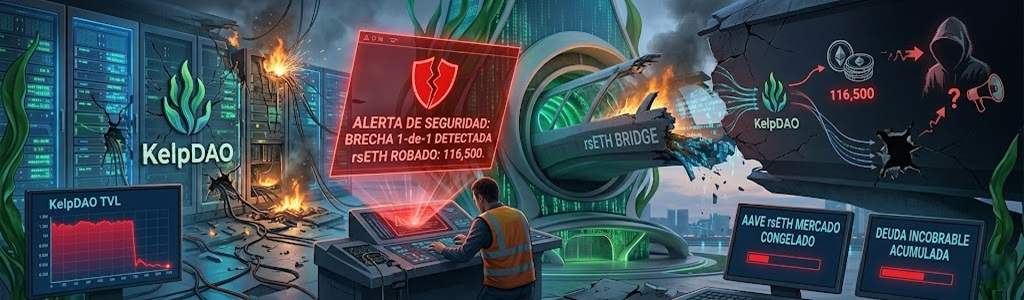
The incident of 2026 in terms of volume was the attack on Kelp DAO. On April 18, an attacker drained approximately 116,500 rsETH, valued at $293 million, by exploiting a bridge built on LayerZero. The attack vector was not a vulnerability in the smart contract code but a deficient configuration of the verification mechanism. Kelp DAO had implemented a Decentralized Verifier Network (DVN) 1-of-1 configuration, meaning a single validator was responsible for authorizing cross-chain transfers.
LayerZero, for its part, maintained that it had warned against this type of configuration. However, Dune Analytics data reveal that at the time of the attack, 47% of approximately 2,665 applications based on LayerZero were operating with the same single-verifier configuration.
This discrepancy between the official recommendation and the default configuration adopted by most projects raises questions about shared responsibility between infrastructure providers and the development teams that implement them.
Chainalysis subsequently confirmed that the attack did not originate from a smart contract bug but from an off-chain compromise. This distinction is relevant because it shifts the focus from code correction to key management and permission configuration.
The pattern observed in Kelp DAO is not isolated
Gravity Bridge, a bridge protocol connecting the Cosmos ecosystem with Ethereum, suffered an attack on May 30, 2026, resulting in the theft of approximately $5.4 million. The stolen assets included $4.3 million USDC, 274 WETH, $434,000 USDT, and $64,000 in PAYG. The contract on the Ethereum side was left with a residual balance of approximately $85,000.
Post-incident analysis indicated that this was a compromise of the validator signing key, not an exploitation of the contract itself. The attacker reduced the active validator set from 58 to 34 members and then proceeded to withdraw funds via authorized submitBatch calls. This case illustrates how a bridge’s security can be broken without exploiting code vulnerabilities, simply through the compromise of the credentials that authorize operations.
On July 19, 2026, Allbridge Core was exploited on the Solana network, with estimated losses of $1.65 million. The attacker used a flash loan of $1.12 million through the Kamino protocol, executed rapid swaps between USDC and USDT to distort the internal ratios of the stablecoin pool, and then withdrew assets at manipulated exchange rates before repaying the loan in the same transaction.
What makes this incident particularly notable is that Allbridge had suffered a similar attack in 2023, after which the firm had implemented a single-pool-per-chain architecture designed precisely to prevent this type of manipulation in a single transaction. However, the compromised pool in 2026 operated with USDC and USDT side by side on Solana, a configuration that the previous patch was supposed to eliminate. This case demonstrates that corrective measures can be insufficient or poorly implemented, and that attacks tend to recycle known vectors when defenses are not applied consistently.
Cross-chain bridges present a significantly larger attack surface than protocols operating within a single chain. This structural complexity manifests in multiple dimensions:
- First, the messaging component. Bridges must transmit information between chains that do not share a global state. This requires oracle, relayer, or verifier systems to authenticate and relay messages. The case of Verus-Ethereum Bridge, which lost $11.58 million in May 2026, exemplifies this vulnerability. The attacker exploited insufficient validation of the source amount in the bridge’s Solidity logic, allowing a fraudulent transfer message to be executed as valid. Blockaid, the security firm that detected the attack, noted that this was not an ECDSA bypass or a notary key compromise, but a failure in input validation logic.
- Second, the custody component. Bridges operating under the lock-and-mint model must custody assets on the source chain while issuing representations on the destination chain. This concentration of value in smart contracts creates a disproportionate economic incentive for attackers. According to Sherlock, attacks on cross-chain vulnerabilities in 2026 follow predictable patterns: trust assumptions coded as security guarantees, failures in authenticating message boundaries, and systems granting full permissions through a single path.
- Third, the configuration component. The Kelp DAO attack demonstrates that even when the underlying protocol is technically sound, an insecure configuration can nullify all security guarantees. The decision to use a single validator, although permitted by LayerZero, constituted a single point of failure that proved catastrophic.
The problem of trust-minimization
Most cross-chain bridges operate under some model of trust-minimization rather than trustlessness. This means they delegate verification of transfers to a set of validators, oracles, or signers. The bridge’s security then depends on the integrity and availability of these external actors.
This trust-minimized model introduces a systemic risk that does not exist in protocols operating within a single chain. If a validator is compromised, or if a sufficient number of validators collude or are co-opted, the bridge can be drained. The attacks on Gravity Bridge and Alephium TokenBridge (which lost $815,000 when the attacker gained control of 3 out of 4 guardian keys) are concrete examples of this structural vulnerability.
The most immediate consequence of the Kelp DAO attack was a massive migration of assets from LayerZero to Chainlink CCIP. Kelp DAO became the first major protocol to abandon LayerZero after the exploit. It was followed by Lombard Finance, which moved over $1 billion in Bitcoin-backed assets, and Solv Protocol, which migrated $700 million. In total, an estimated $40 billion in assets have been transferred or are in the process of migrating from LayerZero to Chainlink CCIP.
Chainlink CCIP offers a fundamentally different security model
It requires a minimum of 16 independent node operators per communication “lane,” plus a separate Risk Management Network. This defense-in-depth approach aims to eliminate the single points of failure that characterize configurations with unique verifiers. CCIP has obtained SOC 2 Type 2 certification and has processed over $30 trillion in cross-chain transaction value.
However, this migration should not be interpreted as a definitive solution to the bridge security problem. It merely shifts the risk from one verification model to another. No architecture is immune to implementation or configuration failures.

