The events of August 2026 have tested one of the fundamental premises of cryptocurrency security: user sovereignty over assets. The data breaches at hardware wallet manufacturers Trezor and SafePal, which affected over 53,000 customers in total, did not compromise private keys or seed phrases.
However, they exposed names, email addresses, phone numbers, and physical shipping addresses. This incident shifts the focus of security from key custody to personal data protection and physical security, an attack vector the industry has systematically underestimated.
The risk of a targeted phishing attack is the most immediate and probable consequence of a contact data leak. Attackers now possess verified information (name, email, and in many cases, phone number) to construct high-fidelity social engineering campaigns.
An email that references the exact model of the wallet purchased, the purchase date, or the shipping city, and simulates originating from the manufacturer, yields a significantly higher conversion rate than a generic phishing email.
These campaigns may request the “verification” of the seed phrase under the pretense of a firmware update, or direct the user to a cloned website to harvest credentials. The exposure of phone numbers adds an additional risk layer, enabling SMS phishing (smishing) and phone call spoofing attacks.
The exposed phone number serves as the entry vector for SIM swapping. This attack, which does not require compromising the user’s device, allows an attacker to take control of the telephone line. With control of the number, the attacker can intercept two-factor authentication (2FA) codes based on SMS and proceed to reset passwords on critical services such as exchanges or email accounts. The effectiveness of SIM swapping lies in its ability to bypass traditional multi-factor authentication.
The leakage of phone numbers belonging to hardware wallet clients is not an isolated incident; it represents a catalog of high-value targets for attackers. The recommendation to replace SMS authentication with authenticator applications or, preferably, hardware security keys (FIDO2) is a necessary mitigation measure, although it does not reverse the data exposure.
The most severe attack vector, and the one the industry has addressed with the least depth, stems from the exposure of the physical shipping address. The combination of a residential address with the acquisition of a device designed to custody cryptocurrencies transforms the user into a target for physical coercion attacks, known as “wrench attacks.” These attacks, which have exhibited a documented increase, do not rely on technical vulnerabilities; they employ intimidation or physical force to compel the victim to unlock their wallet or reveal their seed phrase.
The existence of a physical address linked to cryptocurrency holdings lowers the entry barrier for this type of crime, which can be executed with low operational cost. The recommendation to avoid publicly linking the residential address with crypto activity, and to consider using P.O. boxes or pickup points for future acquisitions, is an OPSEC measure that acquires critical relevance following a leak of this nature.
The response from the manufacturers, Trezor and SafePal, has been formally correct: notifying affected users, confirming that private keys have not been compromised, and warning about the increased risk of phishing.
However, the post-incident communication reveals a structural deficiency in the industry: personal data security has not been treated with the same diligence as key security. The Trezor leak occurred through its logistics provider ShipMonk, while the SafePal leak originated from an authorization vulnerability in a third-party order tracking plugin.
These incidents expose the attack surface represented by the supply chain of these devices. The security of a hardware wallet does not end at the secure chip; it encompasses all systems and partners that process customer data, from the time of purchase to delivery.
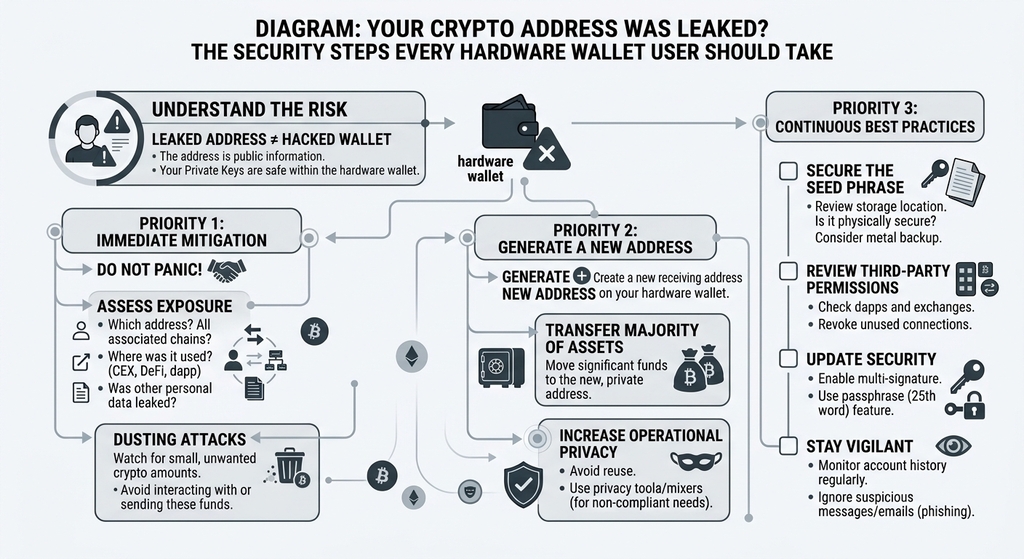
The user response upon receiving a personal data breach notification requires a structured risk analysis. The immediate action of transferring funds to a new address is not the priority unless there is evidence that the seed phrase or private key has been exposed.
Precipitous movement of funds, especially if executed from a wallet with an unverified security configuration, can introduce operational risks (errors in the destination address, transaction costs on congested networks) that outweigh the immediate threat. The focus must be on fortifying perimeter defenses:
-
Secure the email account: Implement a unique and robust password and activate 2FA via authenticator application or hardware key.
-
Protect the phone number: Contact the carrier to establish a port-out PIN and restrictions on SIM changes. Eliminate SMS as a 2FA method on all accounts that permit it.
-
Active monitoring: Remain vigilant regarding incoming communications (email, SMS, calls) that request sensitive information or urgent actions. Verification of any communication’s authenticity must be conducted through official channels, not via links or numbers provided in the suspicious message.
-
Physical security: Evaluate the exposure of the residential address and consider deterrent or security measures at the domicile. Personal OPSEC must be updated to reflect the new risk profile.
The Trezor and SafePal incidents are not exceptional; they are a manifestation of the risks inherent to the centralization of personal data within entities that, by their nature, custody high-value assets. The hardware wallet industry must integrate personal data protection as a core component of its security proposition, not as a peripheral aspect of order management.
This entails auditing the supply chain, minimizing data retention, and developing incident response protocols that address all attack vectors enabled by a data breach. User sovereignty over private keys is a necessary condition, but it is not sufficient for comprehensive security. The protection of user identity and physical integrity is, ultimately, the foundation upon which the sovereign custody of digital assets is built.