TL;DR
- Chainlink has become a core infrastructure provider for major DeFi protocols, supplying market data, cross-chain messaging, automation, and other services.
- Aave has expanded its integration into V4, governance, and GHO transfers, while Lido uses Chainlink for cross-chain staking.
- The broader ecosystem also includes GMX, Maple Finance, Compound, Kamino, and tokenized-asset platforms, reinforcing Chainlink’s role across onchain finance.
Chainlink is increasingly positioned as foundational infrastructure for decentralized finance, connecting smart contracts with market data, cross-chain liquidity, and automated processes. Its adoption by Aave and Lido shows how DeFi applications are moving beyond basic swaps and lending toward more sophisticated financial markets.
Chainlink reported that its infrastructure had enabled more than $27 trillion in transaction value across over 70 blockchains by December 2025, while securing more than $100 billion across DeFi. The company also reported roughly 70% market share across blockchains and more than 80% on Ethereum.
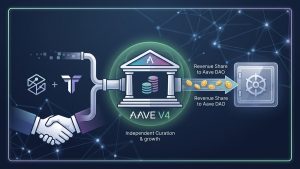
Aave represents a clear example. Chainlink Data Feeds have supported Aave markets since 2020, providing pricing data for collateral valuation, borrowing limits, and liquidations. In 2026, Aave expanded the relationship as its V4 markets adopted Chainlink as their exclusive oracle platform, while Smart Value Recapture and Chainlink Runtime Environment added revenue and automation capabilities.
Chainlink Expands Across Core DeFi Markets
The integration now reaches beyond price feeds. Aave uses Chainlink CCIP for cross-chain GHO transfers and governance, while its infrastructure supports automated workflows across multiple networks. Aave has also expanded CCIP into cross-chain functions for its consumer-facing application.
Lido provides another important case. Chainlink supports cross-chain infrastructure for Lido’s liquid-staking ecosystem, including Direct Staking rails that allow users on Arbitrum, Base, and Optimism to stake ETH and receive wstETH. This makes liquid-staking assets more usable across lending and trading applications.
Other integrations broaden the picture. Chainlink supports lending platforms such as Compound and Kamino, derivatives venues including GMX, and interoperability for Maple Finance. Data Streams also supplies low-latency market data for prediction markets and tokenized real-world asset platforms.
From Oracles To A Broader Onchain Financial Stack
This expansion matters because DeFi increasingly requires more than decentralized price feeds. Protocols need interoperability, automated execution, reserve verification, compliance tools, and reliable data for assets beyond cryptocurrencies. Chainlink now combines these capabilities into a platform connecting blockchains with financial markets and external systems.
For developers, this infrastructure can reduce the need to build separate systems for each market function. For users, it can support deeper liquidity, broader asset availability, and more interconnected applications. As tokenized securities, stablecoins, liquid staking, and cross-chain finance expand, Chainlink’s role gives DeFi a more standardized infrastructure layer.