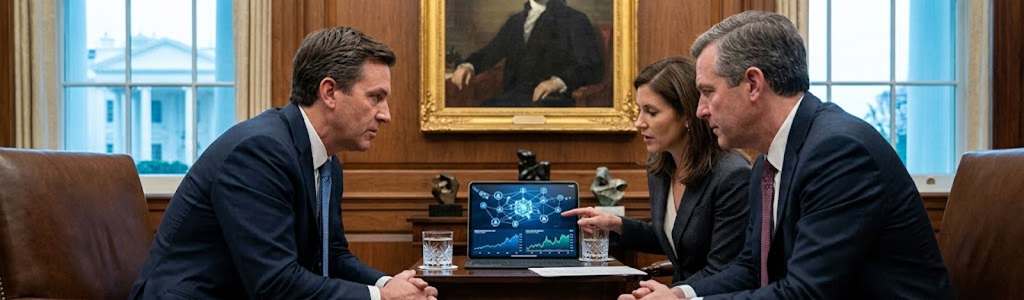
The meeting held at the White House on Wednesday, August 19, delivered an important political signal for the digital asset industry: Washington is increasingly treating crypto as an integrated part of the U.S. financial infrastructure. The gathering brought President Donald Trump together with executives from companies such as Ripple and Coinbase, SEC and CFTC officials, and major Wall Street institutions, as new regulatory rules advance while the CLARITY Act remains stalled in the Senate.
Crypto And Wall Street At The Same Table
One of the meeting’s most significant features was the composition of its participants. Ripple CEO Brad Garlinghouse and Coinbase CEO Brian Armstrong were among the leading representatives of the digital asset sector, alongside executives from other crypto companies, prediction markets and financial services firms. Traditional financial institutions including Nasdaq, NYSE and CME Group were also represented, while SEC Chairman Paul Atkins and CFTC Chairman Michael Selig provided the perspective of the main U.S. regulators.
The combination of these participants broadens the scope of the discussion. The debate is no longer only about Bitcoin, XRP or crypto exchanges, but also about transforming traditional financial markets through blockchain technology. The tokenization of stocks, bonds and other financial instruments is emerging as a major opportunity if the United States can establish clearer rules for companies and investors.
The meeting did not, however, produce final approval of the legislation the industry has been awaiting. The CLARITY Act remains pending in the Senate after lawmakers left Washington for the August recess without completing the necessary procedure. The next key step is expected on September 15.
SEC Takes A Major Step For The Crypto Market
Against this backdrop came one of the week’s most important regulatory developments. One day before the White House meeting, the SEC introduced its “Regulation Crypto Assets” proposal, a new framework designed to give certain crypto companies clearer ways to raise capital without automatically going through the full registration process traditionally required for securities offerings.
The proposal includes two significant exemptions. The so-called “startup exemption” would allow issuers to raise up to $5 million over four years, while another pathway would allow fundraising of up to $75 million during any 12-month period, subject to specific financial reporting requirements.
The SEC also proposed a conditional safe harbor for certain tokens, potentially allowing some digital assets to fall outside the definition of a security when specific conditions related to the issuer’s managerial efforts are met.
SEC Chairman Paul Atkins described the proposal as a “minimum effective dose” of oversight, designed to protect investors without creating unnecessary barriers to innovation. Industry groups initially welcomed the initiative, although the proposal is not final and will face a 60-day public comment period after its formal publication.
The development is particularly significant because the SEC is moving forward while Congress has yet to complete broader market-structure legislation. The CLARITY Act seeks to establish a clearer division of responsibilities between the SEC and CFTC, but the Senate entered recess without voting on the bill. Majority Leader John Thune filed a cloture motion on August 7, with September 15 emerging as the next key date.
XRP And Oscar Ramos Watch The New Landscape
XRP attracted particular attention because of Brad Garlinghouse’s direct participation in the meeting. The token was trading near the $1 area during the session, as investors assessed whether the new regulatory environment could become a catalyst for a broader recovery.
The event was also closely followed by crypto-focused YouTuber Oscar Ramos, who had analyzed the importance of the meeting for XRP and short-term market expectations. In his pre-event coverage, Ramos explained that he held a leveraged long position on XRP through BTCC, reporting a return of more than 14% at the time. This represented his own trading position and should not be interpreted as an objective prediction for XRP’s future price.
The familiar “buy the rumor, sell the news” dynamic remains relevant. A favorable political signal can boost expectations ahead of a meeting, but markets can react differently once the event takes place if concrete commitments fail to emerge. For XRP, the real test will be whether the new regulatory direction develops into permanent rules capable of supporting business activity and institutional investment.
Final Reflection: Clarity Will Matter More Than The Noise
The White House meeting could ultimately be remembered as a sign of crypto’s growing political acceptance, but its real impact will depend on what happens next. The simultaneous presence of Ripple, Coinbase, Wall Street, the SEC and CFTC shows that digital assets now occupy a significant place in discussions about the future of U.S. finance.
For XRP, the environment is particularly interesting. The SEC proposal creates new regulatory pathways for certain projects, while the CLARITY Act remains the legislative initiative that could provide a broader structure. The crypto sector now has stronger signs of institutional openness, but it still needs to turn those signals into permanent rules.
The real victory for crypto will not be a temporary XRP rally following a presidential meeting, but the creation of a framework where innovation, investor protection and legal certainty can coexist. If Washington turns the growing cooperation between government, regulators, crypto companies and Wall Street into durable rules, the August 19 meeting could become one of the events defining the next stage of institutional digital asset adoption.
Disclaimer: This article has been written for informational purposes only. It should not be taken as investment advice under any circumstances. Before making any investment in the crypto market, do your own research.