Solana retains its position as the primary destination for memecoin trading activity, according to onchain data from multiple sources covering July and August 2026. Despite the launch of Robinhood Chain on July 1 and renewed memecoin activity on BNB Chain, trading volumes and user metrics indicate that speculative capital continues to concentrate on Solana rather than migrating permanently to competing networks.
Solana’s DEX Volume Maintains Lead Over Competitors
As of July 8, Solana’s decentralized exchanges recorded over $440 million in 24-hour trading volume, edging out Robinhood Chain’s roughly $405 million. The $35 million gap persisted even during Robinhood Chain’s peak novelty window, a period when competitor chains typically exhibit their strongest relative performance.

Robinhood Chain had launched its mainnet just one week earlier, on July 1, riding a wave of market hype that historically inflates early adoption metrics before stabilizing.
Robinhood Chain’s Memecoin Activity Dominates Its Use Case
Robinhood Chain was designed primarily for tokenizing real-world assets and stocks, yet memecoin trading accounted for roughly 79% of the chain’s DEX activity in its initial weeks. The chain attracted approximately $431 million in total value locked shortly after launch. Daily DEX volumes peaked above $600 million, supported by integrations with Uniswap and Chainlink oracle services. However, the chain has since retraced to only five tokens maintaining a market capitalization above $10 million.
CASHCAT, the flagship memecoin that briefly approached a $400 million valuation, has stabilized around $135 million, with the cumulative market cap for all memecoins on the chain sitting at approximately $358 million. Tokenized stock volumes reached an estimated $70 million by late July, representing roughly fivefold growth in under two weeks but still commanding approximately one-fifth the market capitalization of memecoins on the platform.
BNB Chain’s October 2025 Pattern Repeats with Robinhood Chain
BNB Chain underwent an almost identical cycle in October 2025. A burst of memecoin trading activity temporarily pulled speculators away from Solana and generated headlines about a potential shift in the ecosystem’s center of gravity. Traders subsequently migrated back to Solana as the initial excitement cooled.
— Bold (@boldleonidas) October 9, 2025
The Robinhood Chain phenomenon in July-August 2026 follows the same trajectory, with onchain data showing a return of trading activity to Solana rather than a sustained rotation.
August 16 Trading Data Shows Solana in First Place
On August 16, the combined memecoin trading volume across Solana, BNB Chain, and Robinhood Chain exceeded $250 million. The distribution was as follows: Solana accounted for $99.96 million (39.3%), BNB Chain recorded $90.56 million (35.6%), and Robinhood Chain posted $63.89 million (25.1%).
The previous day, Robinhood Chain held the largest share at 42.1% with $113.13 million, followed by Solana at 38.4% ($103.33 million) and BNB Chain at 19.5% ($52.32 million). The combined trading volume across the three chains declined by 5.3% from the previous day, yet BNB Chain posted a 73.1% increase, the largest gain among the three networks.
According to Dune Analytics data, Robinhood Chain’s period as the leading memecoin trading hotspot lasted only a few weeks before being overtaken by BNB Chain. Solana subsequently regained the leading position.
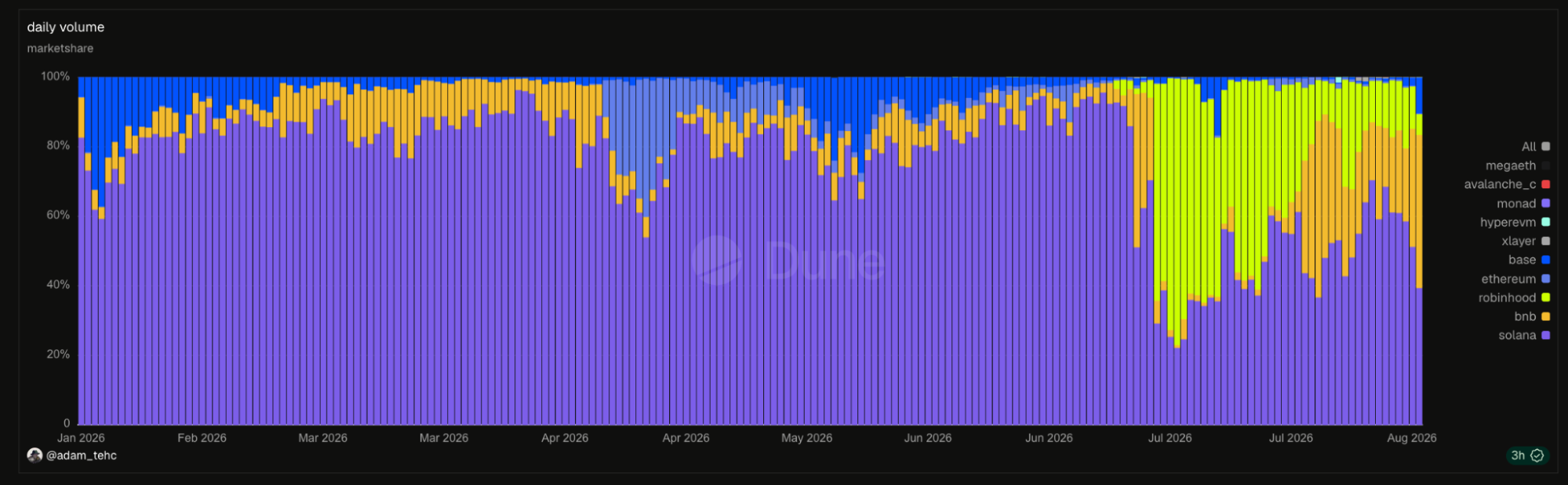
While BNB Chain has recently shown strength due to individual high-profile tokens, Solana continues to register a higher number of onchain traders, indicating broader market participation. Blockworks data shows that over 46% of Solana’s daily trading volume comes from memecoin trading pairs, confirming that memecoins remain one of the network’s most significant use cases.
Solana has built its infrastructure since 2024 around characteristics that align with memecoin trading patterns. Sub-second finality and transaction costs measured in fractions of a cent provide a technical foundation suited for the high-frequency trading that defines memecoin activity.
During the current rotation, Solana-native tokens such as $ANSEM faced selling pressure as traders liquidated positions to fund activity on Robinhood Chain, yet the network maintained its volume lead.
Independent analysis indicates that approximately 6% of traders on Solana are in profit, with a median loss of approximately $120 per trader. Some market participants have cited the relative absence of new high-profile memecoin projects on Solana—with certain tokens failing to break the $20 million market cap threshold—as a signal of capital rotation, while BNB Chain has hosted individual memecoins exceeding $40 million in market capitalization.
On August 17, the BNB Chain memecoin “Niu Lai” reached a market cap of $49.2 million before retracing 26% to $36 million, with 24-hour trading volume of $37.7 million and a 227% gain. Individual token performance on competing chains has not translated into sustained network migration of trading volume or user activity.
Robinhood Chain’s Strategic Positioning
Robinhood Chain’s long-term value proposition depends on attracting the tokenized real-world-asset use case for which it was built. The chain processes over 200 million transactions and has reached nearly $800 million in TVL within its first month. However, the ratio of memecoin activity to asset-backed trading remains structurally imbalanced. If 79% of a chain’s activity derives from a use case it was not designed for, this represents either a deviation from intended function or a structural mismatch awaiting correction.