The foundational narrative of Web3 positions financial democratization as the core of its value proposition. The removal of intermediaries, permissionless access, and sovereign custody of assets are presented as mechanisms capable of integrating populations excluded from the traditional banking system. However, an analysis of the incentive architecture and on-chain capital flows reveals a different reality. The infrastructure enables open access, but the system’s operation disproportionately rewards those with risk capital, advanced technical knowledge, and tolerance for extreme volatility. The result is not financial democracy but a high-friction risk market where initial advantages are amplified in every cycle.
Anyone with an internet connection can generate a cryptographic key pair and interact with DeFi protocols without identity checks, minimum balance thresholds, or geographic restrictions. In jurisdictions with hyperinflation or dysfunctional banking systems, stablecoins offer dollar exposure and lending protocols provide yield without a bank account. This technical capability represents an advance over traditional banking. Yet access is only one layer of the financial architecture. The distribution of economic benefits depends on how risks and rewards are allocated within the system.
Multiple distribution analyses of wallets across DeFi protocols show a Gini coefficient comparable to or higher than that of traditional economies. Private funding rounds allocate tokens to venture capital funds and angels at significant discounts to the public listing price. By the time the token reaches a decentralized exchange, early investors already hold a proportion of the supply that grants them voting power and liquidity extraction capacity. Airdrop distributions intended to broaden the holder base often weight interaction volume or liquidity provided, benefiting whales that can fragment positions or execute high-value transactions. The direct consequence is a reinforcement of on-chain plutocracy, where decision-making power and value capture replicate the concentration structures that the decentralization narrative claimed to overcome.
Information asymmetry constitutes a second filter that selects the participants capable of extracting profitability. Managing private keys, signing transactions across networks with different consensus mechanisms, manual calculation of slippage, and verification of smart contract addresses require a technical literacy with no equivalent in traditional banking interfaces. Less experienced users remain exposed to phishing exploits, wallet drains from malicious approvals, and bridging errors that result in irreversible loss of funds.
Simultaneously, the existence of MEV (Maximal Extractable Value) allows validators, searchers, and bot operators to capture value through transaction reordering, sandwich attacks, or early position liquidations. That value does not redistribute; it concentrates among actors with technical infrastructure and capital to optimize extraction. The technical architecture of the ecosystem does not penalize the exploitation of complexity; it monetizes it in favor of the sophisticated operator.

The promise of credit inclusion encounters a structural limit in the mandatory overcollateralization of DeFi loans. Platforms such as Aave or Compound require collateral ratios typically exceeding 130% of the borrowed value, meaning the borrower must possess prior capital. The design eliminates counterparty risk without credit assessment but fully excludes anyone lacking assets to deposit. Genuine financial inclusion would require undercollateralized loans based on on-chain reputation or identity, yet such mechanisms depend on decentralized identity infrastructure that still lacks maturity, interoperable standards, and resistance to Sybil attacks.
Existing attempts, such as credit protocols based on social graphs, operate at experimental scale and have not altered the overall dynamic. Until the ecosystem resolves solvency verification without centralized custodians, decentralized credit will remain a capital optimization instrument for digital asset holders, not a tool of inclusion.
Transaction volume concentrates in yield farming, leveraged trading, liquidity provision in volatile asset pools, and delta-neutral strategies dependent on inflationary governance tokens. Aggregate profitability largely derives from the issuance of new tokens and capital rotation between narratives, not from financing productive activity.
The sharp declines in total value locked (TVL) during systemic deleveraging events show that yields are correlated with speculative liquidity flows rather than underlying economic value generation. In this environment, participants who can absorb complete losses and maintain positions during market contractions capture the greatest portfolio recompositions. The system rewards ruin-risk tolerance, not broadened participation.
The absence of consumer protection reinforces the advantage of patient and diversified capital. Decentralized finance lacks deposit insurance equivalent to the FDIC, dispute resolution mechanisms, and developer legal liability in the event of code failures. Every interaction with a smart contract exposes the user to exploit risk, rug pulls, and oracle errors without possibility of recourse. Post-mortem analyses of incidents such as the Euler Finance exploit or cross-chain bridge attacks show that recovered funds depend on informal negotiations with white hats or centralized asset freezing by stablecoin issuers — solutions that contradict the principles of immutability and decentralization.
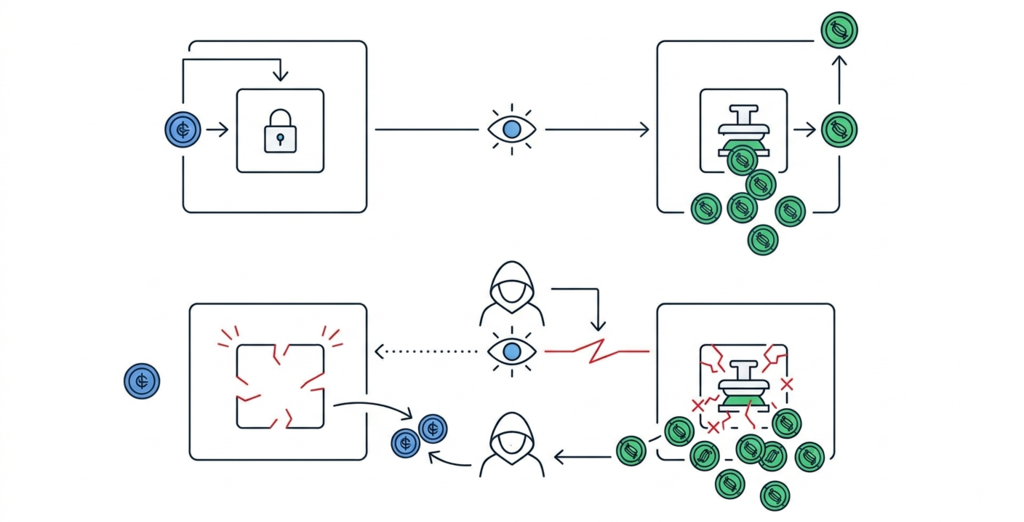
The burden of due diligence falls entirely on the user. Those who can diversify across protocols, audit code, or contract external risk analysis minimize the impact of catastrophic events; those who cannot bear losses that no compensation system will cover.
Decentralized governance, presented as the mechanism to align incentives between users and protocols, reproduces patterns of voting power concentration. Governance token delegation generates structures where a small number of delegates control decisions on risk parameters, interest rates, and contract upgrades.
Voting participation is low, and the rational apathy of minority holders allows large holders to dictate protocol conditions. Governance forums and preceding off-chain votes reflect coordination dynamics where actors with greater social and technical capital filter proposals before they reach an on-chain vote. The operational result resembles digital corporatism more closely than direct democracy.
The Web3 infrastructure contains necessary conditions for unprecedented financial openness: permissionless access, smart contract composability, and self-custody remove structural entry barriers. But the current environment operates as an accelerated risk market where those conditions are asymmetrically exploited by actors concentrating capital, information, and technical capacity. The democratization promise does not materialize automatically from the existence of non-custodial wallets or open protocols.
A second layer of instruments is required — ones that reduce informational asymmetries, protect inexperienced participants, and enable productive credit allocation without demanding full collateral. As long as those instruments remain immature, the ecosystem is not democratizing finance: it is systematically rewarding those who can absorb the losses the system itself generates.