TL;DR:
- ZEC recovered 41.5% from its June 5 low of $303 and is currently trading around $437.
- Josh Swihart, founder of ZODL, detailed a two-step emergency update that included a soft fork and a hard fork (NU6.2) activated on June 3.
- The vulnerability in the Orchard pool exposed the network to unlimited minting of fake ZEC tokens; Shielded Labs confirmed no real exploit occurred.
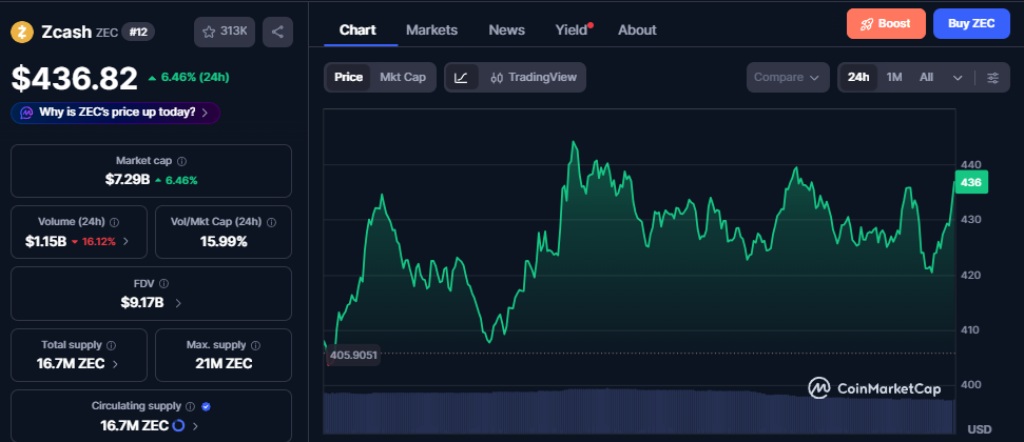
The price of ZEC, the native token of the Zcash network, is partially recovering after the heavy blow it suffered last week. According to data from CoinMarketCap, it is trading around $437, with a gain of 6.5% over the past 24 hours, although its volume fell 16% to around $1.15 billion and its market capitalization approaches $7.3 billion.
The total recovery amounts to 41.5% from the low of $303 reached on June 5, when the public disclosure of a critical vulnerability in the Orchard pool caused a price crash of more than 50% from $630.
A Flaw That Threatened the Integrity of ZEC
The independent support group Shielded Labs revealed last Thursday the existence of a severe bug in Zcash’s Orchard circuit, the zero-knowledge proof system that verifies transaction validity. The flaw exposed the network to a potential unlimited minting of counterfeit ZEC. Shielded Labs subsequently confirmed that the bug was fixed and that a real exploit is unlikely to have occurred.
The news shook market confidence. Among those affected was Arthur Hayes, co-founder of BitMEX, who announced that he liquidated his entire position in ZEC after the vulnerability became public.

ZODL Details the Emergency Response
Josh Swihart, founder of the Zcash Open Development Lab (ZODL), published details of the technical intervention. The team deployed a two-step update: first, a soft fork to disable Orchard transactions and contain the risk without publicly exposing the full scope of the problem before disclosure. Then, on June 3, a hard fork identified as NU6.2 was activated to resolve the root cause and restore transactions. Swihart highlighted the role of mining pools ViaBTC and Foundry in coordinating the response, and noted that the team addressed multiple code review requests from exchanges and pools to verify the integrity of the work carried out.
— Josh Swihart 🛡 (@jswihart) June 7, 2026
“We solved the problem, stress-tested our incident support processes, and unified as a builder community to agree on a path forward,” Swihart wrote.
Looking ahead, ZODL proposed a new network upgrade and a pool called Ironwood, developed alongside Tachyon, Valar Group, the Zcash Foundation, and Shielded Labs. The project will build on the Orchard protocol, incorporating formal verification and additional independent audits.