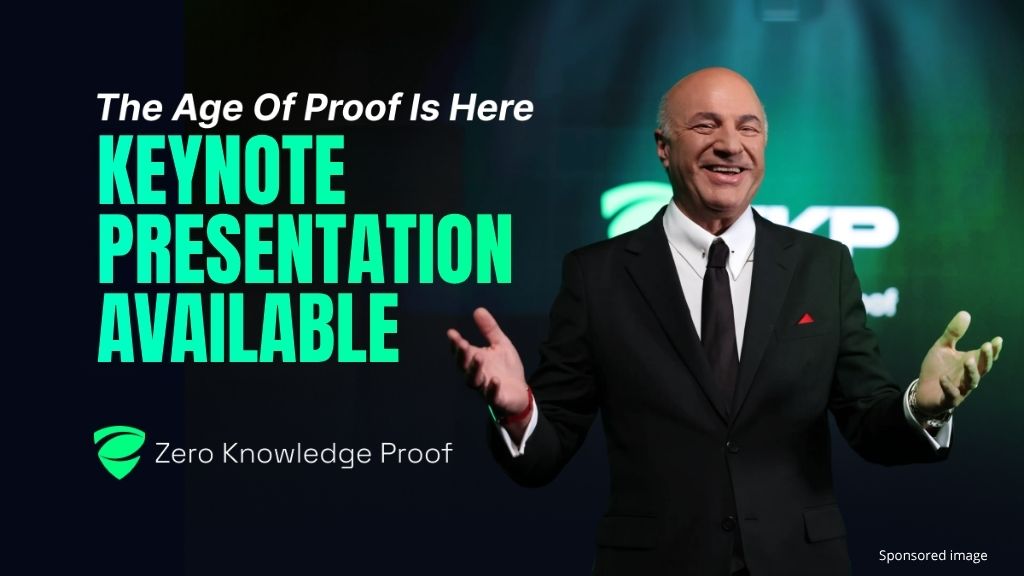
Kevin O’Leary built his success on a simple fact. Belief is cheap. Confidence is costly. He shares this view in meetings, on TV, and during large financial discussions. When O’Leary connects his reputation to a new venture, observers often take note regardless of his compensation.
Regarding Zero Knowledge Proof (ZKP), he appears to express support for the project’s approach. When reviewing what Zero Knowledge Proof (ZKP) proposes and how its token sale is structured, the rationale he highlights becomes clearer.
The Reality O’Leary Noticed That Other Crypto Ventures Often Overlook
The video O’Leary made for Zero Knowledge Proof (ZKP) highlights a concern that commentators and regulators have raised: as artificial intelligence is applied more broadly, outputs and data provenance can be difficult to verify. Some industry estimates anticipate substantial growth in AI markets, and there have been reported cases of AI-generated inaccuracies in legal and medical contexts.
The concern he raises is not about the capabilities of AI per se but about verifiability. In the video O’Leary said that power without proof can create uncertainty. Zero-knowledge proofs are a cryptographic approach intended to allow a prover to demonstrate the validity of information without revealing the confidential data itself.

Using zero-knowledge proofs, an AI system could demonstrate it reached a particular conclusion without exposing private training data. Similarly, a transaction can be validated without disclosing the identities involved, and healthcare projects may be able to share verifiable results while keeping patient details private.
In the video O’Leary referred to this shift as the “Time of Verification,” describing a space where mathematical proofs are used to establish trust rather than relying solely on corporate assertions. He argued that verifiable computation could become a foundational element for certain AI and data-processing use cases.
What the Zero Knowledge Proof (ZKP) Team Says It Has Built and Why It Matters
The project team reports that they invested significant capital in development prior to the token sale. According to project materials, the creators say they invested about $100 million before opening the token sale to broader participants.
The team states they allocated funds to develop a multi-layer system that supports EVM and WASM tooling. They also describe investments in hardware “Proof Pods” for distributed processing and in domain infrastructure. These descriptions and figures are presented by the project and have not been independently verified by this publication.
The protocol documentation, as described by the project, includes mechanisms the team calls “Proof of Intelligence” for nodes that process AI workloads and “Proof of Space” for nodes that provide storage. The project says these mechanisms are intended to improve efficiency and to provide specific utilities for the network.
The project materials suggest the network’s utility could increase with adoption. Those claims reflect the project’s stated roadmap and objectives rather than an independently confirmed outcome.
Token Sale Stages Described by the Project
The Zero Knowledge Proof (ZKP) team describes a multi-step token sale. The project reports initial step pricing and an intended initial market price, presented in its sale materials. These pricing figures are reported by the project and should be treated as unverified project information rather than guarantees of future value.
Project representatives describe the offering as infrastructure-focused and say the protocol is aimed at servicing applications that require verifiable data processing. Observers of established tokens may evaluate this project differently given its stated focus on infrastructure rather than consumer-facing token use cases.
Key Point Emphasized by O’Leary
O’Leary framed “Time of Verification” as a move toward mathematically verifiable data and argued that proof will be increasingly relevant for institutions handling sensitive information. He discussed how verifiable computation could be used by schools, clinics, and banks to process and monetize verified data without exposing underlying private data, according to his comments in the video.
The project describes a staged token sale and reports prior developer investment; these are claims made by the project and by O’Leary in his presentation.

Project links and references:
Official website: https://zkp.com/
Token sale page: purchase.zkp.com
Telegram: https://t.me/ZKPofficial
This article contains information about a cryptocurrency presale. Crypto Economy is not associated with the project. As with any initiative within the crypto ecosystem, we encourage users to do their own research before participating, carefully considering both the potential and the risks involved. This content is for informational purposes only and does not constitute investment advice.