TL;DR:
- Legal scope: House Bill 5882 seeks to grant municipalities explicit authority to temporarily halt the construction of mining facilities and data centers.
- Defined deadlines: The legislation proposes that initial moratoriums have a maximum duration of six months, with a possible one-time 90-day extension under justification.
- Evaluation costs: The regulation would allow local governments to transfer the expenses of environmental impact and infrastructure studies directly to developers.
The Michigan legislature has formally introduced a bill that could restrict the expansion of cryptocurrency mining in the state. The proposal, designated House Bill 5882, arises in response to growing concerns regarding energy consumption and the stability of the local electrical grid.
NEW: Michigan bill allows local governments to impose moratoriums on the construction of crypto miners and data centers.
— Bitcoin Laws (@Bitcoin_Laws) May 4, 2026
HB 5882 provides a roadmap and checklist for local governments wanting to block construction. pic.twitter.com/kx8WTH36kT
Introduced on April 23, 2026, by State Representatives Miller, Dievendorf, and Paiz, the legislative piece is currently under review by the Government Operations Committee. The objective of this bill is to regulate high-intensity computing facilities through a strengthening of the zoning powers of local government units.
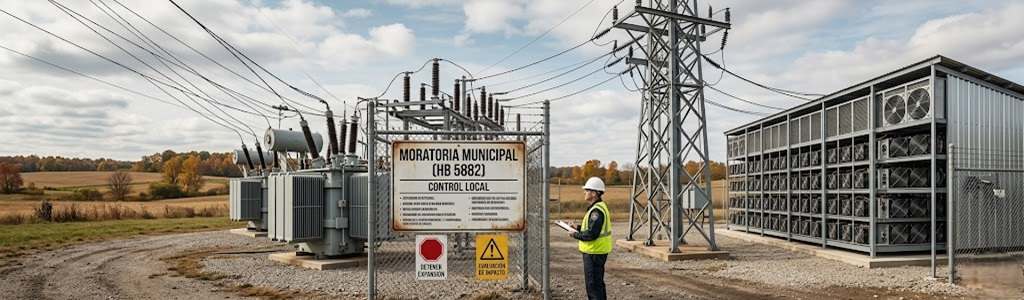
Municipal Control and Infrastructure Regulations
The regulation establishes a framework for action so that counties and cities can evaluate environmental effects before authorizing the start of commercial works. Data from the legislative tracking platform Bitcoin Laws indicates that the law functions as a roadmap for local governments to block or condition constructions that do not meet specific sustainability standards.
Reports from the Michigan legislature indicate that local community concerns regarding noise pollution and excessive load on electrical transformers are recurring. HB 5882 would require authorities to hold transparent public hearings and would prohibit elected officials from signing non-disclosure agreements (NDAs) with development companies.
The technical draft of the project suggests that legislators are operationally grouping Artificial Intelligence (AI) data centers and mining farms under the same regulatory category. This strategy seeks to avoid legal loopholes where companies might bypass restrictions simply by changing the technical designation of their primary activity.
Requirements for Implementing Moratoriums
Under this new scheme, for a moratorium to be valid, the local government must meet strict conditions. According to Section 7 of the proposed act, any pause in construction must be adopted through a public ordinance detailing how the measure serves the general interest and what appeal processes exist for those affected by “extraordinary hardships.”
Ecosystem data indicates that at least 19 communities in Michigan have already attempted or approved suspension measures independently. However, HB 5882 seeks to standardize these processes so that municipalities can demand reimbursements for technical inspections carried out during the pause period. According to the current trend in the House of Representatives, the success of the law will depend on the ability of municipalities to demonstrate compelling circumstances that justify time extensions.
The future of cryptocurrency mining in the region remains contingent on the decision of the Government Operations Committee. It is projected that initial votes to advance the project to the plenary session could occur before the close of the current legislative period in June 2026.