For more than half a decade, Jamie Dimon, Chairman and CEO of JPMorgan Chase, maintained a publicly adversarial position toward crypto-assets. His vocabulary included terms such as “fraud,” “pet rock,” and “decentralized pyramid scheme.”
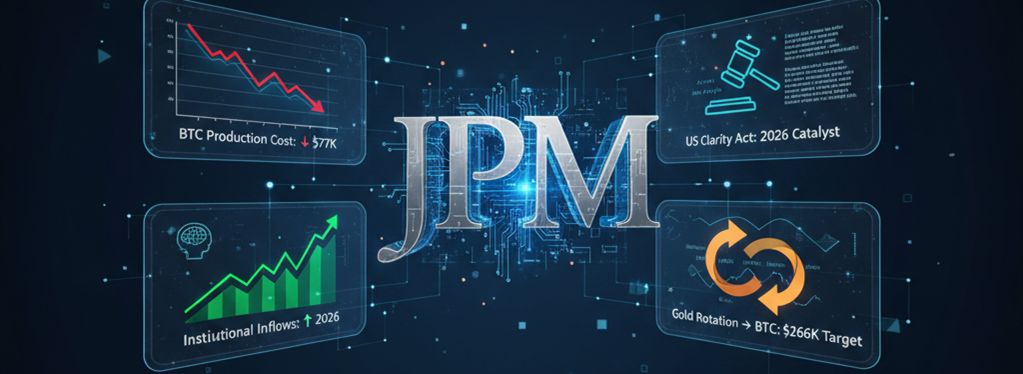
That discursive phase has now concluded. In his April 2026 letter to shareholders, Dimon formally listed blockchain technology, stablecoins, and asset tokenization as direct competitors to JPMorgan’s core banking operations — alongside established fintech firms like Stripe and Revolut. This reclassification is not rhetorical noise. It signals an observable structural shift in financial intermediation.
The question is not whether Dimon has undergone a personal conversion. The question is whether his diagnosis corresponds to measurable changes in capital flows, settlement systems, and institutional behavior.
The Historical Position and Its Inversion
Between 2017 and 2023, Dimon’s public commentary on Bitcoin exhibited low variance: he labeled it a “dangerous speculative asset” with no intrinsic value. During that same period, however, JPMorgan internally developed the Onyx blockchain platform (now rebranded as Kinexys), launched JPM Coin for wholesale payments, and hired hundreds of distributed-ledger engineers.
This divergence between public skepticism and private infrastructure investment is not contradictory. It reflects a rational separation between the speculative volatility of unbacked crypto-assets and the utility of the underlying ledger technology.
The 2026 shareholder letter removes that separation in competitive terms. Dimon now states that “stablecoins, tokenization, and smart contract platforms represent a new set of competitors that do not hold banking charters but offer substitutes for deposit accounts, payment systems, and collateral management.”
From a microeconomic perspective, any instrument that performs the same function as a bank deposit — store of value, unit of account, medium of exchange — with lower friction or higher yield will generate deposit migration.
Empirical Indicators of the “Silent Devouring”
The metaphor “devouring” is connotative. The underlying denotative reality consists of three measurable flows.
First, stablecoin supply growth. As of March 2026, total circulating supply of fiat-backed stablecoins exceeded $310 billion, a 42% increase year-over-year. Standard Chartered’s digital-assets research unit estimated that stablecoins currently displace approximately $80 billion in demand deposits in U.S. commercial banks. Their forward model projects $500 billion in deposit displacement by 2028. This is not a future possibility; it is a quarterly reported statistic.
Second, tokenized U.S. Treasury securities. By Q1 2026, aggregate tokenized government debt exceeded $18 billion in face value. These tokens are programmable, transferable 24/7, and usable as collateral in decentralized lending protocols. Settlement in minutes instead of T+2 days reduces counterparty risk and opportunity cost. Banks that historically earned float income now face structural compression of that revenue line.

Third, on-chain foreign exchange and payments. The SWIFT network processed 45 million messages per day, with settlement finality from 12 hours to 3 days. In parallel, blockchain-based payment rails settled $7.2 trillion in notional value during 2025. This represents approximately 4% of total global cross-border flows, with 67% year-over-year growth. At that pace, blockchain rails will handle 15–20% of cross-border payments by 2028.
Dimon’s acknowledgment is therefore factually correct. The threat is not hypothetical. It is quantifiable.
Is Dimon Correct in His Assessment? A Denotative Evaluation
Yes, with two qualifications.
First qualification: Dimon continues to distinguish between blockchain infrastructure and Bitcoin as a store of value. In the same April 2026 letter, he reiterated that “Bitcoin itself has no intrinsic value and remains unsuitable as a currency due to price volatility.” From a strict financial intermediation perspective, Bitcoin is not devouring banking. Stablecoins and tokenized assets are.
Second qualification: The “silent devouring” is currently concentrated in wholesale and institutional segments, not retail banking. The median U.S. household maintains a checking account balance of $8,000, and only 3% has migrated to stablecoins. The primary displacement occurs in corporate treasuries, hedge funds, and high-net-worth portfolios. Thus, the devouring is real but localized.
Nevertheless, Dimon’s strategic response — preparing JPMorgan to accept Bitcoin and Ethereum as collateral for institutional loans — is a rational adaptation. This is not ideology. It is intermediation.
Entrepreneurial Opportunity: A Structural Map
The same structural forces that Dimon identifies as threats produce new profit opportunities for entrepreneurs. The key is to locate friction points banks cannot address due to legacy systems, regulatory constraints, or organizational inertia.
Stablecoin Payment Infrastructure (B2B Focus)
Most companies lack middleware to convert, settle, and reconcile stablecoin payments with ERP systems. API-first gateways handling acceptance, fiat conversion, and automated reconciliation represent a solvable engineering problem. The total addressable market is $7.2 trillion, with solution penetration below 10%.
Real-World Asset (RWA) Tokenization Platforms
Tokenizing private credit, real estate debt, or trade finance requires legal structuring, oracle integration, and secondary-market liquidity. Banks move slowly due to compliance costs, creating space for vertical-specific tokenization engines. The margin is in origination and servicing, not speculation.
Regulatory Technology (RegTech) for On-Chain Compliance
As CLARITY Act and MiCA 2.0 take effect, institutions must verify counterparty identity, source of funds, and sanction status. Compliance automation integrated with bank core systems represents an underserved segment.
Institutional DeFi Gateways
Protocols like Aave, Compound, and Morpho offer higher yields, but institutions face wallet security and compliance barriers. Custodial gateways abstracting complexity solve a concrete pain point. The market shows $120 billion in institutional DeFi vs $18 trillion in bank-held securities.
Smart Contract Automation for Corporate Treasury
Replacing manual reconciliation with smart contract logic reduces operational cost. High-frequency rule-based workflows such as payment netting, escrow automation, and royalty distribution represent practical opportunities.
Each opportunity does not require price speculation. They require engineering discipline, regulatory literacy, and measurable value propositions.
What to Think of Dimon’s Statement: A Pragmatic Realignment
Dimon is neither a convert nor a cynic. He is a commercial banker who reads deposit reports. The denotative reality: JPMorgan’s net interest income from corporate deposits declined 1.2% while stablecoin supply grew 42%. Correlation is sufficient for strategic action.
When the largest U.S. bank by assets publicly reclassifies blockchain as a competitor, three consequences follow:
- Regulatory attention increases.
- Vendor procurement shifts.
- Talent mobility accelerates.
Entrepreneurs should read Dimon’s letter as a signal of institutional validation. Every deposit leaving via stablecoin creates infrastructure demand. Every tokenized asset requires custody and reporting. Every smart contract needs auditing and legal integration.
Jamie Dimon’s final recognition that “cryptocurrencies are not a toy” is belated but accurate. The silent devouring of banking is observable in stablecoin supply growth, tokenized Treasuries, and on-chain payments.
For entrepreneurs, the present moment offers a narrow window of structural arbitrage. Banks are constrained by legacy core systems (average age: 40 years) and regulatory fragmentation. Blockchain-native startups are not.
The winning ventures will solve one measurable inefficiency — settlement speed, collateral mobility, or compliance cost — and charge a fee for that solution.
Dimon has placed his bet: JPMorgan will build internal blockchain rails while accepting external crypto-assets as collateral. Entrepreneurs do not need to beat JPMorgan.
They only need to serve segments JPMorgan cannot reach without disrupting its own business model. Those segments are large, growing, and under-served. The time to enter is now.