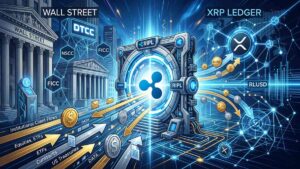
Real‑world asset tokenization on XRPL has surpassed $2.3 billion, yet XRP’s price has fallen 40% in 2026. The thesis that ecosystem growth automatically translates into appreciation of the native token deserves to be revisited: XRPL’s structural design allows institutions to capture its benefits without being exposed to XRP, and that is the real narrative the market has yet to process.
Since January 2026, XRP Ledger has added more than $1.3 billion in tokenized assets. Société Générale has launched its euro stablecoin on the network. Aviva Investors has announced the tokenization of its investment funds. SBI Holdings has issued on‑chain bonds with XRP rewards. The list of institutions choosing XRPL grows every week.
In that same period, XRP has lost 40% of its value against the dollar and 35% against Bitcoin.
The dominant narrative within the community holds that institutional adoption of XRPL will inevitably drive demand for XRP. This thesis, repeated in forums and market analyses, rests on an assumption that the data contradicts: that network usage implies usage of the native token as something more than a marginal fee payer.
Ripple surveyed 1,000+ global finance leaders in 2026. A few things stood out: https://t.co/414dTO9Qit
→ 72% say digital assets are now table stakes to stay competitive
→ 74% see stablecoins as a cash-flow tool, not just a payment rail
→ 89% of those surveyed say digital…— Ripple (@Ripple) March 19, 2026
What we are witnessing is not a temporary market failure, but a structural revelation about how value capture actually works on blockchains designed for institutions.
The data that define the disconnect
Metric 1: Extreme holder concentration
As of March 2026, XRPL has only 22 holders of tokenized assets that concentrate the $2.3 billion in value. The JMWH Energy token, representing $861 million in megawatt‑hours of energy, has 12 holders. This is not a liquid market; it is a record‑keeping system for bilateral institutional transactions using XRPL as settlement infrastructure, not as an open exchange platform.
Metric 2: Stablecoin dominance
Of the $2.3 billion tokenized on XRPL, $1.1 billion corresponds to RLUSD and EURCV, stablecoins denominated in dollars and euros. When institutions like Société Générale tokenize their euro stablecoin, the operation can be carried out without any party needing to hold XRP beyond the fraction of a cent required to pay the transaction fee.
Metric 3: XRP burn has collapsed
The daily volume of XRP burned has dropped 95% since December 2024, from 15,000 XRP per day to a current range of 163 to 750 XRP. Over the entire history of XRPL, only 14 million XRP have been burned, equivalent to 0.014% of total supply. To put it in perspective: even if tokenized asset activity generated a burn rate 100 times higher than today, it would still take decades to create meaningful scarcity.
Metric 4: ODL without proportional growth
The use of XRP for cross‑border payments via On‑Demand Liquidity (ODL), which does generate buy demand for the token, has not shown the same growth as tokenization. ODL volumes remain at levels that do not, on their own, explain sustained buy pressure.
Historical context: why Ethereum is not the model
Those who project onto XRP the same behavior as Ethereum are making an error of analogy. On Ethereum, tokenized assets (ERC‑20s) require ETH for every interaction: transfers, approvals, contract interactions. Network congestion during usage peaks has pushed gas fees above $50, creating forced demand for ETH.
XRP Ledger was designed with a different approach. Its native features — Multi‑Purpose Tokens (MPTs), Clawback, Credentials — allow tokenized assets to operate without the need for complex smart contracts. The network was not conceived to generate scarcity through fees, but to maximize operational efficiency.

This design difference, once a competitive advantage for attracting institutions, has become the Achilles’ heel of the value‑capture thesis. Institutions can deploy billions in assets on XRPL, meet all regulatory requirements, settle transactions in seconds, and do it all with an aggregated XRP cost that barely exceeds a few hundred dollars per day.
The counter‑argument: what do those who hold the opposite thesis say?
There is a valid argument in favor of XRP eventually capturing value from XRPL’s growth, and it deserves consideration.
Argument 1: Native lending protocol (XLS‑66)
Later in 2026, XRPL will incorporate a native lending protocol that will allow XRP to be used as loan principal and as collateral. Evernorth has already announced its intention to use this mechanism to generate institutional yield on its XRP holdings. If this market takes off, it could create significant structural demand for the token.
Argument 2: Permissioned DEX (XLS‑81)
Since February 2026, XRPL has had a decentralized exchange with access controls that allows institutions to trade tokenized assets in KYC/AML‑compliant environments. If these markets use XRP trading pairs, they would generate sustained demand.
Argument 3: Tokenization as a precursor phase
Those who defend the positive thesis argue that the current phase — institutions tokenizing assets on XRPL without using XRP — is only an initial stage. Once tokenized assets reach critical mass and become fractionalized for retail investors, the need for XRP as a bridge asset and collateral will emerge naturally.

These arguments are technically sound, but they depend on two conditions being met: first, that the new protocols (lending, DEX) achieve real adoption; second, that issuers of tokenized assets choose to use XRP as a medium of exchange instead of continuing to operate in stablecoins.
What would invalidate my thesis? If over the next six months we observe that (a) lending volumes in XRP exceed $500 million, (b) at least three of the major RWA issuers incorporate XRP as a trading pair in their products, and (c) ODL volumes consistently exceed $500 million per day, then the current disconnect would indeed be a transitory phase and not a structural feature.
Asset tokenization on XRP Ledger is an undeniable success
But the thesis that this success will translate into XRP appreciation requires a more rigorous examination than it has received. The available evidence suggests that XRPL has achieved what few blockchains have: becoming a financial infrastructure adopted by institutions that value efficiency, regulatory compliance, and low costs. The cost of that design is that the native token can remain relegated to a marginal role in the ecosystem it underpins.

If over the next three months the total tokenized value on XRPL exceeds $5 billion, but (a) the number of RWA holders remains below 100, (b) the percentage of tokenized value denominated in stablecoins stays above 40%, and (c) daily XRP burn volumes do not consistently exceed 5,000 units, then the disconnect between network adoption and token value will have consolidated as a structural, not transitory, feature.
The relevant question for those evaluating XRP is not whether XRPL will continue to grow — it will — but under what conditions that growth will generate demand for the native token. Until those conditions materialize, the narrative of automatic value capture remains an untested hypothesis, sustained by incorrect analogies to other networks and not by the network’s own data.