TL;DR:
- Bittensor sets a new record: the aggregate value of its subnet tokens reached 27% of TAO’s market capitalization.
- Yuma’s annual report, from DCG subsidiary, documents more than 120 active subnets with real use cases in artificial intelligence.
- After the network’s first halving in December, the TSP rebounded to 1.18, signaling greater value flow toward ecosystem subnets.
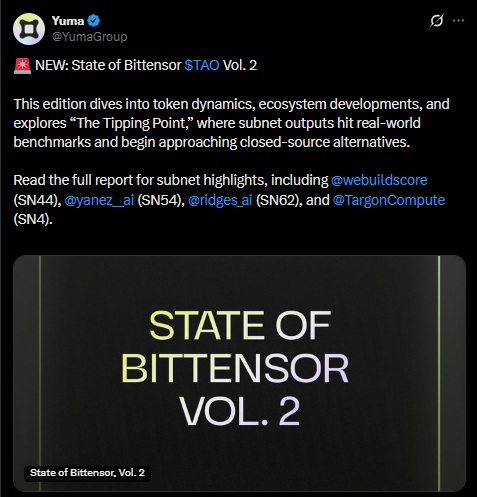
Bittensor completed its first halving in December 2025 and published its second annual report, “State of Bittensor,” through Yuma, the Digital Currency Group subsidiary focused on accelerating the network’s adoption. The document reveals that the aggregate value of all subnet tokens reached a record 27% of the market capitalization of the TAO token, a sign of maturation within the decentralized artificial intelligence ecosystem.
Yuma Asset Management, launched in late 2025 with a $10 million anchor contribution from DCG, offers composite funds that invest in subnet tokens —known as “alpha tokens“— as an alternative to direct TAO staking. Since its launch on September 4, the Composite Fund fell 31.9%, while the price of TAO declined 46.1% over the same period. The fund outperformed TAO staking returns, which the report describes as “the first investable alternative to TAO staking available on the market.”
Bittensor: The Subnet Ecosystem Scales and Diversifies
The network now hosts more than 120 active subnets. Among the most notable are Ridges, a code generation tool comparable to Claude Code; Score, a computer vision project capable of processing raw video streams; and Targon, which offers access to H200 GPU computing at $2 per hour. Reading Football Club uses Manako, Score’s video intelligence product, to process match data. Yanez Compliance, another subnet, provides a financial crime prevention scanner with a multimillion-dollar client base.
The Total Subnets Price indicator, which measures the cumulative value of subnets denominated in Bittensor, rebounded to 1.18 following the halving in December, when TAO’s daily issuance was cut from 7,200 to 3,600 tokens. The top 20% of subnets currently capture 55% of the TSP, a share lower than the 82% recorded following the introduction of alpha tokens in February 2025, which indicates growing economic diversification across subnets.
Toward a New Governance Model
“It’s still early, but we are seeing the first signals of this value flow toward subnet tokens, which are becoming something more than simple network incentives,” wrote Barry Silbert, chief executive officer of DCG.
Looking ahead to the first half of 2026, Bittensor plans to implement a governance upgrade that will allow validators and subnet owners to vote on future protocol changes. The network has also begun transitioning away from its Proof of Authority consensus model toward the more democratic Nominated Proof of Stake.