TL;DR
- Polymarket filed a federal lawsuit against Massachusetts, arguing that the CFTC has exclusive authority over event-based contracts.
- Other states, such as Nevada, are also taking action against similar platforms, and Coinbase is litigating over comparable products.
- Courts are showing divergent rulings; in Tennessee, a state order against Kalshi was temporarily blocked.
Polymarket filed a federal lawsuit against the state of Massachusetts as conflicts between prediction market platforms and state gaming regulators in the United States continue. The action aims to determine who has the authority to oversee event-based contracts, particularly those linked to sports outcomes.
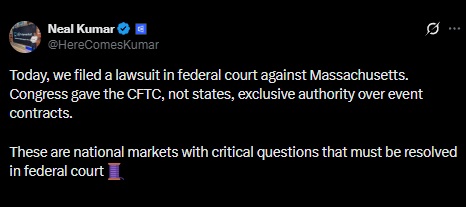
The company argues that Congress granted exclusive authority over these types of contracts to the U.S. Commodity Futures Trading Commission (CFTC). According to Polymarket, states do not have the power to impose licensing or restrictions under local gambling laws when it comes to federally regulated derivatives. The lawsuit was filed in a federal court and is based on the argument that prediction markets operate as national markets, not as state gambling products.

Kalshi, Polymarket, and Other Affected Platforms
The conflict escalated following a decision by the state of Massachusetts. A state judge ruled that Kalshi, a competing platform, cannot allow state residents to trade contracts linked to sports events without a local gaming license. The ruling aligned with the position of Attorney General Andrea Joy Campbell, who classified those contracts as unlicensed sports betting. Subsequently, the court denied Kalshi’s request to pause the order while the appeal proceeds and granted a 30-day period for compliance.
Massachusetts is not the only state involved in this legal push. In Nevada, regulators also targeted Kalshi, Polymarket, and other platforms offering sports-linked contracts. Additionally, Coinbase is facing litigation over similar products, indicating that the conflict has expanded beyond platforms specialized in prediction markets.

Regulators Fail to Align
The judicial system shows divergent rulings. In January, a federal judge temporarily blocked a cease-and-desist order issued by the state of Tennessee against Kalshi. The measure was adopted while the court evaluates whether federal commodities law preempts state gambling regulations. That precedent contrasts with the actions taken in Massachusetts.
Platforms maintain that their contracts qualify as financial derivatives supervised by the CFTC and are therefore outside the scope of state gambling laws. States, on the other hand, seek to treat them as gambling products subject to local licensing.
The litigation progresses alongside federal regulatory changes. In early February, the CFTC withdrew a Biden-era proposal that aimed to ban certain political contracts and removed guidance related to sports-linked contracts