TL;DR
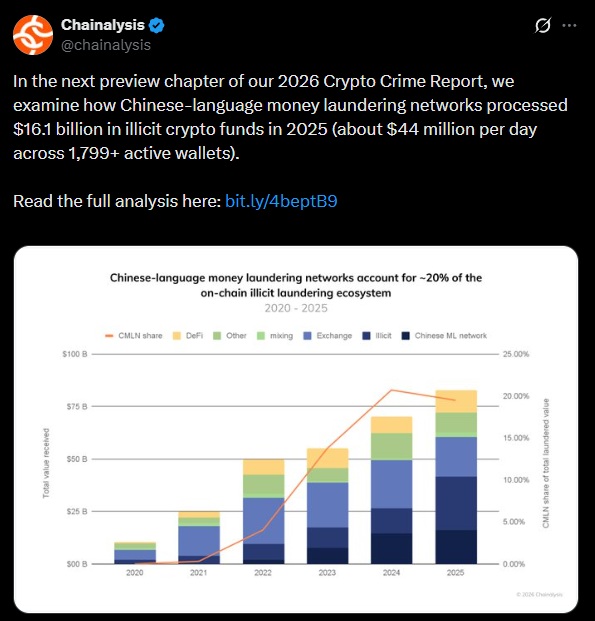
- Chinese-language crypto networks accounted for nearly 20% of global money laundering in 2025, moving more than $16 billion, according to Chainalysis.
- During 2025, these structures handled around $44 million per day through roughly 1,800 wallets, operating via Telegram and guarantee platforms with escrow-style custody.
- Platforms such as Huione and Xinbi underpin these flows and play a central role in the operations.
Chinese-language crypto money laundering networks accounted for close to 20% of all illicit activity recorded in 2025, according to a report published by Chainalysis. Total crypto laundering volume for the year reached approximately $82 billion, with more than $16 billion flowing through these structures.
Throughout 2025, these networks processed an average of about $44 million per day across roughly 1,800 active wallets. Activity was channeled mainly through Telegram and affiliated platforms known as guarantee platforms, which operate as marketplaces using escrow-style custody to exchange illicitly sourced funds.
Chainalysis: Crypto Scams Are Becoming Harder to Trace
Among the main nodes in the ecosystem are platforms such as Huione and Xinbi. These infrastructures facilitate intermediation between buyers and sellers of illegally obtained crypto assets. According to Chainalysis, enforcement actions have succeeded in disrupting some of these hubs, but users typically migrate quickly to alternative channels without causing lasting reductions in overall activity.
The report notes that the expansion of these networks has far outpaced the growth of laundering routed through centralized exchanges or DeFi protocols. Over the past five years, the scale of these structures has increased steadily, establishing a specialized circuit that operates in parallel to the regulated financial system.

Structural Issues in the Crypto Industry
Chainalysis attributes this pattern to a combination of structural factors. These include nationally defined legal frameworks, jurisdictional barriers, limited information sharing between authorities, and constrained capabilities for on-chain tracing and asset recovery. Together, these conditions allow cross-border operations to persist with relatively low friction.
The report also warns of changes in the techniques used by the actors involved. In early 2026, Chainalysis noted that crypto scams are becoming increasingly difficult to trace due to greater use of decentralized exchanges and cross-chain bridges. These tools allow funds to be fragmented and moved across networks, complicating the identification of their origin