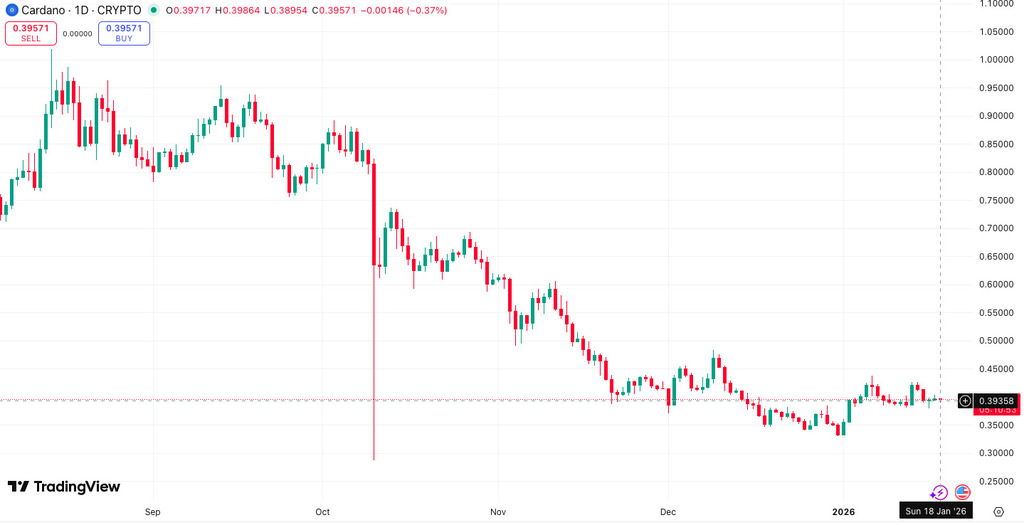
For years, Cardano (ADA) has been recognized as one of the most research-driven blockchain networks in the industry. Its peer-reviewed development approach and emphasis on long-term scalability have earned it a strong reputation. However, despite these credentials, ADA’s market performance has remained constrained, with the price hovering near the $0.39 range while newer projects explore more direct real-world applications.
As the digital asset space matures, attention is increasingly shifting from theoretical capability to measurable utility. In this context, Digitap ($TAP) is emerging with a different approach, focusing on bridging blockchain infrastructure with everyday financial activity through a unified banking framework.
Cardano (ADA) at $0.39: Stability With Limited Near-Term Expansion
Cardano’s recent price behavior highlights a period of prolonged consolidation. For an extended timeframe, ADA has moved within a narrow band, suggesting reduced volatility and a strong equilibrium between buyers and sellers. While this stability appeals to long-term holders, it also limits short-term growth expectations.
From a technical perspective, a significant portion of the circulating supply was acquired at higher historical price levels. This creates persistent overhead resistance whenever the asset attempts to move upward. As a result, momentum has remained muted despite broader market fluctuations.
In terms of utility, Cardano continues to serve developers, validators, and staking participants effectively. However, for non-technical users, its practical role in daily financial activity remains limited. Tokens largely circulate within the ecosystem rather than being used directly for payments or consumer transactions. As efficiency and usability become more important in 2026, this constraint may continue to cap upside potential.
Digitap’s Omni-Banking Framework: Connecting Crypto and Everyday Finance
Digitap approaches the market from a different angle. Instead of focusing primarily on smart contract infrastructure, it aims to unify decentralized finance and traditional financial services into a single user-facing platform.
Through its Omni-Banking Protocol, Digitap allows users to manage digital assets and fiat-related financial activities from one interface while maintaining self-custody. This structure is designed to reduce friction between wallets, exchanges, and traditional banking tools, streamlining how users interact with their funds.

By minimizing the need for asset transfers across multiple platforms, Digitap emphasizes convenience, transparency, and cost efficiency. The result is a system where blockchain-based assets can be integrated into everyday financial routines rather than remaining isolated within crypto-native environments.
User-Centric Design Over Technical Narratives
Cardano’s ecosystem remains highly technical by design, prioritizing robustness and long-term research goals. While this approach has merit, it primarily serves users who are already familiar with blockchain mechanics.
Digitap, by contrast, focuses on accessibility. Its card-linked payment functionality enables users to spend digital assets for common expenses such as subscriptions, retail purchases, or cross-border payments. This emphasis on usability broadens the potential audience to include freelancers, remote workers, and individuals in regions with limited access to traditional banking services.
By positioning itself as a financial application rather than a purely technical blockchain platform, Digitap aligns more closely with users seeking practical functionality rather than infrastructure experimentation.
Token Models: Inflationary Rewards vs. Revenue-Linked Mechanics
Differences between the two projects also extend to token economics. Cardano utilizes an inflation-based staking model, where new ADA is issued continuously to reward network participation. While this supports network security, it introduces ongoing supply expansion that must be offset by sustained demand.
Digitap employs a revenue-linked structure. Platform income generated through transactions, card usage, swaps, and subscription services is partially allocated to token buybacks and burns. This model ties token dynamics to actual platform usage rather than issuance alone.
As activity increases, circulating supply may gradually decrease, aligning token behavior with real economic participation. This approach reflects a broader trend toward utility-backed digital assets.
A Utility-Oriented Perspective for 2026
Cardano remains an established and resilient blockchain network, offering long-term stability and a strong technical foundation. However, its scale and maturity naturally limit the speed at which its valuation can change.
Digitap represents an earlier-stage project centered on financial utility and user experience. Its focus on integrating crypto into everyday transactions addresses a persistent gap in the ecosystem and reflects evolving market priorities.
For observers evaluating digital assets through the lens of functionality rather than legacy positioning, Digitap illustrates how application-driven platforms may gain relevance as the market continues to evolve.

Learn More About Digitap
-
Presale: https://presale.digitap.app
-
Website: https://digitap.app
-
Social Links: https://linktr.ee/digitap.app
This article contains information about a cryptocurrency presale. Crypto Economy is not associated with the project. As with any initiative within the crypto ecosystem, we encourage users to do their own research before participating, carefully considering both the potential and the risks involved. This content is for informational purposes only and does not constitute investment advice.