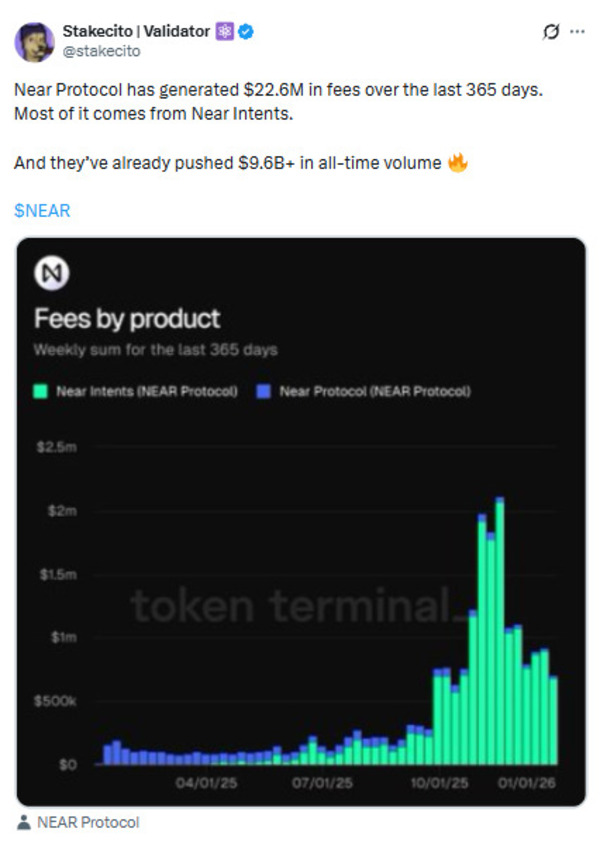
As the cryptocurrency market moves through January 2026, price volatility and infrastructure-focused development remain central to market discussions. NEAR Protocol (NEAR) has recently recorded a brief upward price movement before stabilizing near resistance levels, reflecting continued uncertainty across Layer-1 assets.
At the same time, Zero Knowledge Proof (ZKP) is attracting attention for reasons unrelated to short-term price action. The project is being discussed primarily for its hardware-supported approach to verifiable computation, which represents a different direction compared to many software-only blockchain initiatives.
NEAR Records a Short-Term Price Increase Before Consolidation
NEAR experienced a same-day price increase of approximately 5.7%, reaching highs near $1.73 before retracing part of the move. Following the initial rise, selling pressure emerged, pushing the asset back toward the $1.68–$1.70 range.
Market data from the session reflected mixed signals:
- Intraday movement: Approximately +5.7% at peak
- Trading volume: Roughly 47% above the 30-day average
- Price range: Around $0.11, representing moderate volatility
- Relative performance: Lagged broader crypto benchmarks
The price movement appeared driven by short-term positioning rather than sustained accumulation, suggesting that broader market conviction remains limited.
Technical Levels Continue to Define NEAR’s Trading Range
Support and Resistance Overview
From a technical perspective, NEAR continues to trade within a defined range:
- Primary support: $1.66–$1.67
- Near-term support: $1.71–$1.72
- Immediate resistance: $1.73–$1.74
- Upper range boundary: $1.74–$1.76
Repeated pullbacks near resistance indicate consolidation rather than a confirmed trend shift. Until price action establishes consistent closes above resistance with sustained volume, NEAR remains classified as range-bound by many market observers.
ZKP Draws Attention With a Hardware-Supported System Design
While NEAR’s discussion centers on short-term price behavior, Zero Knowledge Proof (ZKP) is being evaluated through a different lens. The project is focused on developing infrastructure that combines cryptographic verification with dedicated physical hardware.
Rather than relying solely on software-based execution, ZKP integrates hardware components designed to support verifiable computation. These devices generate cryptographic proofs confirming that specific workloads were executed correctly, without revealing the underlying data involved.
This approach embeds privacy and verification directly into execution, rather than treating them as secondary layers.
Hardware-Based Infrastructure as a Differentiator
Why Hardware Matters in Verifiable Computation
ZKP’s hardware-supported model addresses several structural challenges:
- Verifiable execution: Computation results can be proven without data exposure
- Infrastructure-backed design: Physical devices support system integrity
- Reduced reliance on assumptions: Verification is tied to execution, not promises
- Privacy-first architecture: Sensitive data remains protected
This framework is being discussed in relation to use cases involving data-sensitive computation, artificial intelligence workloads, and privacy-preserving verification systems.
Market Attention Shifts Toward Infrastructure Readiness
As the digital asset sector matures, market participants are increasingly examining whether projects demonstrate operational readiness rather than focusing exclusively on speculative narratives.
ZKP’s emphasis on hardware deployment introduces higher costs and complexity, but it also signals a longer-term infrastructure commitment. This focus has positioned the project within broader discussions around blockchain systems designed for verifiable execution rather than short-term market momentum.
Broader Market Perspective for Early 2026
NEAR’s recent price movement illustrates how quickly momentum can emerge and fade in the absence of broader confirmation. Despite short-term strength, technical resistance and moderate volume suggest continued consolidation.
In contrast, ZKP’s visibility stems from system architecture rather than price action. By linking computation to physical infrastructure and cryptographic verification, the project occupies a different category from many early-stage blockchain initiatives. As market scrutiny increases in 2026, infrastructure-driven development is becoming a key factor in how projects are evaluated.
Frequently Asked Questions
Why did NEAR experience a short-term price increase?
The movement coincided with elevated trading activity but lacked sustained follow-through, leading to consolidation near resistance levels.
Is NEAR breaking out of its trading range?
Current price behavior suggests NEAR remains range-bound, with resistance near $1.73–$1.74 continuing to limit upside movement.
What does “hardware-supported” mean in ZKP’s context?
It refers to the use of dedicated physical devices that support verifiable computation and generate cryptographic proofs, rather than relying exclusively on software execution.
Why is ZKP being discussed in infrastructure-focused conversations?
Its emphasis on hardware-backed verification and privacy-preserving execution differentiates it from many software-only blockchain projects.
Additional Information
Website: https://zkp.com/
Auction: https://auction.zkp.com/
X: https://x.com/ZKPofficial
Telegram: https://t.me/ZKPofficial
This article contains information about a cryptocurrency presale. Crypto Economy is not associated with the project. As with any initiative within the crypto ecosystem, we encourage users to do their own research before participating, carefully considering both the potential and the risks involved. This content is for informational purposes only and does not constitute investment advice.