TL;DR
- Vitalik Buterin argued that Ethereum’s base layer should operate like BitTorrent: a decentralized foundation that preserves its structure while scaling globally.
- According to Vitalik, Ethereum’s base layer must remain open and accessible to individuals, companies, and public institutions, without intermediaries and without reliance on commercial products.
- Linux’s segmentation model can be compared to Ethereum’s: a stable and conservative core at the base layer, while everything else adapts without altering the fundamentals.
Vitalik Buterin presented a long-term vision for Ethereum built around two specific references: BitTorrent and Linux. He shared his views on X, focusing on the role of the base layer as public, open, and accessible infrastructure. He also addressed global adoption and institutional use.
Buterin cited BitTorrent as an example of a decentralized network that preserved its original structure and continues to operate at large scale. He noted that the protocol retains its peer-to-peer design and serves millions of users worldwide. He also pointed out that companies and public institutions use BitTorrent to distribute large files. He stated that Ethereum’s goal is to replicate that approach applied to consensus and verification, not to data exchange.
According to Buterin, this model requires Ethereum’s base layer to remain stable, open, and directly accessible. The network must allow individuals, companies, and public institutions to interact without centralized intermediaries, even as on-chain activity continues to grow. The focus must stay on the base layer, not on commercial products or derivative solutions.
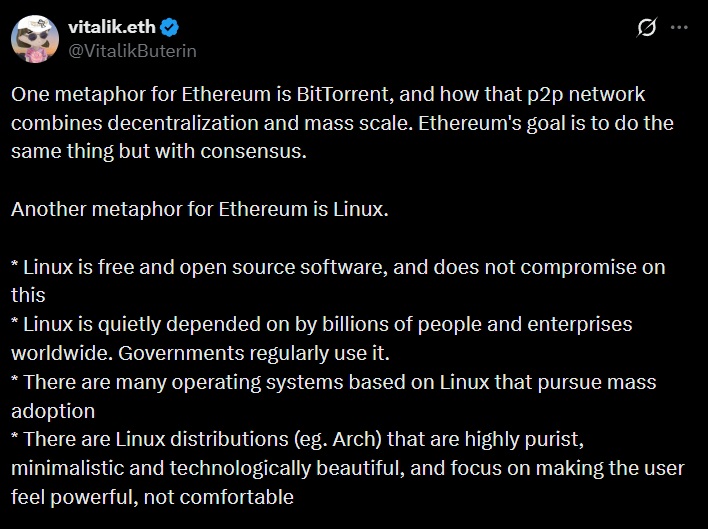
Parallels Between Ethereum and Linux
The second axis focused on Linux. Buterin described the operating system as an open foundation that supports a significant portion of global digital infrastructure. He recalled that Linux is used by companies and governments across servers, critical systems, and embedded devices. He also highlighted the coexistence of multiple distributions, ranging from general-purpose versions to technical and minimalist variants, all built on the same core.
This structure can be applied to Ethereum through a clear separation of functions. The base layer preserves conservative and stable rules. Upper layers, such as wallets, rollups, and applications, can adapt to different operational, regulatory, or user experience requirements without modifying the core protocol.

Buterin: Ethereum Should Not Depend on a Company or Centralized Provider
Buterin defined Ethereum as a foundational layer for finance, digital identity, governance, and social tools. In his view, full access to the network should not depend on any single company or specific provider. In corporate environments, he described “trustless” systems as suitable mechanisms to limit counterparty risk and operational fragility.
This approach spans everything from the development of scaling solutions through rollups to improvements in data availability. Even so, he emphasized that base layer decentralization must continue to be treated as a fixed technical criterion