TLDR:
- The STRC product sparks debate by promising an 11% monthly dividend, challenging conventional risk metrics.
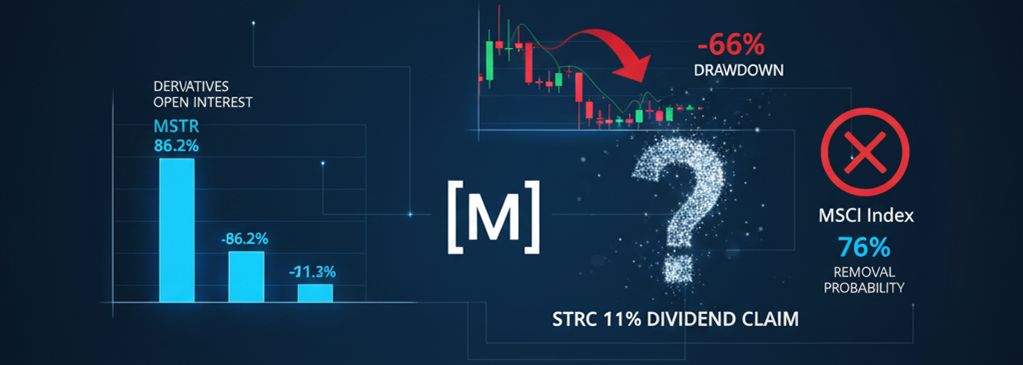
- The probability of MSTR being removed from the MSCI index rises to 76% on Polymarket following a 66% drop in its price.
- MicroStrategy records a derivatives open interest of 86.2% relative to its market cap, far surpassing giants like Tesla.
High volatility and media scrutiny face those who decide to invest in MicroStrategy MSTR. This week, attention focused on the new investment vehicle STRC, linked to Michael Saylor’s strategy, which promotes an unusual 11% monthly cash dividend. While supporters claim the company’s balance sheet can support these payments for years without relying on refinancing, critics question the legitimacy and origin of such cash flows.
In this regard, Adam Livingston argues that STRC is being unfairly valued as “junk credit.” He asserts that this asset offers superior security compared to government bonds, which depend on persistent deficits, while STRC relies on a digital asset structure that does not depend on traditional economic growth. However, skepticism prevails on Wall Street, where double-digit yields are typically seen as red flags.
Index Uncertainty When Investing in MicroStrategy MSTR
Pressure on the company comes not only from its yield products but also from its institutional status. Data from Polymarket reveals that traders see a 76% probability of MicroStrategy being removed from the MSCI index by March 31. This increase in exclusion odds coincides with a 66% plunge in the stock’s value over the last six months, dropping from approximately $457 to $152.
Despite the setback, Saylor insists that “Bitcoin makes $MSTR interesting,” highlighting that the appeal of investing in MicroStrategy MSTR lies in its direct exposure to the world’s largest digital asset. Nevertheless, activity in the derivatives market suggests extreme speculation: MSTR’s open interest relative to its market capitalization reaches 86.2%, a massive figure compared to Tesla’s 22% or Nvidia’s 7.2%.
In summary, the start of 2026 presents a complex scenario. Between the promise of disruptive dividends and the threat of losing relevance in traditional indices, investors must carefully weigh the risks before increasing their exposure to this crypto treasury giant.