TLDR
- Transaction volume quadrupled from the previous year, jumping from $2.17 billion to a record-breaking figure.
- Coinbase’s $2.9 billion acquisition of Deribit led the market consolidation efforts.
- The Trump administration’s favorable regulatory framework, including the GENIUS Act, served as the sector’s main engine.
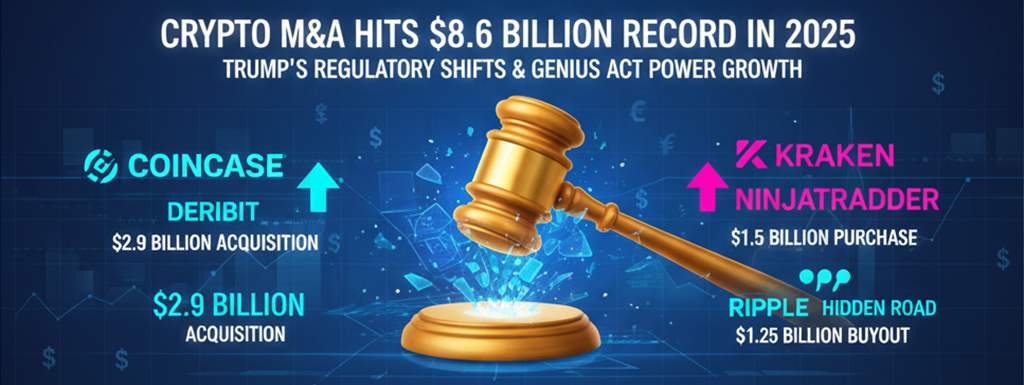
2025 has been an unprecedented year for the digital asset industry in terms of corporate consolidation. Data from the Financial Times indicate that the sector register $8.6 billion in total deal volume, positioning 2025 crypto M&A as the most active period in history.
This represents staggering growth when compared to the $2.17 billion recorded in 2024. Industry giants led the buying frenzy this year; for instance,
Coinbase was the protagonist of the year’s largest operation with the purchase of Deribit for $2.9 billion, significantly expanding its dominance in the derivatives market.
This was followed by Kraken, with the acquisition of NinjaTrader for $1.50 billion, and Ripple, which disbursed $1.25 billion to absorb Hidden Road.
The Trump Factor and the GENIUS Act as Catalysts
This explosive increase in deal activity is no coincidence; it responds to a radical shift in Washington’s policy. The Trump administration has actively supported the sector through a series of regulatory developments that have restored confidence among institutional investors.
The GENIUS Act has been a fundamental pillar of this turnaround. This federal legal framework for stablecoins has paved the way for traditional financial institutions to settle tokenized assets with full legal certainty. Thanks to this favorable environment, 2025 crypto M&A activities have allowed companies to not only grow in size but also integrate critical infrastructure for the next phase of mass adoption.9
In summary, with regulatory clarity finally on the table, the market has moved from a state of survival to one of aggressive expansion. Analysts suggest that this $8.6 billion record is only the beginning of a total reconfiguration of the digital financial map, where the union between traditional finance and blockchain technology is now both a legal and corporate reality.