TL;DR
- Fragmentation across blockchains is already draining between $600 million and $1.3 billion per year due to price divergences, operational frictions, and immobilized capital.
- Each blockchain operates as a silo where liquidity gets trapped, arbitrage fails to correct 1% to 3% spreads, and moving assets costs more than the price difference itself.
- RWA.io projects a $16 trillion to $30 trillion market by 2030; maintaining current frictions implies annual losses of up to $75 billion.
Fragmentation across blockchains already carries a visible economic cost for the tokenized asset market. A report by RWA.io estimates that current inefficiencies drain between $600 million and $1.3 billion annually. This figure comes from an analysis of divergent prices, operational frictions, and capital locked across networks that do not communicate with each other.
The problem is not tokenization itself, but the architecture surrounding it. Each blockchain functions as a silo. Liquidity remains trapped within its own perimeter, and capital does not circulate continuously. The result is a market that replicates the same asset in multiple versions, each priced differently depending on the network where it operates.

The Average Loss Reaches 3.5%
The report identifies persistent spreads of 1% to 3% between economically identical assets issued on different blockchains. In traditional markets, those differences disappear quickly through arbitrage. In the onchain market, that correction does not occur. Technical costs, fees, delays, and operational risks outweigh the potential benefit. Moving an asset to capture the spread often costs more than the spread itself.
RWA.io calculates that transferring capital between non-interoperable blockchains generates losses of 2% to 5% per transaction. Exchange fees, slippage, transfer costs, gas fees, and timing risks explain that deterioration. The modeled average stands near 3.5% per capital reallocation, a meaningful figure for any financial market.
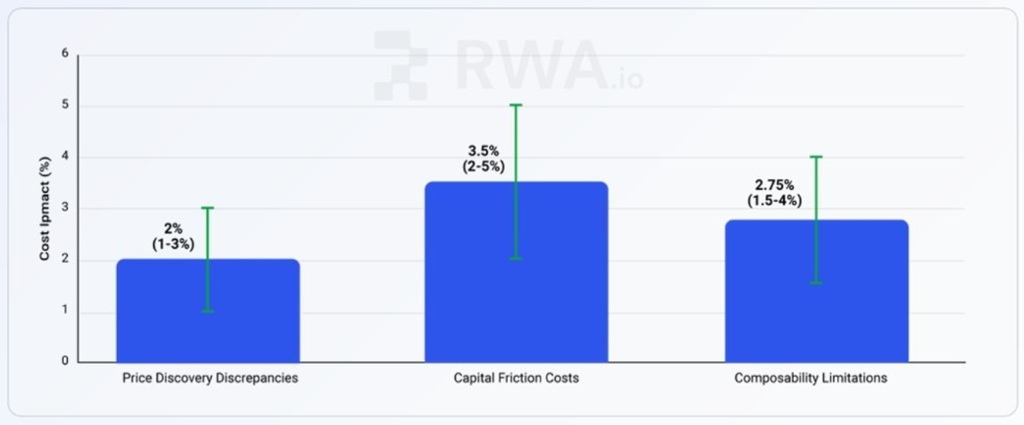
Potential Future Losses from Fragmentation
At the current scale, these frictions explain the annual value drain. Looking ahead, the impact grows proportionally. RWA.io projects a tokenized real-world asset market of between $16 trillion and $30 trillion by 2030. Applying today’s inefficiencies to that volume implies potential annual losses of between $30 billion and $75 billion. Fragmentation thus shifts from a technical issue to a structural limit on growth.
Marko Vidrih, co-founder and COO of RWA.io, argues that this fragmentation represents the main obstacle preventing the market from reaching its multi-trillion-dollar potential. The contrast is clear: traditional systems such as SEPA Instant allow value to move between accounts in seconds, while tokenization reproduces barriers that already exist outside the crypto world.
Despite this, adoption continues. Crypto platforms and traditional financial firms are moving aggressively into the tokenization of equities and other instruments. The market keeps expanding, but it does so while carrying an inefficiency that erodes its real economic performance. Solving fragmentation is no longer a minor technical detail. It is a requirement for tokenization to function as a financial system rather than a collection of isolated markets