
TL;DR
- Florida obtained a court order to seize a wallet holding about $1.5 million after tracing a local complaint tied to an alleged investment scam.
- Prosecutors linked the funds to Tu Weizhi, a Chinese national accused of money laundering and fraud who remains outside the country.
- The state applied the fugitive disentitlement doctrine to move forward with the cryptocurrency seizure.
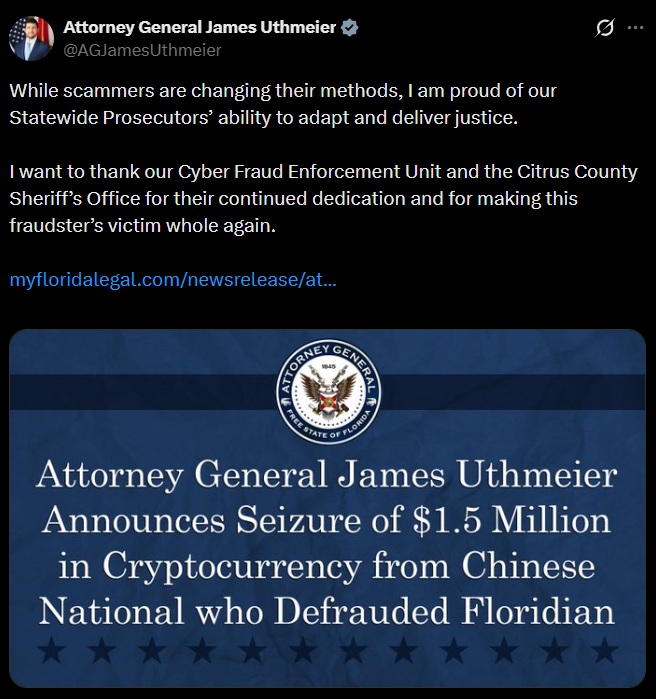
The state of Florida seized nearly $1.5 million in cryptocurrencies tied to an alleged investment scam after tracing funds that ended up in a wallet controlled by a Chinese national.
The action was carried out by state prosecutors using a fugitive disentitlement statute, a legal tool designed for situations where a suspect remains outside the jurisdiction and avoids appearing to face charges.
The Entire Wallet Was Seized
The investigation began in July 2024, when a Citrus County resident reported losing $47,421 after sending money to what appeared to be an online investment opportunity. Prosecutors followed the trail to a wallet that held several digital assets, including AVAX (Avalanche), DOGE (Dogecoin), PEPE (Pepe), and SOL (Solana). Beyond the initial loss reported by the victim, investigators requested a warrant to seize the entire balance of the wallet, which prosecutors valued at approximately $1.5 million.
Florida Attorney General James Uthmeier said that the Office of Statewide Prosecution’s Cyber Fraud Enforcement Unit obtained the court order and is adapting to constantly evolving scam tactics. Authorities stated that Tu Weizhi, the alleged owner of the wallet, now faces charges of money laundering, grand theft, and an organized scheme to defraud. Tu is believed to be in China and, according to officials, will be arrested if he attempts to enter the United States.
The seizure relied on the fugitive disentitlement statute, a doctrine that allows courts to move against assets tied to a criminal case when the defendant refuses to appear in the jurisdiction and therefore forfeits certain procedural rights. In practical terms, it means the suspect cannot use Florida’s courts to contest the forfeiture unless he returns to face the charges, which would result in immediate arrest.

Florida Records Other Similar Cases Across Multiple Counties
Crypto industry experts noted that this is not the first time traditional forfeiture laws have been applied to digital assets, but it shows how these doctrines now extend more comfortably into the crypto world thanks to the transparency and traceability of public blockchains. In Florida, there are already other precedents of similar forfeiture actions across different counties.
According to the FTC, more than $12 billion in losses were recorded in 2024. Investment schemes accounted for a significant share of that figure, and the FBI reported about $9.3 billion in crypto-related losses.