TL;DR
- Ostium closed a $24 million round that accelerates a plan aimed at moving retail trading toward a transparent, self-custodied execution model.
- The company secured a $20 million Series A and a $4 million strategic round, bringing total funding to $27.8 million.
- The Arbitrum-based platform uses direct price feeds from external venues and captures more than 95% of open interest in RWAs.
Ostium closed a $24 million round and is accelerating a plan to shift global retail trading toward a transparent, self-custodied execution model.
The raise includes a $20 million Series A led by General Catalyst and Jump Crypto, plus a previously completed $4 million strategic round that brings total funding to $27.8 million and places the company’s valuation near $250 million. The new capital is meant to meet demand for perpetual exposure to traditional assets and enable structures that pull off-chain liquidity into a verifiable on-chain environment.
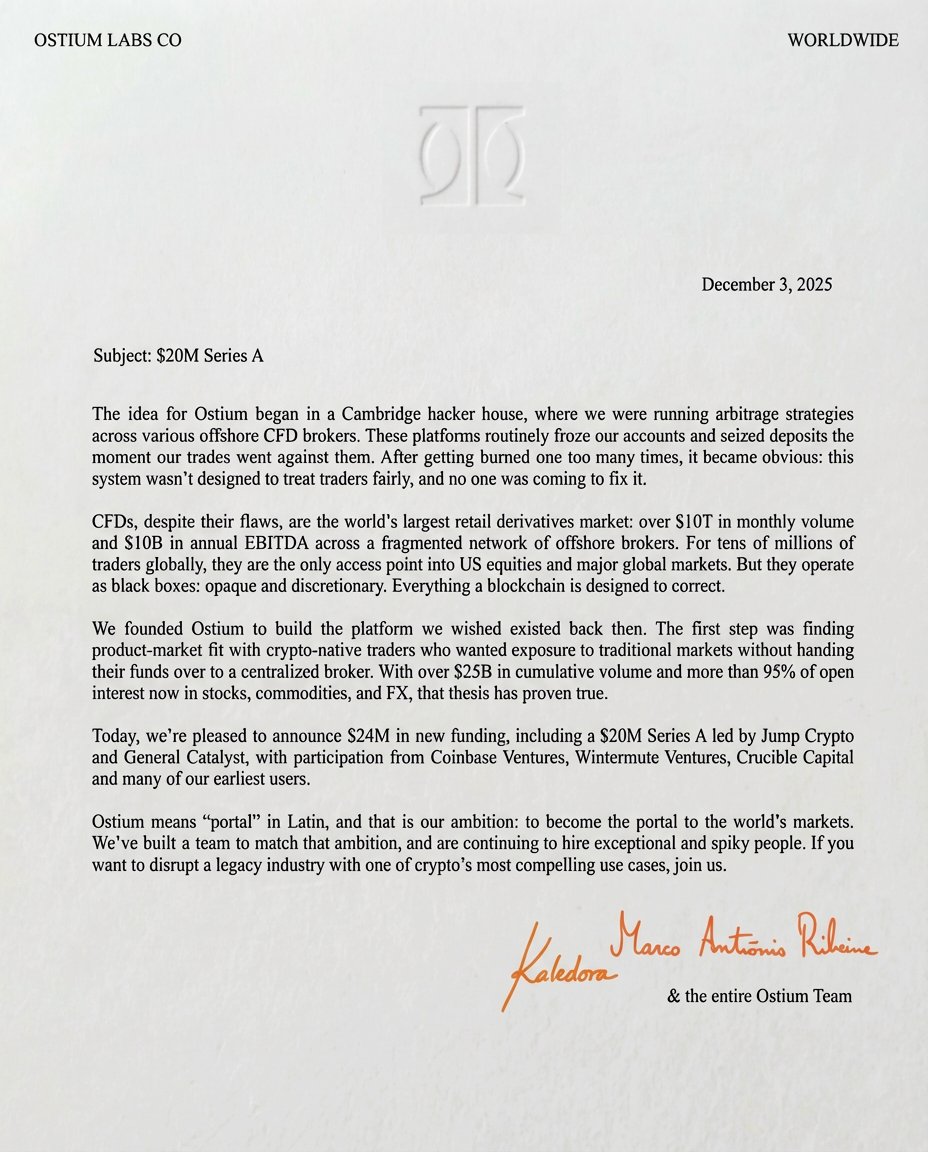
Ostium runs on Arbitrum and offers perpetual futures on stocks, commodities, indices, and FX through a quote-based model that sources prices from external venues. The team says this architecture avoids recreating fragmented markets inside Ethereum and cuts execution times, unexpected spread swings, and unpredictable costs for retail users. Ostium has processed $25B in cumulative volume, including $5B in metals, and more than 95% of current open interest is concentrated in real-world assets. During the most recent gold rally, the platform accounted for more than half of all on-chain gold perpetuals open interest.
Ostium Seeks to Replace Offshore Brokers With Smart Contracts
Founders Kaledora Kiernan-Linn and Marco Antonio Ribeiro argue that the global CFD market is still tied to intermediaries that control pricing, liquidations, and withdrawals. Their thesis is that this setup can be replaced with segregated contracts and real-time auditing. The immediate goal is to bring this model to non-U.S. markets, where thousands of investors rely on offshore brokers with inconsistent execution. In Ostium’s framework, funds remain in segregated smart contracts and every trade is recorded without opaque layers or discretionary permissions.

General Catalyst and Jump Crypto emphasize that Ostium’s core advantage lies in using the liquidity that already powers traditional markets and channeling it into an on-chain flow with clear rules. Other backers, including Coinbase Ventures, Wintermute, GSR, and angels from Bridgewater and Brevan Howard, see room to broaden asset coverage and scale infrastructure with the new capital.
Ostium’s trajectory reflects an active year for crypto venture capital. Between January and September, the sector raised more than $11.4B, with a growing share going to trading platforms, DeFi infrastructure, and tokenization initiatives