TL;DR
- Ethereum will activate the Fusaka upgrade tomorrow, which increases rollup capacity, doubles the block gas limit, and adds native support for passkey-style signatures.
- PeerDAS (EIP-7694) allows nodes to verify blob data through sampling, removing bottlenecks and potentially increasing blob throughput by nearly ten times over time.
- The upgrade includes security and developer-focused EIPs (7823, 7825, 7883, 7934, 7939, 7917, 7951) and will be rolled out gradually.
Ethereum will activate its Fusaka upgrade tomorrow, the most significant since blobs were introduced in March 2024. The update aims to boost rollup capacity, improve the gas market, and add native passkey-style signature support, enabling the network to process more transactions without proportional fee increases.
The Most Significant Upgrade Since the Introduction of Blobs
The core change centers on PeerDAS, defined in EIP-7694, which lets nodes verify blob data existence by sampling small fragments rather than downloading the entire blob. This eliminates a scalability bottleneck introduced by EIP-4844 and opens the possibility of increasing blob throughput nearly tenfold over time.

Fusaka also doubles the block gas limit from 30 million to 60 million, providing more room for standard transactions and blob processing. Additionally, two follow-up forks, BPO1 on December 9 and BPO2 on January 7, will adjust blob parameters without additional code changes, further expanding capacity.
The blob fee market will be restructured via EIP-7918, which links the minimum blob base fee to execution gas. This prevents blob prices from collapsing while L1 gas remains high, keeping the data-availability market economically rational even amid usage fluctuations.
Security and Network Predictability Enhancements
Ethereum will implement several additional EIPs to strengthen network security and predictability. EIPs 7823, 7825, 7883, and 7934 limit ModExp input sizes, raise its gas cost, impose a transaction gas limit, and enforce an RLP block size cap, reducing attack surfaces and making worst-case client workloads more predictable.

For developers, EIP-7939 adds a leading-zeros opcode, facilitating bitwise operations, integer logarithms, and randomness generation. EIP-7917 establishes a deterministic block-proposer schedule, improving coordination for MEV relays and staking operators. EIP-7951 introduces a native precompile for the secp256r1 curve, used by Apple Secure Enclave, Android Keystore, and WebAuthn, enabling biometric authentication without bridges or external circuits.
Ethereum will roll out the upgrade gradually: Fusaka activates on December 3, BPO1 six days later, and BPO2 on January 7. There are no changes to staking incentives or consensus; all modifications target execution-layer throughput, gas mechanics, and developer primitives.
Ethereum Climbs 10% Ahead of Fusaka
With Fusaka, Ethereum is set to handle increased rollup activity without proportional fee increases while providing new tools for on-chain computation and user experience.
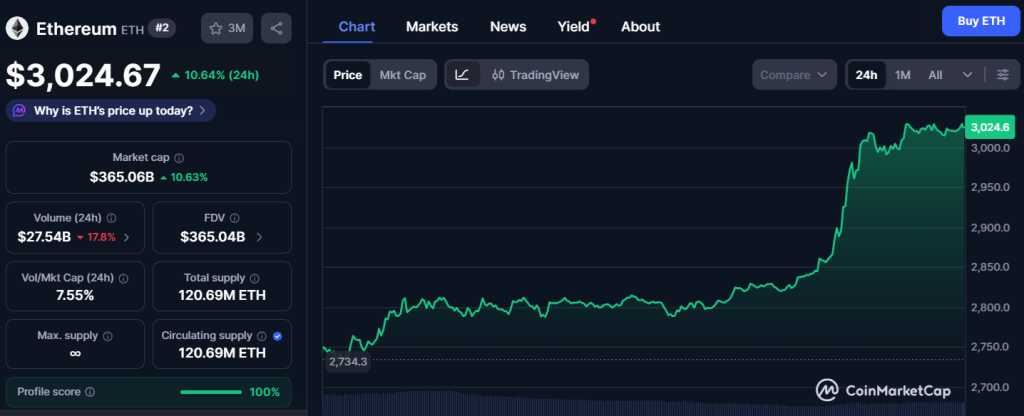
At the time of writing, Ethereum (ETH) trades at $3,024, up over 10% in the previous session. However, its volume is down 18% compared to yesterday, though it still exceeds $27.5 billion. Market reactions to Fusaka will become clearer tomorrow and in the following days