

Meme-coin markets can move quickly, with sentiment often shifting on social media and short-term trading activity. Some tokens hold attention through community activity, while others cool off after an initial spike.
Over the last 24 hours, Peanut the Squirrel has slipped by 0.25%, cooling off after last week’s mini-rally. Meanwhile, Keyboard Cats is down 0.57% over the same period and has been testing nearby resistance levels. Market participants will be watching to see whether either token regains momentum.
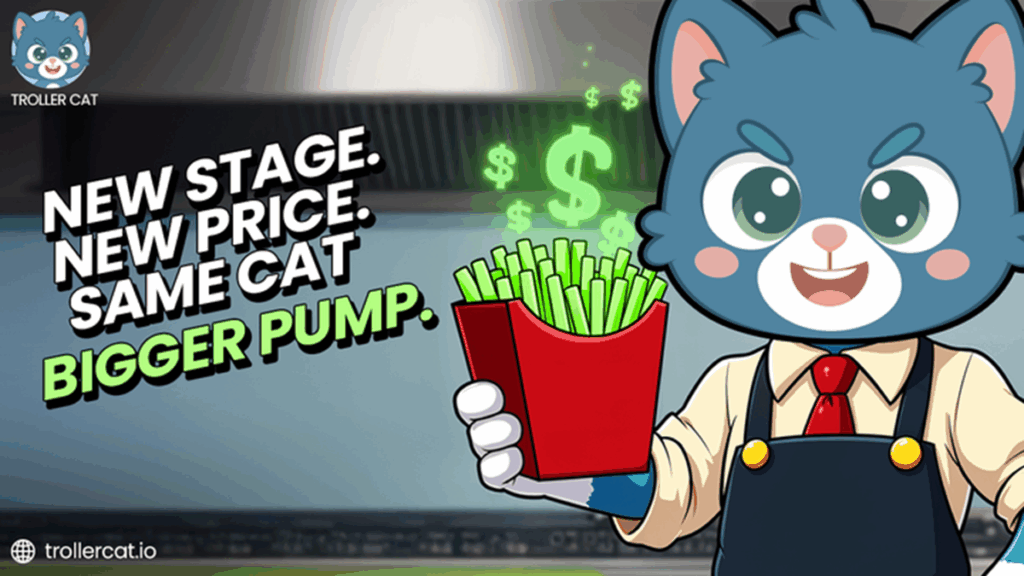
Then there’s Troller Cat ($TCAT), which the project says is currently in Stage 14 of its token sale. The project also references features such as a referral program, staking, and a Game Center; details and outcomes depend on execution and broader market conditions.
Troller Cat ($TCAT): Project overview
The Troller Cat presale (token sale, as described by the project) is presented as being in Stage 14, themed around the “Balloon Boy Hoax.” The project reports raising over $390,000, having more than 1,500 holders, and pricing the token at $0.00009667 at the time of writing. The project also compares current stage pricing to earlier stage pricing; these comparisons reflect the project’s staged pricing model and do not represent market performance or future results.
Stage 14 is described as being inspired by a widely reported media stunt from 2009. The project frames its fundraising as a themed, multi-stage storyline, with 26 stages total.
According to project materials, the token sale uses planned stage-by-stage pricing changes and includes features it describes as deflationary mechanics, an Ethereum-based setup, and a 2-year liquidity lock. These design elements do not eliminate risk and do not guarantee outcomes.
Game Center beta: gameplay and planned monetization
Troller Cat’s Game Center has launched a beta version, which the project says provides early gameplay access to holders. Two games are described as currently available: Troller Verse (an endless runner) and Troller Dash (a top-down reflex runner with day-to-night transitions).
The project says a full version is planned to include video ads and banner placements, and that it intends to use some related revenue for token buybacks and burns. Any impact on token supply, liquidity, or price would depend on adoption, execution, and market conditions, and cannot be assumed in advance.
Peanut the Squirrel ($PNUT): Energy Dip After Recent Push
Over the last 24 hours, Peanut the Squirrel saw a minor drop of 0.25%, settling at $0.004154. This move followed a brief rally that appeared to be driven largely by social-media activity. If volume continues to taper off, price action may remain subdued.
The project shows strength in branding, including community fan art and references to NFT partnerships. However, based on publicly discussed plans, its roadmap has not yet delivered major feature releases or staking mechanisms that could broaden engagement.
Community activity on Telegram and Discord remains a factor, and the project has referenced promotions such as airdrops and contests. The project has also mentioned an “Acorn Farm” staking system; timelines and delivery remain uncertain.
Keyboard Cats ($KEYCAT): Great Branding, Soft Momentum
Keyboard Cats fell by 0.57% over the past day, now trading at $0.004546. While not a major drop, it marks a second consecutive day of weaker volume and softer price action. The project is inspired by the viral “keyboard cat” meme and has used retro branding and pixelated NFT drops as part of its narrative.
Recent updates have teased a mobile rhythm game, but a beta has not launched yet. Support has been discussed around $0.0044, while resistance appears to be forming near $0.0050, a level the token has struggled to break this month. These levels are not guarantees and can change quickly in volatile markets.
The team has also hinted at integrating royalty revenue from upcoming YouTube streams into the token’s ecosystem, though timelines and implementation details remain limited. For now, market participants appear cautious, watching for clearer delivery milestones or other catalysts.
Conclusion
Meme-coin performance is often driven by sentiment, liquidity, and delivery of product milestones. Troller Cat has promoted a structured, multi-stage token sale and says it has launched a beta Game Center, alongside plans that include ad-supported buybacks and token burns. Peanut the Squirrel and Keyboard Cats have shown active communities and branding efforts, but recent price action suggests softer near-term momentum.
This article is for informational purposes only and does not constitute financial or investment advice.
This outlet is not affiliated with the project mentioned.
For More Information:
Website: https://www.trollercat.io/
Purchase page (project link): https://www.trollercat.io/buy-now/
FAQs
- What is the current stage and price of Troller Cat?
The project states Troller Cat is in Stage 14 at a price of $0.00009667. - How many tokens would $40,000 buy at the stated Stage 14 price?
Based on the project’s stated price, this would equate to roughly 413.8 million $TCAT tokens (before any fees or slippage). Future value is uncertain. - Is the Troller Cat Game Center monetized yet?
The project describes the current release as a beta focused on gameplay, with monetization planned for a later version. - How does the referral program work?
The project describes a referral program that may include marketing incentives for participants; terms can change and should be reviewed on the project website. - Are Peanut the Squirrel and Keyboard Cats good investments?
This article does not assess suitability or provide investment recommendations. Meme coins can be highly volatile, and readers should evaluate risks and available disclosures independently.
Glossary of Key Terms
- APY: Annual Percentage Yield, the rate of return for staking crypto.
- Deflationary Tokenomics: A model where token supply decreases over time.
- Referral Code: A code used in marketing programs that may provide incentives to participants.
- Presale Stage: A specific round of a token sale with set pricing, typically before a broader public launch.
- Game Center: A project feature that may include games tied to token mechanics.
- Liquidity Lock: A mechanism intended to restrict access to certain liquidity or tokens for a period of time.
- Buyback and Burn: A mechanism where tokens are repurchased and permanently removed from circulation, typically to reduce supply.
Press releases or guest posts published by Crypto Economy have been submitted by companies or their representatives. Crypto Economy is not part of any of these agencies, projects or platforms. At Crypto Economy we do not give investment advice, if you are going to invest in any of the promoted projects you should do your own research.

