

Digital assets are increasingly discussed in terms of real-world use cases rather than short-term speculation, including how value may be stored and transferred. Looking toward 2026, Stellar (XLM) is often cited for its cross-border payment network. Meanwhile, Qubetics is described in project materials as a platform focused on tokenizing real-world assets.
Below is an overview of commonly cited Stellar price forecasts for 2026 and a separate description of Qubetics’ real-world asset tokenization marketplace as presented by the project. As with all crypto-asset projections, forward-looking figures are inherently uncertain and should not be treated as guarantees.
Stellar Price Prediction 2026: What the Charts Suggest
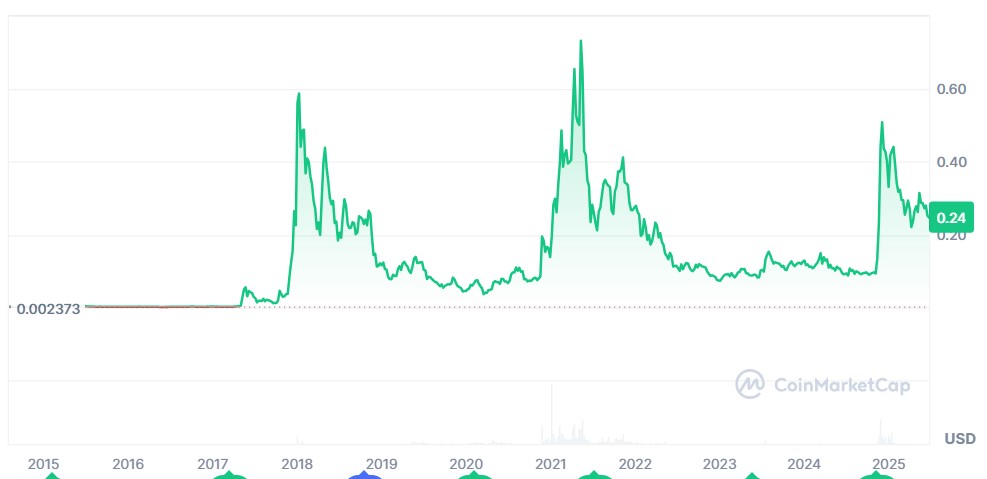
Stellar is known for fast, relatively low-cost cross-border transactions, and it has remained active through multiple market cycles. Some analysts and model-based forecasts outline a range of potential price outcomes for XLM in 2026, but these estimates vary widely and depend on assumptions that may not hold.
Based on forecasting approaches that reference historical prices and network-activity indicators, one projected trading window for Stellar in 2026 ranges from $0.4249 to $0.4995, with an annual average around $0.4398.
Some month-by-month breakdowns further describe a gradual trajectory.
In one set of estimates, January prices are modeled with a low near $0.243 and a high around $0.270, with mid-year levels around $0.374 and an upper boundary near $0.500 by December 2026. These figures are projections, not promises, and actual outcomes can differ materially due to broader market conditions and project-specific developments.
Commentary supporting a higher price path often points to continued use of Stellar in remittance-focused contexts and further integration with financial-services partners. However, adoption rates, regulatory shifts, competition, and macroeconomic factors can all affect network usage and market pricing.
Separate from payment-focused networks, some newer projects are positioning themselves around tokenized representations of off-chain assets. Qubetics is one example of a project using that framing.
The Qubetics Overview: Real-World Asset Tokenization
According to the project’s materials, Qubetics is focused on tokenizing real-world assets and enabling institutions to issue tokens on its blockchain.
The project describes use cases including tokenized interests in real estate, intellectual property, artworks, and environmental credits, with a marketplace intended to facilitate transfers and secondary trading. As with any tokenization model, practical outcomes depend on legal enforceability, custody arrangements, issuer controls, and jurisdiction-specific regulation.
Qubetics also states that it is designed with compliance considerations in mind, but readers should independently verify any regulatory claims and understand that standards differ across regions.
Qubetics Token Sale: Project-Reported Participation Figures
The project describes an ongoing public token sale and reports that its token price is $0.3370. It also states that it has raised over $18.1 million, that more than 516 million $TICS tokens have been sold, and that over 28,300 unique wallets hold $TICS. These figures have not been independently verified in this article.
The project also references a remaining allocation at the stated price, although availability and terms may change.
Exchange Listing Plans and Timing
Qubetics’ communications reference a planned exchange listing and a timeline tied to the end of its token sale. Exchange listings, schedules, and initial trading prices can change, and any listing should be treated as unconfirmed until publicly announced by the venue(s) involved.
Price-scenario discussions: risks and uncertainties
Some project- and community-generated content discusses potential future price milestones for $TICS. Such scenarios are speculative and do not account for factors like market liquidity, token supply distribution, lockups, regulatory constraints, or broader market downturns. Readers should treat any forward-looking price targets as non-predictive and high risk.
Conclusion: Utility-focused narratives in crypto
Stellar is frequently discussed as a payments-focused network, and some forecasters expect continued activity into 2026, although outcomes remain uncertain. Qubetics, by contrast, is presented by the project as infrastructure for tokenizing off-chain assets, a model that raises additional practical and regulatory questions.
Both themes—payment rails and tokenization—reflect how blockchain projects attempt to connect on-chain systems with real-world use, but their risks, maturity, and adoption drivers differ.

For More Information:
Project website (for reference): https://qubetics.com
FAQs
1. What is the projected price range for Stellar (XLM) in 2026?
Some forecast models cited online suggest a 2026 range between $0.4249 and $0.4995, with an average near $0.4398. These figures are speculative and may not reflect actual outcomes.
2. What is Qubetics’ Real World Asset Tokenization Marketplace?
According to the project, it is a marketplace intended to support tokenized representations of assets such as real estate or intellectual property and facilitate on-chain transfers and trading.
3. How much has Qubetics reported raising in its current token sale?
The project states that it has raised over $18.1 million and that more than 516 million tokens have been sold. This article has not independently verified those figures.
4. Is the tokenization of real-world assets legally regulated?
Rules and enforcement vary by jurisdiction and asset type, and regulatory approaches continue to evolve. Any tokenization model may involve securities, consumer-protection, custody, and AML/KYC considerations depending on how it is structured.
Summary:
This article reviews commonly cited Stellar (XLM) price forecasts for 2026 and summarizes Qubetics’ stated focus on a real-world asset tokenization marketplace. It also references project-reported token-sale figures and the project’s communications about potential exchange listings, noting that such details may change and should be independently verified. Both topics illustrate different approaches to blockchain utility—payments infrastructure versus tokenized asset rails—each with distinct uncertainties and risks.
This article is for informational purposes only and does not constitute financial or investment advice. This outlet is not affiliated with the project mentioned. Press releases or guest posts published by Crypto Economy have been submitted by companies or their representatives. Crypto Economy is not part of any of these agencies, projects or platforms. If you are going to invest, you should do your own research.

