


Is Pi positioning itself as a steady, lower-volatility project within the digital asset market? Some observers point to relatively stable community sentiment and user-generated projections as reasons the token continues to attract attention. Pi’s development and adoption trajectory is uncertain and depends on execution, market conditions, and broader crypto sentiment. In parallel, some market participants are also tracking early-stage projects that are running token sales, although outcomes vary widely and carry significant risk.
Against this backdrop, token forecasts are often used as reference points for sentiment, but they are not reliable predictors of future prices. With attention on usability, protocol development, and ecosystem growth, some projects with clearer product progress may retain interest longer than short-lived trends. The following breakdown summarizes Pi-related projections from recent user-generated data and then reviews a separate update on Qubetics based on figures described in the project’s materials.
Pi Price Forecast for 2026 and Longer-Term Projections
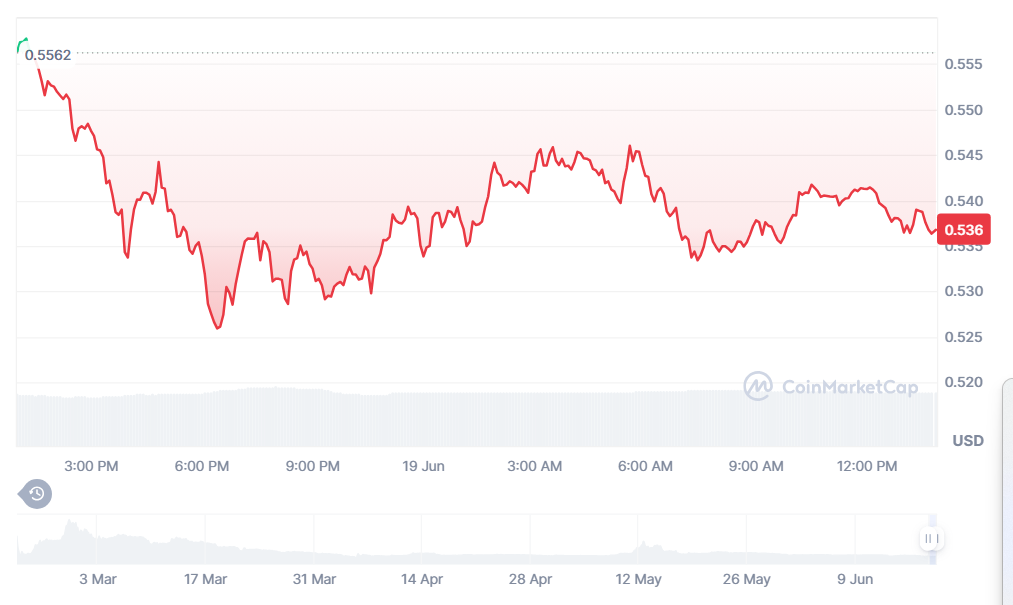
Several public, user-generated forecast tools suggest Pi’s price could move within a relatively narrow range over the next several years. One aggregated projection referenced by market participants places Pi around $0.691022 by 2030, which would imply a moderate change from recent levels. Such figures should be treated as speculative and subject to substantial uncertainty.
One Pi price forecast for 2026 places the token at $0.568905, described as roughly a 5% move from a referenced baseline. The source cited for this figure is user sentiment data (including sentiment shown on major exchanges and aggregation sites), which reflects opinions rather than verified forward-looking information.
Technical Forecasting and Key Assumptions
Some forecast paths extend through 2027 and beyond, with projections such as $0.596931 (2027), $0.626777 (2028), and $0.691022 (2030). In the referenced model, figures are derived from user inputs and a default assumption of roughly 5% annual change. These estimates are not guarantees and may not account for shifts in liquidity, token availability, regulatory developments, or project execution.
More broadly, Pi-related projections are often framed around steady development and gradual adoption. However, crypto markets can be highly volatile, and price behavior may diverge materially from any forecast.
Market Context and Realistic Expectations
Analysts and traders often distinguish between narrative-driven moves and projects that attract interest primarily due to ongoing development. Commentary around Pi frequently emphasizes incremental progress and community participation, though independent verification of long-term outcomes remains limited. Any forecast should be interpreted as one input among many, not as a roadmap.
Some short-term projections also circulate—for example, user forecasts suggesting Pi could reach $0.543609 within 30 days. As with longer-term estimates, this is speculative and may change quickly with market conditions.
Projected Use Case Expansion as Adoption Scales
Supporters of Pi often cite accessibility and potential consumer-facing use cases (including mobile-centric onboarding) as differentiators. If those use cases expand, that could influence demand; if they do not, forecasts may prove inaccurate. Independent confirmation of future adoption levels is not available in advance.
Some longer-range projections extend as far as 2035 (for example, figures such as $0.881939). These numbers are speculative, and longer time horizons generally increase uncertainty. They should not be treated as targets or expectations.
Qubetics: Interoperability Claims and Project Overview
Separately from Pi, Qubetics describes itself as a Web3 aggregator intended to support interoperability across multiple blockchains. According to the project’s materials, the aim is to enable asset transfers, data exchange, and user interactions across different networks.
One frequently cited use case for interoperability platforms is reducing complexity for applications that touch multiple chains (for example, using different networks for different components of a workflow). Whether Qubetics can deliver these capabilities in production depends on the project’s technical implementation and adoption.
The project also states it targets use cases such as tokenization and multi-chain data coordination. These are broad categories, and outcomes will depend on execution, security design, and ecosystem participation.
Qubetics Token Sale: Project-Reported Figures
Qubetics says it is in Stage 37 of its token sale. The project reports that more than 516 million $TICS tokens have been sold and that fundraising has surpassed $18 million, with 28,100+ holders. These figures were not independently verified for this article.
The project also states that its total supply was reduced from more than 4 billion to 1.36 billion, and that 38.55% of supply is allocated to the public. Any discussion of supply changes, allocations, or future listings should be considered informational and does not indicate future price performance.
Conclusion
Pi-related forecasts for 2026 and beyond largely reflect user-generated assumptions about gradual change and continued ecosystem development. Those projections may be useful for understanding market sentiment, but they remain uncertain and can be overtaken by market events.
Qubetics, meanwhile, is being positioned by the project as an interoperability-focused platform, alongside ongoing fundraising through a token sale. Readers should treat project-reported figures as unverified unless corroborated by independent sources.

For More Information:
Qubetics (project website, for reference): https://qubetics.com
Twitter: https://x.com/qubetics
This article is for informational purposes only and does not constitute financial or investment advice. This outlet is not affiliated with the project mentioned. Press releases or guest posts published by Crypto Economy may be submitted by companies or their representatives, and Crypto Economy is not part of these agencies, projects, or platforms. If you choose to invest or participate in any token-related activity, you should do your own research.

