


Monero (XMR) remains a notable privacy-focused cryptocurrency. It is used by some market participants who prioritize confidentiality and fungibility. Unlike many transparent blockchains, Monero uses ring signatures and stealth addresses designed to obscure sender and receiver information. As with other cryptoassets, usage varies by jurisdiction and user preference.

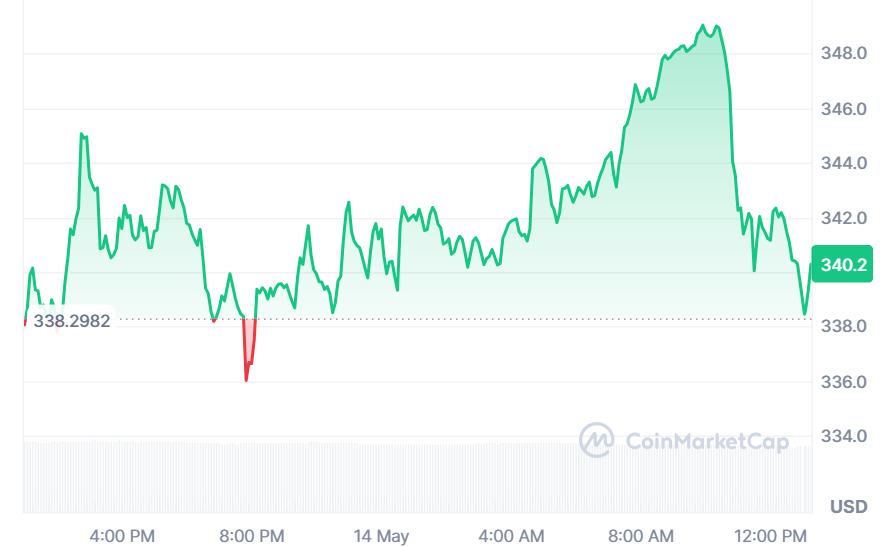
As of mid-May 2025, Monero trades at around $338.90. It holds the #24 rank on CoinMarketCap with a market cap of over $6.26 billion. Its 24-hour volume exceeds $139 million. The total circulating supply is approximately 18.4 million XMR with no hard cap, making it different from Bitcoin’s fixed supply model. Despite market volatility, Monero has shown continued usage among privacy-focused communities.
Monero Price Forecast: Changelly’s 2030 Scenario
According to Changelly’s technical analysis, Monero could trade in a range with a projected minimum of $2,685 and a maximum of $3,008 by 2030. Such forecasts are inherently speculative and may not reflect future market conditions. Changelly’s outlook cites factors including Monero’s user base and ongoing development activity, as well as changing regulatory scrutiny of privacy-oriented cryptoassets.
In the shorter term, Changelly forecasts Monero trading between $197.58 and $274.13 in 2025. The analysis notes potential regulatory risks and broader market conditions as factors that may affect pricing.
From a technical-analysis perspective, some market observers point to support near key moving averages and a period of consolidation. These interpretations can vary widely and do not provide certainty about future price direction.
Monero’s Regulatory Risks and Potential Catalysts
Several factors could influence Monero’s trajectory. Regulatory bodies in multiple jurisdictions have raised concerns about cryptocurrencies designed to be difficult to trace. Delistings from centralized exchanges and potential wallet restrictions are among the risks frequently discussed. At the same time, peer-to-peer trading venues and Monero’s decentralized design may affect how those pressures play out in practice.
Some developers and applications have explored integrating Monero as a privacy-oriented payment option. Separately, broader work on privacy tooling across Web3—including zero-knowledge systems—could influence market attention to privacy-focused assets, though outcomes remain uncertain.
The project has also discussed upgrades such as Triptych and Seraphis, along with research into quantum-resistant cryptography, aimed at improving scalability and privacy. Timelines and impacts of protocol changes can differ from expectations and should be assessed using primary sources and independent analysis.
Why Monero Remains a Focus of Privacy Discussions
Monero is frequently cited in debates about on-chain financial privacy, including questions around fungibility and transaction confidentiality. Like other crypto networks, it also faces trade-offs related to regulation, exchange access, usability, and evolving security assumptions.
Any long-term price targets—including the $3,008 figure cited in some forecasts—should be treated as speculative scenarios rather than outcomes. Market structure, adoption, regulation, and technical development can all change materially over time.
Qubetics: Project Overview (as described by the team)
Qubetics (TICS) is presented by its team as a protocol aimed at supporting cross-border digital-asset transfers. In project materials, it is positioned around use cases such as remittances, payroll, and payments across blockchain networks. As with other early-stage crypto projects, readers should review independently verifiable documentation and risks.
According to the project’s description, the platform is intended to support smart contract execution, asset bridges, and decentralized swaps across networks such as Ethereum, Solana, and BNB Chain. Interoperability designs can carry technical and security risks that vary by implementation.
The team also describes an enterprise-oriented focus and a multi-layered security approach. Claims about performance, compliance readiness, or adoption are not independently confirmed in this article.
Qubetics token sale: project-reported figures
Qubetics states it is in Stage 34 of its token sale and that $TICS tokens are priced at $0.2532 at the time of writing. The project also reports that more than 512 million tokens have been sold and distributed to 26,300+ wallet addresses, with total funds raised of over $17 million. These figures are project-reported and have not been independently verified in this article.
The project and some community materials reference potential future pricing scenarios. Any such projections are speculative, can change quickly, and should not be treated as guarantees of returns.
Qubetics also says it plans smart contract audits, a vesting schedule, and DAO-based governance. Readers should consult primary documentation and independent security reviews where available.
Final Thoughts
Monero and Qubetics address different problem areas as described by their respective communities and teams. Monero is commonly discussed in the context of privacy and censorship resistance, while Qubetics positions itself around cross-border value transfer and interoperability.
Forecasts such as the $3,008 Monero scenario cited by Changelly, and project-reported token-sale metrics for Qubetics, should be interpreted with appropriate caution. Crypto markets are volatile, and regulatory and technical developments can materially affect outcomes.
For More Information:
Qubetics (project website, for reference): https://qubetics.com
Token-sale site (for reference): https://buy.qubetics.com/
Twitter: https://x.com/qubetics
This article is for informational purposes only and does not constitute financial or investment advice. This outlet is not affiliated with the project mentioned. Press releases or guest posts published by Crypto Economy may be submitted by companies or their representatives, and readers should independently verify any claims.

