The cryptocurrency market capitalization recently declined by approximately 2.4%, settling near $3.1 trillion and contributing to cautious sentiment across digital asset markets. XRP has been trading close to the $1.90 level amid elevated liquidation activity, while recent Chainlink developments highlight technical progress even as price performance remains subdued. As several established cryptocurrencies mature, market participants are increasingly evaluating whether these assets can continue to deliver significant growth.
Within this context, Zero Knowledge Proof (ZKP) has entered broader market discussions as a privacy-focused infrastructure project centered on AI-related use cases. Analysts following the project note projections that its extended presale auction could raise up to $1.7 billion over time, potentially establishing a sizable liquidity base at launch. Observers suggest that such a structure may reduce early trading instability compared with smaller launches, particularly if participation continues at scale.
Rather than emphasizing short-term price movement, ZKP is increasingly discussed in terms of its capital structure, presale mechanics, and technical readiness relative to other networks entering 2026.
ZKP: Infrastructure and Capital Structure Overview
Built using the Substrate framework, the ZKP network combines privacy-preserving computation with decentralized infrastructure designed to support AI and data-intensive workloads. The blockchain employs a hybrid model that integrates Proof-of-Intelligence and Proof-of-Space mechanisms, alongside zero-knowledge cryptographic verification. According to project disclosures, more than $100 million was allocated to development prior to the presale phase.
Market analysts tracking the project have focused on its economic design rather than promotional milestones. The presale auction model releases tokens on a daily basis, with allocation determined proportionally rather than through fixed pricing or private rounds. This structure is intended to promote broad participation and limit early concentration.
Forecasts suggesting a potential $1.7 billion total raise reflect cumulative participation over the full auction period rather than a single funding event. Analysts note that, if achieved, this scale could support higher liquidity at launch compared with many early-stage networks, potentially reducing price volatility associated with thin order books.

From a structural perspective, ZKP is positioned as a network entering public participation after core infrastructure deployment, rather than funding development retroactively.
XRP Price Faces Volatility Near Key Levels
XRP has experienced a volatile period, declining more than 13% over the past week while trading near the $1.90 range. Despite the drawdown, trading activity remains elevated, with daily volumes exceeding $3 billion, reflecting continued market engagement.
Technical analysts have highlighted repeated tests of the $1.80–$1.90 zone, an area viewed as significant support. Price action around this level may influence short-term direction, particularly as broader market sentiment remains uncertain.
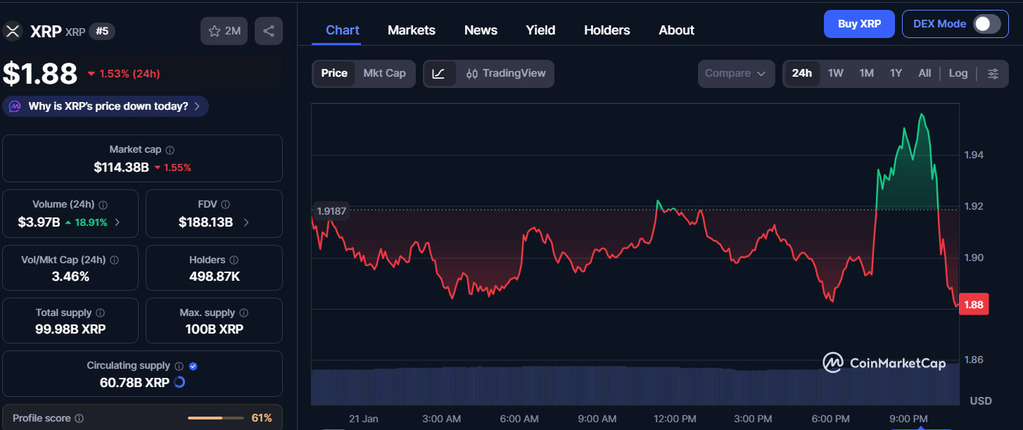
On the fundamentals side, Ripple continues to expand enterprise partnerships, including infrastructure-related collaborations. However, recent ETF outflows and broader market caution have contributed to mixed outlooks. For now, XRP remains in a consolidation phase as participants assess whether current levels represent stabilization or further downside risk.
Chainlink Developments Continue Despite Sideways Price Action
Chainlink has traded within a narrow range between approximately $12.50 and $12.80, reflecting resilience amid broader market pressure. Recent Chainlink news includes the rollout of 24/5 U.S. equity data feeds, designed to connect traditional financial instruments with blockchain-based systems.
This development enables continuous access to tokenized equity data and has attracted interest from large financial institutions exploring on-chain settlement and data verification. While these advancements strengthen Chainlink’s long-term infrastructure role, near-term price performance has remained muted.

On-chain data indicates accumulation by larger holders, and upcoming milestones such as futures listings may influence market dynamics. For now, Chainlink’s position reflects a network with strong institutional relevance but limited short-term momentum.
Comparing Market Positioning Heading Into 2026
XRP and Chainlink illustrate two mature crypto narratives. XRP continues to navigate regulatory, liquidity, and sentiment-driven challenges, while Chainlink expands its role as a data layer for institutional finance despite flat price movement.
ZKP represents a different approach, centered on infrastructure readiness, extended token distribution, and a presale auction designed to gradually establish liquidity. Analysts note that this model prioritizes predictable issuance and capital depth rather than rapid market entry.
Rather than framing outcomes in terms of price performance, market observers increasingly compare these assets based on structure, timing, and risk profiles. ZKP’s emphasis on completed development, daily allocation mechanics, and long-duration distribution places it in a distinct category among projects entering the 2026 cycle.

Find Out More About Zero Knowledge Proof
- Website: https://zkp.com/
- Buy: https://buy.zkp.com/
- X: https://x.com/ZKPofficial
- Telegram: https://t.me/ZKPofficial
This article contains information about a cryptocurrency presale. Crypto Economy is not associated with the project. As with any initiative within the crypto ecosystem, we encourage users to do their own research before participating, carefully considering both the potential and the risks involved. This content is for informational purposes only and does not constitute investment advice.