TL;DR:
- The XRP Ledger reached $1 billion in tokenized assets, driven by the growth of Treasury bills and the RLUSD stablecoin.
- Despite a 2,900% growth in tokenized bonds, XRPL holds only 1.4% of the global market compared to Ethereum’s massive dominance.
- Analysts suggest Ripple’s historic legal battle slowed institutional adoption, leaving the network in an early recovery stage.
Ripple recently recorded a new adoption record. It was confirmed that they achieved a major XRP Ledger milestone in tokenized assets, surpassing the $1 billion barrier in total on-chain value.
This growth was primarily driven by the expansion of Real-World Assets (RWA) and the deployment of the RLUSD stablecoin. Data from rwa.xyz reveals that U.S. Treasury bonds on XRPL grew by 2,900% annually.
Regarding this, analyst Wendy O warns that this success must be analyzed carefully. Although it is a staggering figure for the network, XRPL still represents a tiny fraction of the global market when compared to its largest competitors.
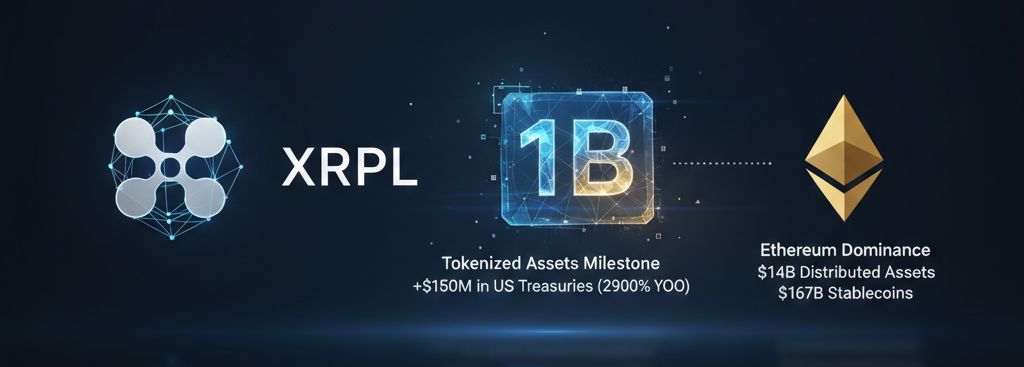
The Institutional Gap Between XRPL and the Ethereum Ecosystem
When conducting a technical comparison, the figures reveal a significant disparity between the two giants. The value of distributed assets on XRPL sits near $205 million, while Ethereum manages at least $14 billion.
This difference is even more notable in the stablecoin sector, where Ethereum dominates with a market capitalization of $167 billion. In contrast, Ripple’s network barely registers $393 million in this specific category.
Furthermore, the regulatory factor plays a leading role in the current hierarchy. The prolonged litigation between Ripple and the SEC dampened the appetite of institutional partners, granting Ethereum a competitive advantage that seems difficult to overcome today.
In summary, XRPL positions itself as an “early-stage challenger” with great diversification potential. While the road to catching up with Ethereum is long, the current momentum proves the network is ready to compete in the tokenization race.