

XRP’s price did experience a brief period of consolidation in September 2025. This movement echoes mixed signals from the cryptocurrency markets; risk appetite has remained uneven amid weak macro data and profit-taking. Some market participants have also pointed to emerging institutional interest and regulatory developments as potential factors influencing sentiment around XRP.
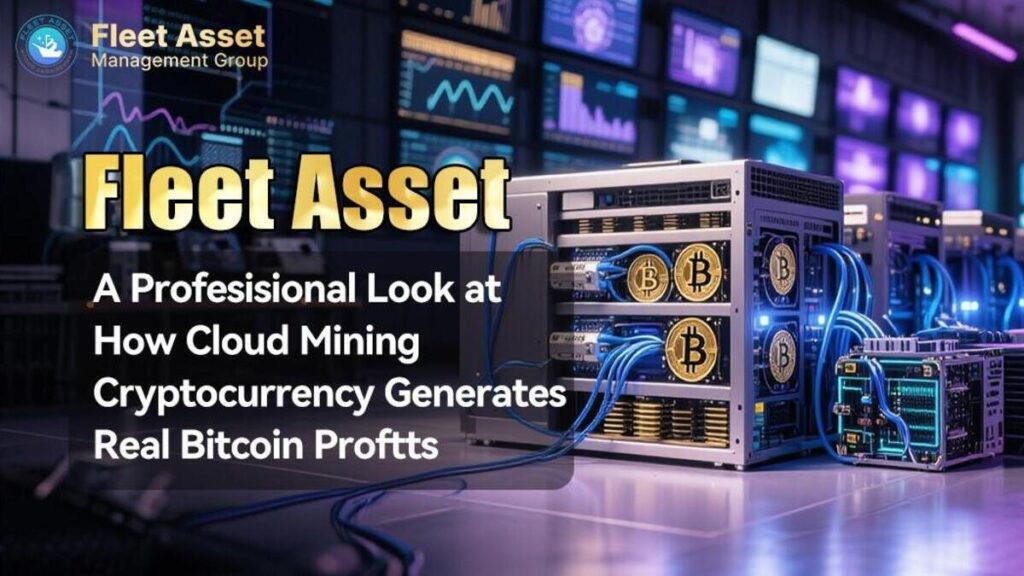
That said, for many cryptocurrency holders, simply waiting for price appreciation is uncertain and may not suit every risk profile. In this context, “cloud mining” is often marketed as an alternative way to seek ongoing payouts by renting computing power through a third-party service. Unlike classic staking or DeFi lending, cloud mining typically involves sending funds to an operator that claims to run mining hardware and distribute proceeds to users.
FleetMining is one such platform. The company promotes its service as accessible to a broad user base and presents it as a way to generate cash flow from digital assets. Readers should note that these are platform claims, and cloud-mining arrangements can involve significant counterparty, operational, and transparency risks.
Why cloud mining is marketed as a passive-income alternative
Some investors look to cloud mining because certain major tokens (such as XRP) are not mined, and because yields in other crypto products can vary widely. Cloud-mining providers generally present the model as follows:
· Users transfer crypto or stablecoins to a service in exchange for a mining contract or allocated computing power.
· The service may report daily or periodic payouts based on its own calculations, fees, and operational assumptions.
· Marketing materials often emphasize predictability, but real-world outcomes can change with mining difficulty, energy costs, crypto prices, provider policies, and the provider’s ability to operate as described.
Any “stable” or “fixed” income framing should be treated cautiously: in practice, payouts are not guaranteed and participants may be exposed to loss of principal if the operator fails, restricts withdrawals, or misrepresents operations.
FleetMining: What the company says
Among many cloud-mining brands, FleetMining has attracted attention online. According to the company’s promotional materials, it describes itself in terms such as:
- Compliance claims: The company presents itself as U.S.-based and compliant. Regulatory approvals and oversight statements should be independently verified by readers, as claims can be incomplete, outdated, or misleading.
· User-base claims: It states it serves users across many countries and cites a multi-million user figure.
· Operations claims: It promotes renewable-energy data centers and other operational features.
· Minimum participation claims: It advertises a low minimum amount to participate.
More broadly, cloud-mining platforms often promote convenience (no hardware management) and short contract durations. These features do not eliminate the central risk of relying on a third party to custody funds and accurately report mining activity and payouts.
About advertised earnings examples
FleetMining and similar services may publish illustrative “earnings examples” or contract scenarios that show specific daily payout figures. Such examples are marketing materials and should not be interpreted as guaranteed results. Even if a platform displays estimated rates or historical payouts, there is no assurance that those figures will continue, and losses—including total loss—are possible.
Comparisons to staking or DeFi lending can also be misleading when they omit differences in risk, liquidity, custody, fee structures, and the transparency of underlying activity.
How participation is typically described
In general, cloud-mining platforms describe participation as opening an account, transferring supported cryptoassets to the platform, and selecting a mining contract. Prospective users may want to review, at minimum, the custody model, withdrawal terms, fee schedule, jurisdiction, identity of operating entities, audited proof-of-reserves or proof-of-mining (if any), and complaint history before transferring funds.
Conclusion
Cloud mining is widely promoted as a way to seek cash flow from crypto holdings, but it involves material risks that are different from simply holding a token in a self-custody wallet. As with any third-party service that requires depositing crypto, users may face counterparty risk, changing terms, and uncertain or unverifiable performance.
Email: [email protected]
This article is for informational purposes only and does not constitute financial or investment advice. This outlet is not affiliated with the project mentioned. We recommend that our readers conduct thorough research before using any service, as these types of products may involve certain risks associated with the crypto sector.

