One of the worst moments in the crypto ecosystem occurs when you press send and immediately realize that while the address is correct, the destination network is not. It is a common mistake that affects not only beginners but experienced users as well. The processing speed of the blockchain contrasts drastically with the immutability of its records, turning a simple click into a financial headache.
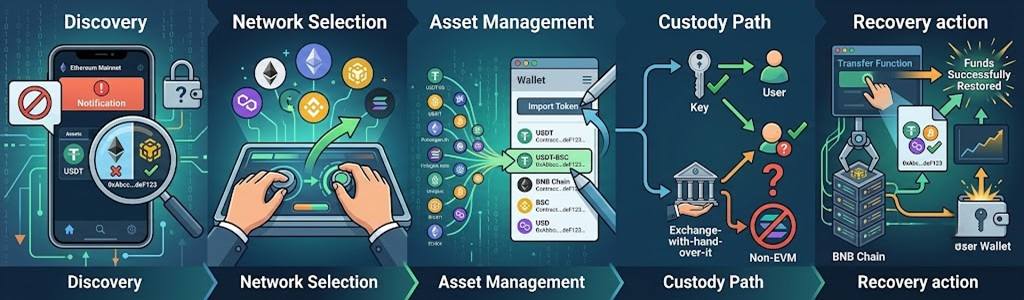
The viability of resolving this issue depends on a fundamental principle: who maintains custody of the private key and which network architectures were involved. Some of these mistaken transfers are resolved easily and quickly, but other errors are irreversible, leading to permanent losses. For this reason, it is important to understand recovery methods before executing a transaction.

Market Context: The EVM Compatibility Trap
The rise of the Ethereum Virtual Machine (EVM) facilitated interoperability across multiple blockchains such as Ethereum, BNB Chain, Polygon, and Arbitrum. The technical derivation of these networks is similar, meaning that the same private key generates the exact same 0x address across different crypto ecosystems.
The problem arises when users prefer lower-fee networks to send tokens to platforms operating under a different infrastructure. By using compatible addresses on different chains, assets will be deposited on the wrong network. Now, if the destination is a self-custody wallet, the user remains in control of the funds, with the possibility of recovering them simply by switching networks.
The story changes when the transfer involves non-compatible ecosystems, such as sending Bitcoin, Solana, or XRP to an Ethereum address. Because they use incompatible signature schemes and formats, cross-chain transactions outside the EVM standard usually end in a total loss with no possibility of recovering the capital.
Technological Impact and Custody: Who Holds the Keys?
In crypto recovery analysis, ownership of the private key determines the rules of the game. If the error occurs between personal wallets, such as MetaMask or Ledger, the technical process to visualize the tokens consists of configuring the network used and importing the smart contract of the asset.
On the other hand, when funds are transferred to a centralized exchange (CEX), the response capability rests entirely on the exchange’s technical team. Platforms manage keys internally and require manual processes to extract funds sent via unsupported networks. This often results in lengthy delays and additional operational fees.
It is crucial to highlight the constant danger of fake support scams proliferating on forums and social media. No legitimate entity will ever request a recovery seed phrase to trace or unlock stuck transactions. Any third-party service promising to unlock funds in exchange for private keys is categorically a fraud.
Future Outlook: Navigation Standards and Mitigation
As the industry moves toward greater adoption, user interfaces must evolve to integrate dynamic validation mechanisms before processing transfers. Advanced tools for automatic contract detection and network incompatibility alerts are becoming increasingly common in decentralized applications.
The routine implementation of address whitelisting and the mandatory execution of test transactions with minimal amounts are emerging as best operational security practices. These measures substantially reduce the margin for human error in transactions involving significant volume.
Likewise, the development of account abstraction protocols and advanced cross-chain interoperability solutions will help mitigate current fragmentation. The goal of blockchain infrastructure is to make network selection seamless for the end user, eliminating losses stemming from configuration errors.
Sending cryptocurrency over the wrong network exposes the existing gap between the technical autonomy granted by blockchain technology and the responsibilities it demands from users. While EVM compatibility offers a safety net for self-custody, the lack of universal standardization remains a latent risk. Financial education and caution when transacting continue to be the best defense for safeguarding digital assets.