TL;DR:
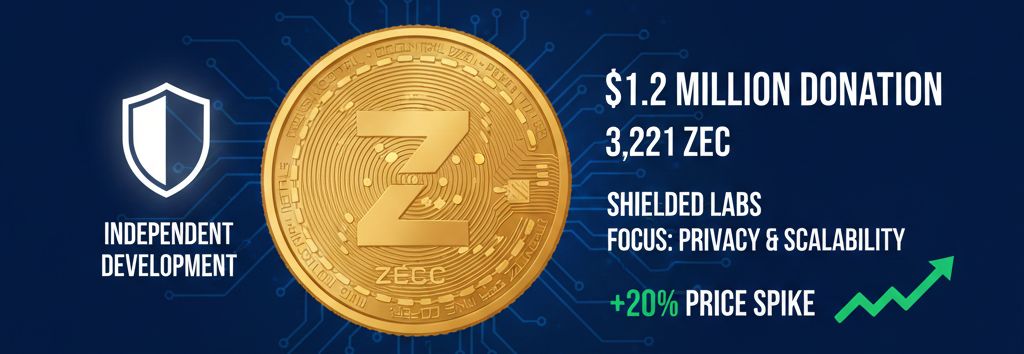
- Tyler and Cameron Winklevoss donated $1.2 million to improve Zcash’s security and scalability.
- The funding arrives after the mass resignation of the Electric Coin Company development team.
- The funds will boost the Crosslink mechanism and a hybrid Proof-of-Stake layer on the network.
This Wednesday, the privacy segment of the crypto market received significant financial backing at a critical moment. The Winklevoss donation to Shielded Labs and Zcash, valued at $1.2 million, aims to ensure that protocol development continues in a decentralized and resilient manner.
In this time of crisis at Electric Coin Company (ECC), the contribution from the Gemini founders is vital, as the development team recently resigned due to disagreements with its board of directors. In this sense, support from high-profile figures helps mitigate the uncertainty that led the ZEC token to trade near its monthly lows.
Now, Shielded Labs is positioned as a fundamental pillar for the technical evolution of the network. By operating independently of traditional development funds, this organization ensures that Zcash’s privacy mission does not depend on a single corporate entity.
Technical Innovation: Sustainability and the Crosslink Hybrid Model
The funds provided by the entrepreneurs will be allocated to ambitious technical projects seeking to modernize Zcash’s infrastructure. For instance, the development of Crosslink, a technology that introduces a Proof-of-Stake (PoS) layer to work alongside the current mining system.
Additionally, work will focus on the Network Sustainability Mechanism and the implementation of dynamic fees to improve long-term economic efficiency. These advancements are essential for Zcash to maintain its relevance against competitors and meet the growing demand for privacy in the digital financial sector.
In summary, despite the recent volatility in the asset’s price, the backing from institutional investors and industry leaders suggests a positive outlook for 2026. The community expects these independent development efforts to stabilize the ecosystem and regain the confidence of global markets.