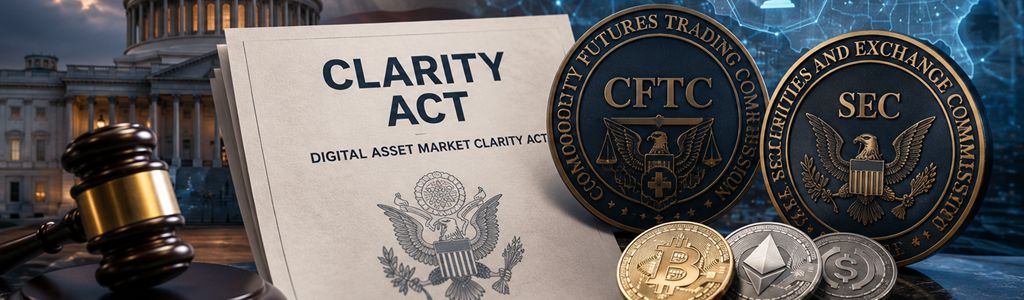
Ask a crypto lawyer about “the Clarity Act” in July 2026 and nobody reaches for H.R. 2792. Representative Tom Emmer’s narrower Securities Clarity Act matters as an early idea. It is not the legislation one Senate committee vote away from reshaping US crypto oversight. The bill actually driving the news cycle is the Digital Asset Market Clarity Act.
It is a market-structure package that passed the House by a wide margin. It cleared the Senate Banking Committee 15-9 in May. It now sits on the Senate calendar, racing an August recess deadline.
The mechanism matters more than the name. The Act splits digital assets into categories, and the split determines who regulates what.
An investment contract asset covers a token sold during a capital raise. Buyers expect profit from a team’s effort, the classic Howey scenario. The SEC keeps authority here. The bill adds a safe harbor too: issuers can raise up to $75 million over twelve months under tailored disclosure rules, instead of full securities registration.
A digital commodity is a different animal: a token whose value comes from a decentralized network’s actual use, not a promoter’s promises. Bitcoin is the plain-vanilla example named in committee materials. A network has to pass a maturity test first. No single actor can control more than 20% of supply or voting power.
The code has to run open-source, with rules operating transparently. Clear the bars, and the token graduates from SEC-regulated investment contract to CFTC-regulated digital commodity. An issuer, an affiliate, or a decentralized governance system can certify the maturity directly.
The graduation clause is the whole ballgame. It answers the question that has driven a decade of enforcement chaos. Does a token stay a security forever just because it started as one?
The consumer protection case, stated plainly
Right now, protection mostly runs ex post. The SEC sues after a collapse. Investors rarely get made whole, and they were unprotected during the transaction that actually hurt them.
Registered digital commodity exchanges under the new system would face capital requirements, customer-fund segregation, trade surveillance, and cybersecurity rules, and the rules apply before a single trade happens, not after a bankruptcy filing.
The structure itself is the argument for why the bill, more than any single disclosure form, could reshape consumer protection. Standards get built into market infrastructure rather than bolted onto enforcement actions years later.
The bill also carries a DeFi carve-out, formally Section 604 and drawn from the standalone Blockchain Regulatory Certainty Act. Developers who write and publish decentralized software would be shielded from money-transmitter registration, provided they never take custody of user funds or control transactions. Supporters frame the shield as the difference between regulating a service and regulating a text editor.
Here the analysis has to stop arguing and start reporting. The remaining fight is not about market structure at all.
The bill’s ethics provision would restrict crypto holdings and activity for federal officials, the president included. President Trump’s 2025 financial disclosure showed roughly $1.4 billion in crypto-related income. About $636 million ties to the $TRUMP meme coin. More than $500 million comes from World Liberty Financial, a DeFi venture his family co-founded.
Senate Democrats, including Senators Elizabeth Warren and Angela Alsobrooks, have objected specifically to one detail. Enforcement would sit with the Department of Justice, whose leadership reports to the president the provision is meant to constrain.
A White House official has called the administration’s offer “the most comprehensive ethics provision in history,” without releasing its text. Draft language circulating in the Senate this week reportedly includes a sunset clause ending enforcement in 2029. Democrats have not yet endorsed the detail.
A separate objection comes from law enforcement groups, not lawmakers. The Center for American Progress and several police organizations argue the DeFi carve-out defines compliance obligations too narrowly. They say it would functionally shield bad actors from anti-money-laundering rules, at a moment when the Justice Department has already raised the bar for BSA enforcement against crypto exchanges.
One law enforcement group broke ranks. The National Organization of Black Law Enforcement Executives endorsed a revised version, citing its anti-money-laundering and forfeiture provisions specifically.
Neither dispute is a technical footnote. Both are about who gets exempted and who enforces the exemption, which is where legislation does its real distributional work. Last year’s stablecoin law easily created obligations nearly every stakeholder could accept, and it moved fast. The CLARITY Act keeps stalling precisely because its carve-outs touch someone with real power to resist them.
What Passage Would Change, and What Stalling Preserves
If the bill clears the Senate before recess, the consumer-protection case above becomes real. A statutory maturity test replaces case-by-case SEC enforcement. Spot exchanges register under actual capital and custody rules. US consumers get regulated domestic on-ramps instead of offshore workarounds.
If it stalls again, the underlying problem the source document correctly diagnosed does not go away. Projects still avoid US registration or operate in gray zones. Consumers still trade on platforms with no baseline custody rules. The SEC and CFTC keep fighting a jurisdictional turf war that leaves no single accountable regulator.
Prediction markets priced 2026 passage odds at roughly 31% two weeks ago, before this week’s reported ethics compromise. The honest read: the bill’s substantive merits and its political survival are now two separate questions.
The Clarity Act’s real innovation was never a single rule. It is a bright statutory line for jurisdiction. Congress has failed to draw a clear line for over a decade of Howey-era ambiguity. Whether the line gets drawn this year depends less on market-structure logic and more on whether Washington can settle who watches the people writing the rules.