TL;DR
- Specialization Shift: Vitalik Buterin said L2s should move beyond being cheaper versions of Ethereum, arguing that the base layer is becoming more capable and that many rollups still rely on multisig bridges instead of inheriting full security.
- Diverging L2 Responses: Optimism highlighted hurdles such as long withdrawal windows and the lack of production-ready Stage 2 proofs, while Arbitrum insisted scaling remains central.
- Ecosystem Repositioning: Base and Starknet embraced differentiation, with leaders saying application focus, privacy features, and ZK-native designs align with Buterin’s vision.
Ethereum’s layer 2 ecosystem is recalibrating after Vitalik Buterin questioned whether L2s should remain the network’s primary scaling engine, arguing that the original vision “no longer makes sense.” His comments sparked immediate reactions from major rollup teams, who broadly agreed that L2s must evolve but differed on how central scaling should remain to their mission.
Vitalik Buterin’s Call for Specialization Reshapes the L2 Conversation
In his Wednesday X post, Buterin said many L2s have not fully inherited Ethereum’s security because they still rely on multisig bridges. He added that Ethereum’s base layer is becoming more capable through gas-limit increases and future native rollups. This shift, he argued, means L2s should move toward specialization rather than simply offering cheaper execution. The remarks triggered debate across the ecosystem, with builders acknowledging the need for differentiation while assessing how much scaling should remain part of their identity.
Optimism Highlights Technical Hurdles and Modular Ambitions
Karl Floersch of the Optimism Foundation welcomed the challenge of building a modular L2 stack that supports “the full spectrum of decentralization.” Still, he pointed to significant obstacles. These include long withdrawal windows, the absence of production-ready Stage 2 proofs, and limited tooling for cross-chain applications.
CHALLENGE ACCEPTED.
Not a challenge related to drama farmers saying "L2s bad, Ethereum dumb."
But instead the challenge of creating a modular L2 Stack that supports and enables customization and the full spectrum of decentralization. And you know — we're already closer to that… https://t.co/s6mDG9KOk8
— karl.floersch.eth (✨🔴_🔴✨) (@karl_dot_tech) February 3, 2026
Floersch reiterated that “Stage 2 isn’t production-ready,” noting that current proofs are not secure enough for major bridges. He also backed native Ethereum precompile support for rollups, a feature that Buterin recently emphasized.

Arbitrum Defends Scaling as a Core L2 Value
Arbitrum co-founder Steven Goldfeder responded more forcefully, arguing that scaling remains fundamental to the rollup model. He said Arbitrum was not created as a “service to Ethereum,” but because Ethereum offers a high-security, low-cost settlement layer that enables large-scale rollups.
1. Arbitrum is not Ethereum. It’s a core part of the ecosystem, a close-knit ally, and has enjoyed a symbiotic relationship for the last half-decade. But it is not Ethereum. And the notion that a scaled L1 and a thriving L2 ecosystem are somehow at odds is wrong.
— Steven Goldfeder (@sgoldfed) February 3, 2026
Goldfeder disputed the idea that a scaled Ethereum L1 could replace L2 throughput, citing periods when Arbitrum and Base exceeded 1,000 transactions per second while Ethereum processed fewer. He warned that hostility toward rollups could push institutions toward independent layer 1 chains.
Base and Starknet Embrace Differentiation
Base head Jesse Pollak agreed that L2s cannot be “Ethereum but cheaper,” calling L1 scaling “a win for the entire ecosystem.” He said Base is focused on onboarding users and developers while advancing toward Stage 2 decentralization.
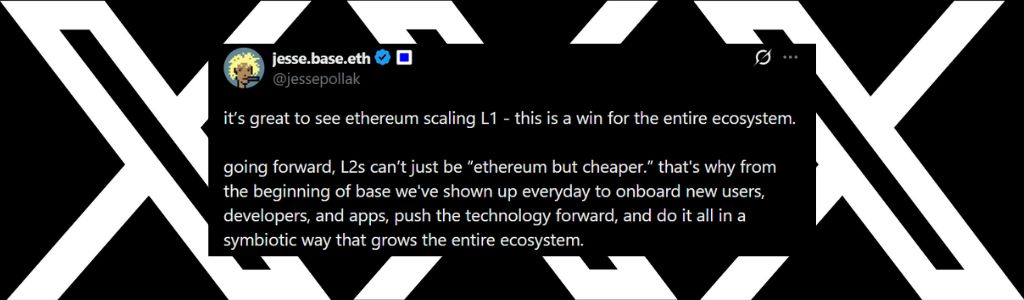
Pollak added that application-driven differentiation, account abstraction, and privacy features align with Buterin’s direction. StarkWare CEO Eli Ben-Sasson offered a pointed reaction, suggesting that ZK-native systems like Starknet already embody the specialized model Buterin described.