TLDR:
- Buterin warns that technical complexity forces users to rely on a small circle of experts.
- The roadmap prioritizes stateless clients and Verkle trees to reduce hardware requirements.
- It is proposed that Layer 2 solutions delegate their security directly to the Ethereum base layer.
Vitalik Buterin aims to guarantee true decentralization; to that end, he has launched a crusade for the simplification of the Ethereum core network. He argues that the excessive growth of the protocol’s architectural complexity represents an invisible risk: a return to technical centralism.
Fundamentally, the concept of trustlessness implies that the user does not have to rely on intermediaries. In this regard, the Ethereum co-founder points out that if only an elite group of developers can understand the internal workings of the system, the community ends up placing blind faith in that group.
To offset this, the simplification of the Ethereum core network seeks to enable a larger number of people to audit and understand the protocol from start to finish, eliminating knowledge barriers that currently act as exclusionary filters.
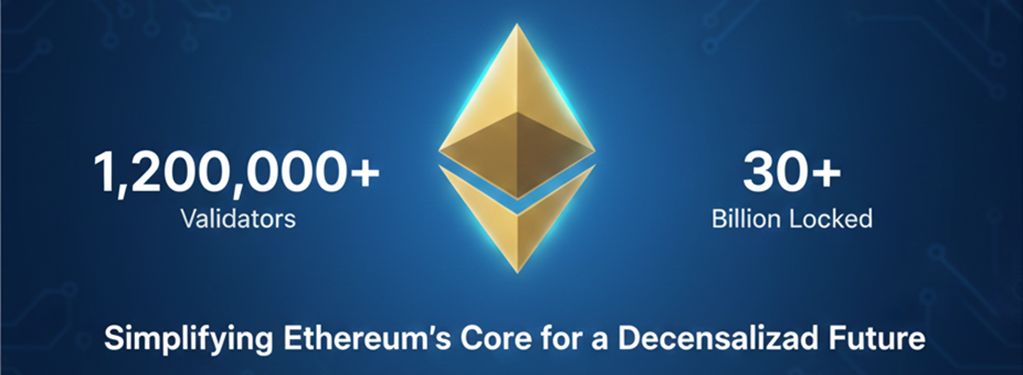
Toward a Stateless Design and Lighter Nodes
For Buterin’s crusade to reach a successful conclusion, current development is focused on “stateless client” strategies. The goal is to allow participants to validate the network without needing to store the entire blockchain, drastically reducing hardware demands. The implementation of technologies such as Verkle trees and Peer-to-Peer Data Availability Sampling (PeerDAS) are crucial steps in this direction.
By reducing the operational load, the simplification of the Ethereum core network will allow any user with standard equipment to manage a node. This approach reinforces the “Trustless Manifesto” published by the Ethereum Foundation, which explicitly rejects sacrificing decentralization for the sake of technical convenience or the use of centralized relayers.
Finally, Buterin suggests that this optimization should extend to Layer 2 solutions. By relying more closely on the base layer for security and avoiding redundant complex logic, the ecosystem can scale massively without compromising its integrity. Ultimately, the goal is clear: to transform Ethereum into a protocol so transparent and lightweight that its sovereignty truly resides in each of its nodes, and not in its architects.