TL;DR:
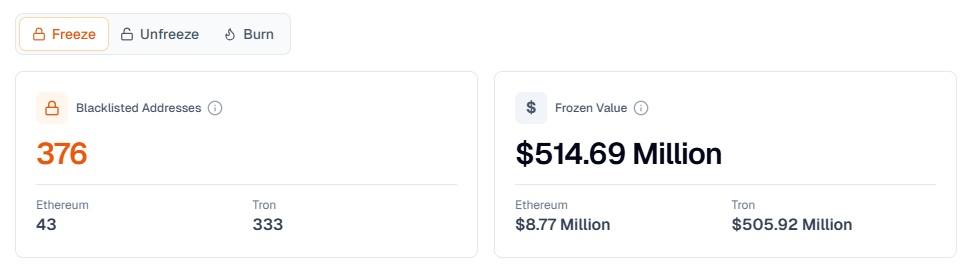
- Tether froze over $514 million in USDT across 376 addresses on Ethereum and Tron in the last 30 days, according to BlockSec.
- Throughout 2025, the company blocked $1.26 billion across 4,163 unique addresses; more than half of that amount was later destroyed via contract.
- Between 2023 and 2025, Tether froze approximately $3.3 billion across 7,268 addresses, far surpassing rival Circle.
Over the past 30 days, Tether froze over $514 million in USDT spread across 376 addresses on the Ethereum and Tron networks, according to onchain data from BlockSec. Of that total, approximately $505.9 million corresponds to addresses on Tron —333 on that network— and $8.77 million to 43 addresses on Ethereum, revealing a heavy concentration of enforcement activity on the blockchain founded by Justin Sun.
Throughout 2025, Tether blacklisted approximately 4,163 unique addresses across both networks and blocked a total of $1.26 billion. More than half of that amount —around $698 million— was subsequently destroyed through the “destroyBlackFunds” function in the corresponding contracts. Only 3.6% of sanctioned addresses were removed from the blacklist, indicating that freezes are rarely reversed once applied.
The Historical Scale of the Freezes
An analysis of the 2023–2025 period estimated that Tether froze approximately $3.3 billion in USDT across 7,268 addresses, a figure that far surpasses Circle, the issuer of USDC, over the same time horizon. In February of this year, the company itself disclosed that it had frozen around $4.2 billion over three years due to ties to illicit activities, with approximately $3.5 billion of that amount blocked since 2023.
Among the most significant cases of the year was an operation carried out in April, when Tether collaborated with the U.S. Treasury’s Office of Foreign Assets Control to freeze over $344 million in USDT across two Tron addresses allegedly linked to Iran-related sanctions evasion. In February, it also cooperated with authorities to seize over $61 million associated with pig butchering scams.

Excessive Control Over USDT?
The growing scale of these blocks raises wide-ranging debates about the limits of the control that centralized issuers exercise over assets circulating on decentralized networks, and about who determines when and how those intervention mechanisms are triggered.