TL;DR
- The CLARITY Act compromise may leave both bankers and crypto firms dissatisfied.
- SEC and CFTC partner to create unified rules for digital assets.
- CFTC shifts focus to prediction markets and drops climate risk unit.
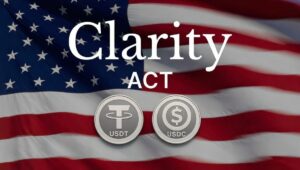
WASHINGTON — A new bill seeking to set federal standards for stablecoins is facing pushback from both the banking industry and cryptocurrency firms. The legislation’s lead sponsor told bankers this week that the final version will not fully satisfy either side.
Senator Angela Alsobrooks (D-Md.) spoke at the American Bankers Association summit in Washington. She told community bankers that the CLARITY Act, a bipartisan bill she introduced with Senator Thom Tillis (R-N.C.), is a compromise. She said the legislation will likely leave everyone involved “a little bit unhappy.”
🚨NEW: At the @ABABankers Summit in Washington, @Sen_Alsobrooks told a room full of community bankers they will likely have to make some compromises on the Clarity Act, reminding them that perfect cannot be the enemy of the good when it comes to getting the bill across the finish… pic.twitter.com/TLqSDNWCin
— Eleanor Terrett (@EleanorTerrett) March 10, 2026
The disagreement centers on whether stablecoin issuers can pay interest to users. Banks want to prohibit such payments. They fear that if holding stablecoins becomes too attractive, customers will withdraw their deposits from traditional bank accounts. Some analysts have estimated that banks could lose up to $500 billion in deposits to digital assets by 2028.
Stablecoin issuers such as Circle and Ripple oppose a flat ban on interest payments. They argue that preventing them from offering rewards would put them at a disadvantage compared to traditional banks, which can pay interest on deposits.
Senator Alsobrooks proposed a middle ground. Under the bill, stablecoin companies could offer rewards only if they are tied to specific user actions. These actions include making a payment, providing liquidity to a trading platform, or using a particular application. Passive rewards for simply holding stablecoins would not be permitted.
SEC and CFTC Agree on Joint Rules
In a separate development, the Securities and Exchange Commission and the Commodity Futures Trading Commission announced a formal partnership. The two agencies will work together to create consistent rules for digital assets.
The agreement, called the Project Crypto Initiative, focuses on three areas. First, the agencies will develop a unified taxonomy. This guide will help companies determine whether their digital asset is a security, a commodity, or a hybrid. Second, a substituted compliance model will allow firms registered with both agencies to follow one set of rules instead of two.

Third, the SEC and CFTC will revise Form PF, a reporting tool for private funds. They plan to limit data collection to what is needed to monitor systemic risk, reducing the amount of sensitive information stored in government databases.
CFTC Chairman Selig spoke at the Futures Industry Association conference in Boca Raton, Florida. He said the agency is preparing guidance for software developers. The guidance will address when developers of digital wallets and decentralized finance apps must register as financial intermediaries. Selig said the goal is to make clear that writing software code does not automatically trigger registration requirements.
CFTC Prioritizes Prediction Markets
The commission has dissolved its Climate Risk Unit and withdrawn previous requests for information on climate-related financial risk. Officials said climate risks are already covered by existing regulations and do not require separate treatment.
These platforms allow users to trade contracts based on the outcome of future events, including elections. CFTC officials said such markets provide accurate information about voter sentiment. During the 2024 election cycle, trading activity on these platforms reflected changes in public opinion that were not captured by traditional polls.
The CFTC plans to assert its jurisdiction over prediction markets to protect them from state-level legal challenges. Several states have filed lawsuits against these platforms, and some foreign jurisdictions have moved to ban them. The commission is drafting a framework to ensure these markets operate transparently and remain free from manipulation.
Bankers at the ABA summit were also briefed on broader trends in digital finance. Regulators and lawmakers are working to define how new forms of money will interact with the existing banking system.