


TLDR
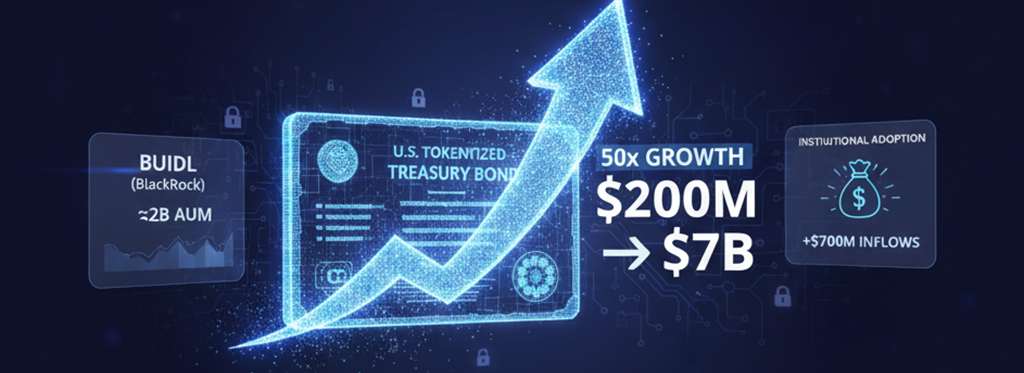
- The market value of U.S. debt on the blockchain rose from $200 million in 2024 to nearly $7 billion in 2025.
- BlackRock’s BUIDL fund leads the sector with nearly $2 billion in assets under management.
- Major banks like DBS are using these assets to improve efficiency in collateral management and settlements.
In the last two years, the digital finance landscape has undergone a radical transformation. In this context, tokenized US Treasurys have consolidated themselves as one of the fastest-growing segments within the Real-World Asset (RWA) market.
Data from Token Terminal reveals that the market capitalization of these financial instruments went from less than $200 million in January 2024 to nearly $7 billion in December 2025, representing an astounding 50x growth.
This boom responds to an unprecedented institutional demand seeking to combine the security of debt backed by the U.S. government with the agility of blockchain technology.
The undisputed protagonist of this trend is BlackRock’s BUIDL fund, a digital vehicle that allows for daily yield accrual and immediate on-chain settlement, accumulating nearly $2 billion on its own.
Financial Institutions Boost the Use of RWA as Collateral
The adoption of tokenized US Treasurys is not limited to passive investment. Banking giants, such as DBS in Southeast Asia, are leading pilots to use these government securities in collateral management and settlement processes.
By bringing traditional fixed income to the blockchain “rails,” financial institutions achieve superior capital efficiency and a level of transparency that legacy systems cannot offer.
In addition to BlackRock’s success, other key players such as Ondo Finance with its OUSG fund, Circle with USYC, and Superstate with USTB, have created regulated structures that facilitate institutional access to sovereign debt.
These products act as a secure “gateway” to decentralized finance (DeFi), allowing institutional investors to maintain exposure to low-risk assets while operating within digital ecosystems.
This phenomenon of tokenized US Treasurys is advancing in parallel with private credit, benefiting from competitive yields. Supported by firms like Goldman Sachs and BNY, the momentum of on-chain finance suggests that the tokenization of public debt is just the beginning of a massive migration of global financial markets toward blockchain infrastructure.

