
TL;DR:
- Software agents are evolving from clicks to autonomous settlement, using wallets created by code.
- This shift turns payments into API calls, favoring Bitcoin and stablecoins for their 24/7 settlement and low cost.
- Machine wallets act as permission systems with defined spending rules, increasing auditability.
Software autonomy is no longer limited to making purchases or planning trips; the next step is value settlement. Since a wallet can be created and funded using code without manual intervention, this evolution transforms payments into a simple API call. This shift places public blockchains and stablecoins at the center of a new transaction layer that never sleeps: the AI Agent Economy on Blockchain.
This is no longer a distant futuristic vision. It follows directly from the logic of how agents fetch data, route tasks, and make bounded choices. Once an agent can hold value, it can pay for compute, storage, and data, and it can accept income for completed work, such as labeling, modeling, or orchestration.
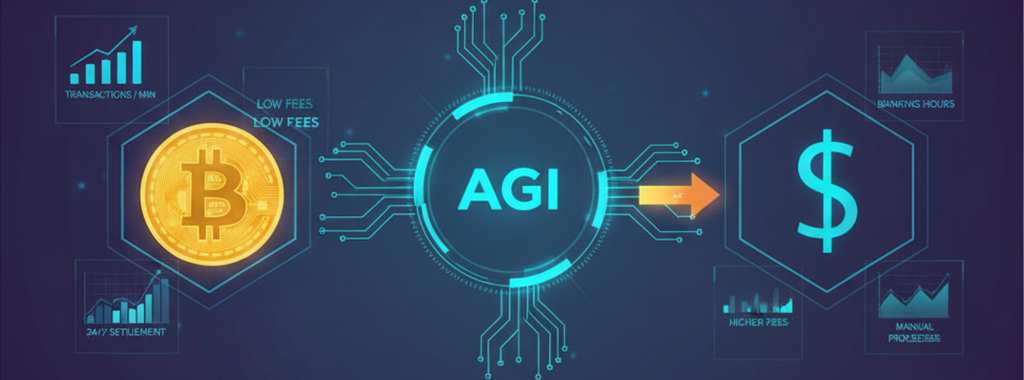
This market microstructure rewards always-on rails with low fees and programmable controls, qualities that intrinsically favor Bitcoin and major stablecoins over traditional banking systems that rely on banking hours.
Machine Wallet: From Purse to Permission System
An AI agent operating through a browser or a scripted environment can generate an address, set spending rules, and move funds under policy constraints defined by its owner. This capability removes the need for a traditional bank account in many machine contexts. Bitcoin and major stablecoins already settle value at any hour and provide deterministic outcomes that agents can reason about, reducing operational risk in machine workflows.
In this context, the wallet becomes a permission system as much as a purse. Human owners can impose daily limits, permitted counterparties, and audit trails, while services can demand proof of funds or time-locked payments before fulfilling requests.
These machine wallets would pay other machines for access to GPUs, specialized datasets, or bandwidth, with prices expressed in tokens that settle quickly and atomically. This creates a parallel economy, as agents often trade with other agents, linking token liquidity to the cost of compute and the value of data.
Ultimately, financial regulations, such as KYC, will adapt. A workable pattern is to verify a human or company at the perimeter, delegate spending authority to an agent, and bind the wallet to controls that can be inspected or revoked.
Payment companies can act as a bridge, allowing agents to draw against pre-funded fiat balances tied to known principals. The result is a system where Bitcoin and stablecoins manage routine tasks, while banks remain central for fiat entry and exit, thus improving auditability.