The disclosure made by Kraken Security Labs in February 2023 exposed a physical vulnerability in the Coldcard Mk4 that enables seed extraction without knowing the PIN. The finding reignited a technical discussion that the crypto sector tends to avoid: no hardware wallet is immune to a physical attack with sufficient resources. The documented exploit does not represent a product failure, but rather an empirical confirmation of the limits that physical reality imposes on any embedded security system.
The attack focused on the dual-chip architecture that distinguishes the Mk4. The main microcontroller, an STM32, stores the seed encrypted with a secret key safeguarded in the ATECC608A secure element. This secure element was designed to release the key only after verifying the PIN. Kraken’s team applied voltage fault injection —a technique known as voltage glitching— on the communication bus between the two chips at the exact moment the key traveled from the ATECC608A to the STM32. By disturbing the secure element’s operation at that critical instant, they forced it to deliver the key without having validated any PIN. With the key in their possession, they decrypted the seed stored in the microcontroller’s flash memory.
The procedure required physical access to the device, disassembly of the casing, soldering wires to specific points on the board, and the use of specialized instrumentation: oscilloscope, pulse generator, FPGA for nanosecond-precision timing control, and a programmable power supply. The researchers estimated a duration of under thirty minutes once the laboratory environment was set up. Coinkite, the manufacturer of Coldcard, described the attack as viable only with nation-state resources or a well-equipped lab. The characterization is accurate, but it does not diminish the finding’s significance.
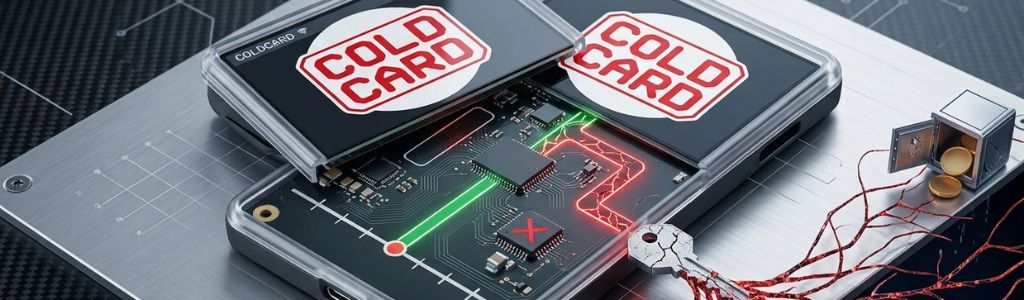
From a threat modeling perspective, the exploit occupies a bounded category. It cannot be executed remotely. It does not compromise the supply chain. It cannot be performed without leaving evident physical traces. However, it exposes a technical truth: secure elements, when mounted on an accessible circuit board, share the same vulnerability plane as any integrated circuit against side-channel and fault injection attacks. Chip certification does not eliminate the vector; it reduces it but does not annul it.
Coinkite’s response through firmware 5.1.0 introduced countermeasures that reduce the temporal window for fault injection. It implemented key release delays and additional internal checks that make the exact moment of transmission less predictable. It also reinforced physical tamper detection mechanisms. After the update, reproducing the attack requires significantly greater effort, although the theoretical possibility persists. The principle that no system with physical access can guarantee absolute security remains in force.
The central lesson of this incident transcends the Coldcard Mk4
The BIP39 passphrase operates as the last line of defense and turns a seed extraction attack into an empty success. If the user activates a passphrase with sufficient entropy and stores it outside the device, the adversary obtains a seed that leads to a decoy wallet. The system’s security then depends on a secret that never resided in the hardware. This fact makes the passphrase an architectural component of the security model, not an optional accessory.
The Coldcard case is part of a sequence of demonstrated physical vulnerabilities in other hardware wallets. Trezor One and Model T have been subject to seed extraction via voltage glitching on the main microcontroller when no passphrase is used. Ledger Nano S and X have faced attacks that exploit side channels in the secure element, albeit with different vectors and dependency on specific conditions. BitBox02 was compromised by the same Kraken team using similar techniques. The repetition of the pattern confirms that the physical security of a commercial chip, however advanced, encounters limits when the adversary controls the system’s power supply, clock, and temperature.
The crypto sector carries a tendency to market devices under the label “unhackable.” That assertion lacks technical support and contradicts the accumulated experience in secure hardware evaluation. The security of a hardware wallet is not a binary property, but a function that depends on the attack surface, the adversary profile, and the countermeasures implemented at each layer. A device can resist malware on the host computer, validate transactions on screen, and keep the seed isolated, yet be vulnerable to a direct physical attack if the user does not employ a passphrase or if the firmware lacks updated protections.
Kraken’s disclosure generated polarized reactions. One sector minimized the finding due to the attack’s complexity. Another used it to discredit the entire hardware wallet category. Both stances ignore the nuances. The real attack complexity is high, but not unattainable for a forensic laboratory, a corporate adversary, or a governmental actor. Ignoring that reality creates a false sense of security. But abandoning hardware wallet use due to this physical vulnerability is a disproportionate response, because remote attacks represent a threat with far higher incidence in daily usage.
The security architecture of a physical wallet must be analyzed in layers: isolation from the host environment, on-screen verification, PIN protection, encrypted seed storage, external passphrase, and response to physical tampering. Each layer mitigates a specific set of threats. A failure in one layer —such as the PIN protection in the Coldcard Mk4 before the update— does not invalidate the others, but it forces a review of the design assumptions and the reinforcement of the compromised layer.

A technical aspect that deserves attention is the dependency on the secure element’s chain of trust. The ATECC608A implements a true random number generator and physically protected key storage. But the Kraken exploit demonstrated that data integrity in transit between chips is a critical point that the original design had not protected with sufficient additional cryptographic validations. The transmission of the decryption key without a robust authenticated handshake exposed the system to a man-in-the-middle attack on the internal bus. The lesson for firmware designers is that communication between the secure element and the microcontroller must be treated as a hostile channel.
Increasing physical protections implies integrating mesh sensors, opening detectors, probing-resistant encapsulations, and secret self-destruction mechanisms. Each addition increases cost, power consumption, and manufacturing complexity. Users, for their part, must understand that the device is not a talisman, but a component of a custody system that includes physical safeguarding practices, geographic redundancy of backups, a robust passphrase, and periodic integrity verification.
Coldcard’s 5.1.0 firmware update introduced a relevant design pattern: the mandatory key delivery delay, combined with request integrity verification, reduces temporal predictability. This technique, borrowed from defense against timing attacks, turns an opportunity window of a few clock cycles into a diffuse temporal surface. Laboratories evaluating hardware wallet security should standardize resistance tests against fault injection on internal buses and not limit themselves to isolated chip evaluation.
Institutional users and high-net-worth individuals must incorporate this class of findings into their self-custody procedures. A scheme that combines multiple hardware wallets from different manufacturers, differentiated passphrases, and multisignature signing schemes reduces the risk that a punctual vulnerability compromises the funds. Technological diversity is a protection against hardware monocultures and against implementation failures that affect a specific family of chips.
The Coldcard Mk4 attack also has implications for the design of wallets without a secure element
Trezor opted for a general-purpose microcontroller with open firmware and PIN protections based on increasing delays, assuming that code transparency and verifiability provide security against a remote adversary. The model accepts physical vulnerability if no passphrase is used, and it communicates this explicitly. Coldcard’s architecture chose a secure element to shield the PIN, but the exploit demonstrated that the protection provided by that chip can be circumvented with advanced techniques. The comparison between both design philosophies illustrates that no approach is superior in absolute terms, but rather different trade-offs within different threat models.
Specialized journalism and the developer community must avoid treating each vulnerability as a scandal or as proof of a product’s uselessness. Rigorous technical evaluation, with a description of preconditions, necessary resources, and available mitigations, is the only way to produce useful knowledge for the end user. Sensationalist headlines erode trust in tools that, despite not being perfect, represent the solution with the best cost-benefit ratio for individual cryptoasset custody.
Transparency in disclosure and the time granted to the manufacturer to develop patches before publication reflect a responsible procedure. Coinkite, by acknowledging the finding without resorting to defensive denials and by releasing corrective updates, maintained its technical credibility. The episode should serve as a model of interaction between security researchers and manufacturers.
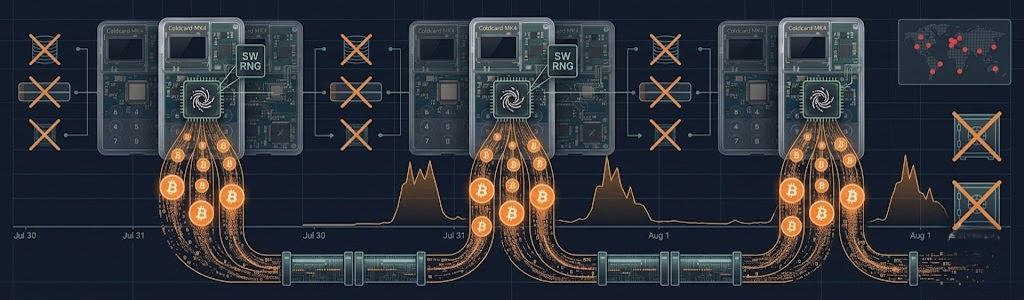
The argument that “only state actors can execute this attack” deserves careful analysis. The required equipment —high-end oscilloscope, pulse generator, FPGA, programmable power supply— has an accumulated cost that places it within the reach of universities, private forensic laboratories, and sophisticated criminal organizations. The barrier is not economic, but one of technical knowledge. And knowledge spreads. Each academic publication on fault injection reduces the practical complexity for the next attacker. Ignoring this dynamic is to underestimate the evolution of threats.
Continuous firmware auditing must be consolidated as a standard practice. Hardware wallet manufacturers should fund bug bounty programs specific to physical and side-channel attacks, with reward scales proportional to severity. The Bitcoin and cryptoasset developer community must demand the publication of security reports with defined periodicity and accessible technical language.
The end user, in turn, needs to internalize a principle: the passphrase is not an accessory functionality, but an indispensable defense layer against any form of physical compromise of the hardware. The passphrase must not be stored in Internet-connected password managers nor in the same location as the seed backup. It must be generated with sufficient entropy and kept in analog format or on isolated devices. The combination of an updated hardware wallet + robust passphrase resists the full spectrum of known attacks, including the one that motivates these reflections.
The Coldcard Mk4 vulnerability does not invalidate the hardware wallet category. It exposes the real limits of the protection offered by secure chips when the adversary has unrestricted physical access. The manufacturer’s response and the user’s adoption of a passphrase constitute the appropriate defense. The crypto sector must replace narratives of invulnerability with a technical discourse of defense layers, threat evaluation, and continuous improvement. Only in this way will the individual custody infrastructure reach the maturity that the magnitude of the stored values demands.