TL;DR:
- Identified threats: The plan mitigates the forging of validator signatures and the derivation of private keys from public ones.
- Execution dates: The roadmap establishes technical phases scheduled to be implemented between the years 2026 and 2027.
- Market evolution: The network’s native token, XLM, recently traded at $0.196 after recording a 12% drop over the last week.
The roadmap just presented by the Stellar Development Foundation has three stages aimed at protecting its blockchain network against the advances of quantum computing. Official information indicates that this strategy seeks to mitigate risks derived from technologies that could compromise traditional cryptography.
LATEST: ⚡️ The Stellar Development Foundation has unveiled a three-stage quantum preparedness roadmap, with enterprise wallets migrating to post-quantum cryptography in 2026 and all accounts upgradeable by the end of 2027. pic.twitter.com/t8UV96O9ov
— CoinMarketCap (@CoinMarketCap) June 10, 2026
The foundation noted that Stellar faces two specific risks in its infrastructure. First, the possibility of attackers forging validator signatures to alter consensus. The second risk lies in the derivation of private keys using public ones. This latter scenario constitutes the main focus of the preventive plan.
The development entity maintains that the network holds a structural advantage over competitors like Bitcoin and Ethereum. Account identity in this protocol is separated from its signing keys. This technical feature would allow users to integrate secure cryptography without modifying their source addresses or transferring funds.
Quantum transition schedule
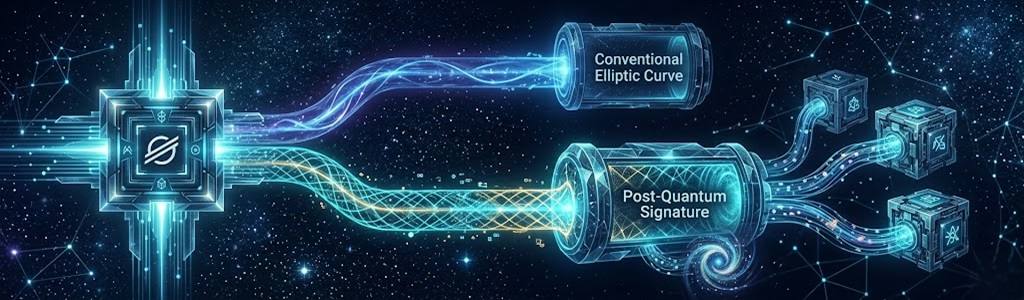
The stipulated schedule contemplates the start of the first phase for the year 2026. During this period, post-quantum signature verification will be added to the smart contract layer. This will enable enterprise wallets to begin an immediate migration.
During the year 2027, the second phase will be executed through a protocol-level upgrade. The roadmap points out that this modification will allow each account to add a quantum-safe signer while maintaining the same address. A third stage will contemplate the definitive removal of the current cryptography. The foundation anticipates that this final step will be executed in line with the progress of the quantum hardware industry.
A complex aspect of the transition involves dormant accounts whose holders cannot be contacted. The organization warns that a definitive block would freeze those assets permanently. For this reason, the documentation indicates that resolving this issue will require open community discussions.
Industry analysts point out that quantum computers will eventually break the elliptic curve cryptography used by major networks. Data from technical agencies suggest that the crypto ecosystem is vulnerable due to the public nature of its ledgers.
Regarding global timeframes, the National Institute of Standards and Technology modified its timeline guidance, placing the danger zone in the year 2029. In parallel, technology firms like Google established 2029 as their internal readiness deadline. For their part, specialized researchers proposed a widespread vulnerability scenario for the year 2030.
The announcement coincides with a period of volatility for the network’s digital asset. At the close of the last week, the XLM token traded at $0.196, meaning it fell 12% in a week. Despite the correction, the source’s commercial balance reflects a cumulative increase of 15% during the last month.